Two Detroit-area startups are deepening a partnership that aims to scale medical drone deliveries at Munson Healthcare, the eight-hospital system serving 29 counties in northern Michigan, according to Crain’s Detroit Business reporting on May 20, 2026.
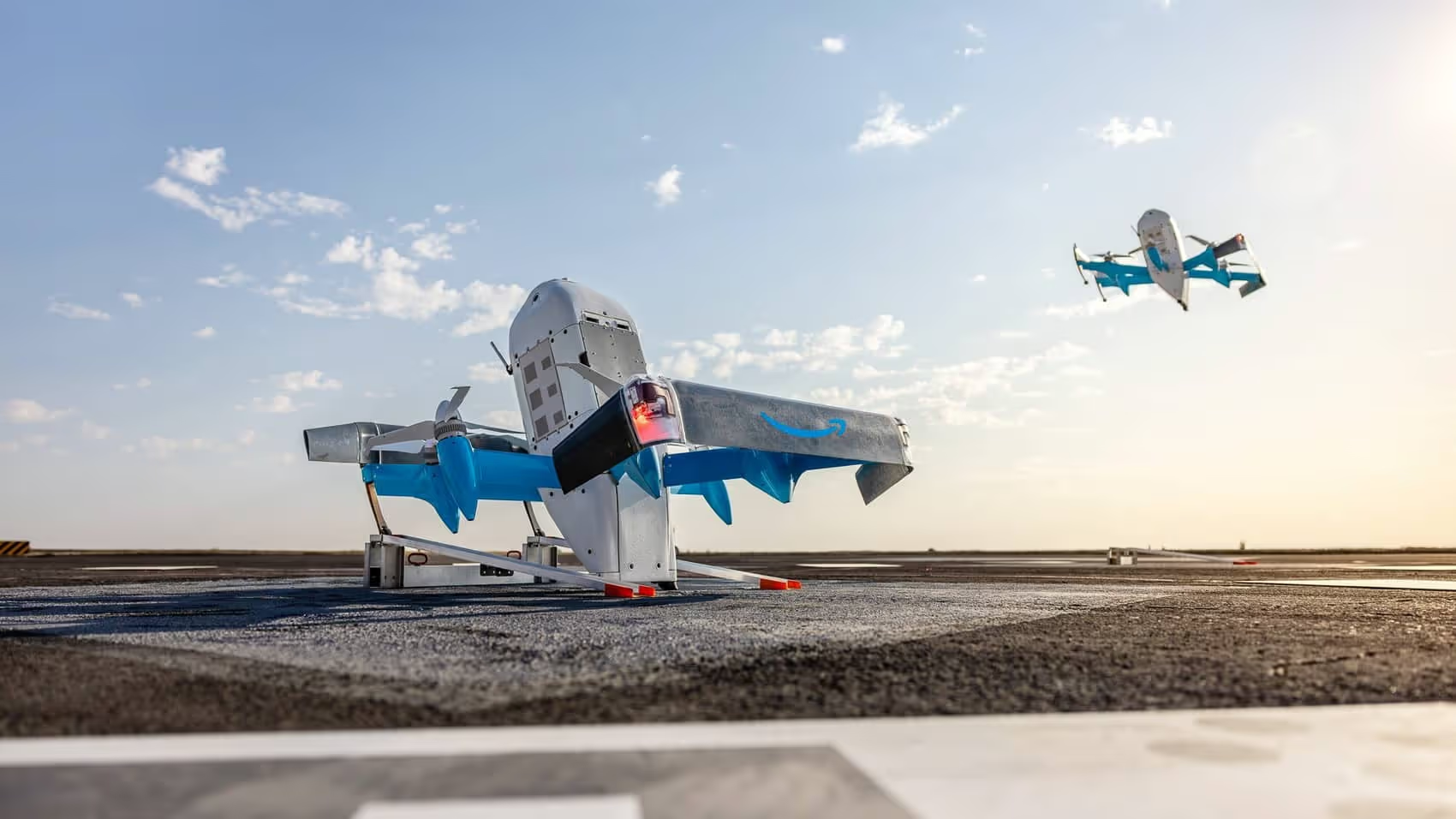
Blueflite, the Brighton-based drone manufacturer that has been flying the Munson pilot, is now integrating its aircraft with medical payload bags developed by ESSPI, the Detroit company that built its name in lithium-ion battery safety monitoring before launching an aerial division called Med Hawk.
The partnership represents a broader push to scale a program that has already delivered measurable results. Munson Healthcare’s first phase of medical drone flights, conducted between May 9 and May 20, 2025, completed 67 missions with a 91 percent success rate, per the 9&10 News reporting and Munson Healthcare’s own disclosure.
The next phase, planned for 2026, will move the program into beyond-visual-line-of-sight operations.
The Pilot That Already Worked
Phase 1 was deliberately small. Flights operated within a one-mile (1.6-kilometer) radius around Munson Medical Center in Traverse City, connecting MMC with the Munson Dialysis Center and the Copper Ridge Surgery Center, according to the Traverse City Business News reporting.
The payload was patient laboratory samples. The flight pattern was simple. The point was not range or volume but proving that a hospital system could route specimens by drone instead of by car within a regulated metropolitan operating area.
Munson Healthcare staff currently drive more than 90,000 miles (145,000 kilometers) per year to move samples and supplies between facilities, per the project’s official disclosures. That number is what makes a drone delivery system economically meaningful for a rural healthcare network.
“The 91 percent success rate is even a little bit deceptive, because we didn’t fail,” said Tracy Cleveland, VP Supply Chain at Munson Healthcare, per the TCBN reporting. The remaining 9 percent was largely weather-driven cancellations rather than aircraft or mission failures.
What ESSPI Brings: Battery Monitoring and Smart Medical Bags
As Crains Detroit reported, ESSPI is the part of the story that is new. The company stands for Energy Storage Safety Products International and was originally built around environmental monitoring technology for lithium-ion battery storage and logistics, developed through three years of collaboration with the U.S. Department of Transportation, per Michigan Central’s announcement of the Med Hawk launch.
Med Hawk, ESSPI’s aerial division, applies that ground-based monitoring expertise to drone operations. The system provides early detection for drone battery failure and data logging for medical payloads in transit. Lithium-ion thermal events are the failure mode most likely to ground a drone fleet, and a medical payload that fails in transit is a regulatory and clinical problem rather than just an operational one.
The partnership with Blueflite, formalized at Michigan Central’s Advanced Aerial Innovation Region facility, deploys the ESSPI medical bags as part of the Munson trials, per the Michigan Central announcement. The bags are the physical interface between a hospital sample and a drone aircraft, and the data logging is what makes the supply chain auditable for clinical purposes.
The collaboration covers both the medical packaging side and the BVLOS testing side of the program.
Why Blueflite’s Tiltrotor Matters for Rural Healthcare
Blueflite is a U.S.-manufactured drone company founded in 2018 and headquartered in Brighton, Michigan, per the company’s official disclosures. The platform is a tiltrotor aircraft rather than a conventional multirotor, which gives it the range and endurance characteristics that matter for inter-facility hospital logistics in rural geography.
“Weather is a challenge, operationally and technologically,” said Frank Noppel, co-founder and CEO of Blueflite, per the TCBN reporting. Northern Michigan winters are exactly the conditions where a tiltrotor’s stability margin and range advantage over a quadcopter become operational rather than theoretical.
The aircraft has also been deployed for a separate Michigan project delivering auto parts in the Detroit metro area, part of a $740,000 grant initiative under the state’s Advanced Air Mobility Activation Fund announced in July 2025, per Blueflite’s own announcements and Dronelife reporting.
The Phase 2 BVLOS Push for 2026
The 2026 phases will test flights that go beyond what the operator can see, which is the operational threshold where drone delivery stops being a curiosity and starts being a logistics asset.
The Munson program is backed by $689,500 in initial 2023 AAM Activation Fund grant money from Michigan, plus an additional $950,000 award received in 2025, per multiple state and project disclosures. That funding pays for the aircraft, the operations, and the evaluation work conducted by Central Michigan University’s Rural Health Excellence Institute, which serves as the evaluation partner.
“We are also going to be able to inform the next hospital system,” said John Jervinsky, Manager of Telehealth Programs at CMU, per TCBN reporting. That is the strategic point. The Munson program is also a template for the next health system in a similar geography.
DroneUp, the Virginia-based drone operator, handles the day-to-day pilot operations across the trials, per Crain’s reporting. Traverse Connect, the regional economic development organization, manages implementation logistics on the ground.
“impacting the lives of patients by getting them results faster,” said Eric Bremer, Operations and Enablement Lead at DroneUp, summarizing the program’s clinical rationale, per TCBN.
DroneXL’s Take
The angle here is: medical drone delivery has been talked about for a decade, and the Munson Healthcare program is one of the few in the U.S. that is moving from press releases into actual mission counts with documented success rates.
A 91 percent success rate across 67 flights is not a marketing number. It is the kind of operational data that lets a hospital chief financial officer compare drone delivery against the 90,000 miles per year that staff currently drive between facilities. Those two numbers, side by side, are what move a program from pilot to procurement.
ESSPI joining the program with the Med Hawk bags and battery monitoring is the part worth watching. Medical drone delivery does not scale on aircraft alone. It scales on the auditable supply chain that hospital systems and regulators require, and that is the layer ESSPI is contributing.
Expect more announcements in the next twelve months as the Munson Phase 2 BVLOS trials produce data and as other rural health systems start watching the cost math.
Photo credit: Blueflite