
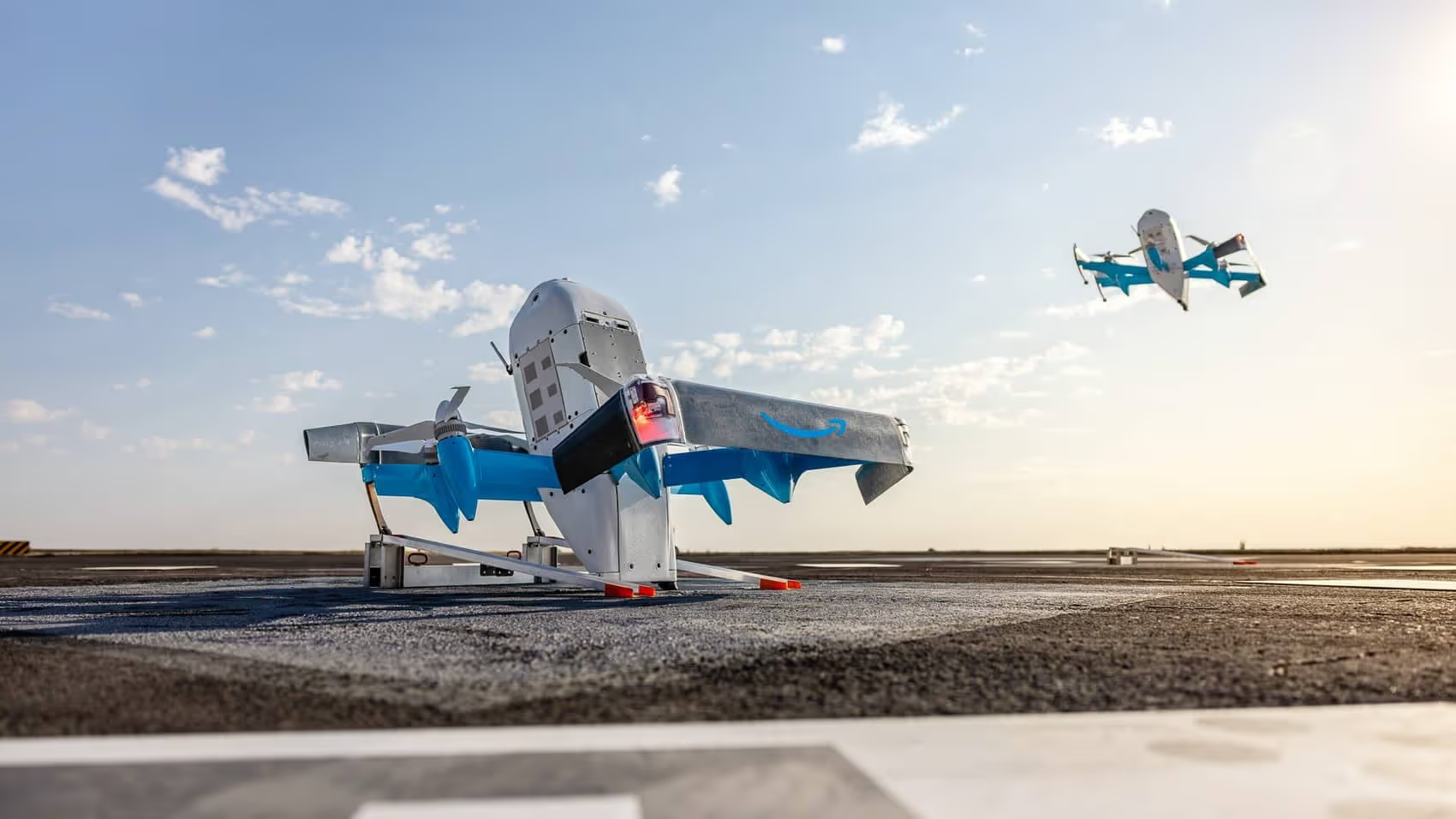
An Amazon Prime Air MK30 delivery drone crashed into a residential garden at Beaumont Hill in Darlington, County Durham, on the morning of Wednesday, July 29. The UK’s Air Accidents Investigation Branch opened an accident investigation. Nobody was hurt, and the damage stopped at a privet hedge and a paved driveway.
The aircraft weighs 83 pounds (37.6 kg) at maximum takeoff and carries 5 pounds (2.2 kg) of cargo. I stood next to an MK30 at XPONENTIAL Europe in Düsseldorf, and that ratio is the first thing you register in person. The investigation lands five months before the decision that sets Amazon’s European future, because the Civil Aviation Authority permission covering Darlington expires at the end of 2026.
The AAIB Is Treating The Landing As An Accident
Fire crews and Prime Air staff were called to Beaumont Hill shortly after 10 a.m., where retired chemical engineer John Peacock found the drone on the ground with its motors still turning. The Air Accidents Investigation Branch confirmed it had begun looking into what it classified as an accident.
The AAIB investigates civil aviation accidents and serious incidents, and its findings arrive as safety recommendations addressed to operators and regulators. Peacock, who heard the impact from inside his house, told ChronicleLive he is not persuaded by the technology at all: “I don’t think they’re designed for an urban or semi rural environment.”
An AAIB spokesperson put the status plainly: “An investigation has been launched, and we have begun making inquiries.” The branch has not yet published a bulletin, so the sequence of events remains Amazon’s account for now.
Amazon Blames An Object On A Moving Vehicle
Amazon’s initial assessment blames contact with an object extending above the roof of a moving vehicle, after which the drone came down as designed. That account puts the cause outside the aircraft and inside the delivery environment, which is the harder engineering problem of the two.
A company spokesman told GB News the collision involved “an object extending above the roof of a moving vehicle” during a delivery, and that the aircraft responded as built and reached the ground safely. Amazon said its own investigation continues alongside the regulator’s.
Take the explanation at face value and it still describes a difficult case. The MK30 descends to roughly 12 feet (3.6 meters) over a garden to release a parcel, which puts it inside the height band where vans, ladders, aerials and roof loads live. Static obstacle maps do not contain a moving vehicle carrying something tall.
The aircraft arrived in Britain with a record. Two MK30s struck the boom of the same construction crane in Tolleson, Arizona within minutes of each other in October 2025, and one ejected a battery that burned on impact. Seven weeks later an MK30 clipped an internet cable in Waco, Texas and drew a second FAA probe. DroneXL examined the pattern behind those failures in April.
Amazon’s August Site Tour Left Out The Trial’s Limits
On August 7, Amazon published a photo feature describing Darlington as a launched service delivering in 60 minutes or less. The piece credits CAA approval. It does not mention the daily cap, the December expiry, or the accident from nine days earlier.
The Darlington operation runs on a trial permission through the end of 2026, capped at 10 flights per hour and 100 deliveries per day on weekdays. Flights go out in daylight and fair weather only, inside a 7.5-mile (12 km) radius. Darlington Borough Council had already cut the authorized flight rate from 21 per hour to 10 in December 2025.
Two claims in Amazon’s August feature sit awkwardly against the record. It dates customer deliveries to February 2026, while local reporting puts the launch in May, following testing that began in January. The 60-minute promise is also newer than the service: DroneXL reported a window of up to two hours from order to arrival when Darlington went live. The service got twice as fast in the retelling.
FreightWaves picked the feature up on Monday under the headline that Amazon had deployed drones outside the United States for the first time, three months after the service actually launched.
British Regulators Built The Fence The FAA Has Not Finished
The CAA capped Amazon’s UK operation before it flew and kept a renewal date in hand. American regulators work in the opposite order. Part 108, the rule meant to standardize routine BVLOS flight, has been sitting at the White House regulations office since July 10.
Executive Order 14307 gave the FAA 240 days to publish a final BVLOS rule, a clock that ran out on February 1. A 43-day government shutdown froze the docket, the comment file reopened in January on detect-and-avoid and right-of-way questions, and the Department of Transportation has since said the delay was deliberate. Review of major rules at that office can run 90 days, which points at early October.
So Amazon flies American suburbs under Part 135 authority and expands on its own schedule, with federal investigators showing up after the crane and the cable. In Darlington it flies 100 parcels a day inside a fence, in front of a regulator holding a date.
DroneXL’s Take
The British setup is the better one, and that should bother anyone who assumes lighter regulation is always the pro-drone position. The CAA wrote limits before the first parcel flew and gave itself a scheduled moment to say no. The FAA has neither. It has a rule stuck in review 197 days past its own deadline and a habit of arriving after the wreckage, which serves nobody, least of all the operators waiting to build businesses on a rule that does not exist yet.
Amazon deserves the concession here. If a vehicle drove under a descending drone with something sticking up above its roof, that is a genuinely hard case, and no obstacle map catches it. My read is that this cuts the other way, though. An 83-pound aircraft that has to drop to 12 feet over a back garden will keep finding the clutter, because 12 feet is where the clutter lives. The environment is the design constraint. Every incident on the MK30’s record is the aircraft meeting something the map did not have.
What nobody has said yet is whether any of this touches the renewal. The AAIB has published no bulletin, and the CAA has made no public statement connecting the Beaumont Hill accident to the December decision. The AAIB cannot ground anything; it writes recommendations. The CAA holds the pen, and it now has a garden in Darlington in its file alongside Tolleson and Waco.
Watch two dates. The regulations office clock on Part 108 points at early October, and the CAA permission dies on December 31 unless renewed. One of those tells American operators whether they get a framework. The other tells Amazon whether Europe is open. I have covered this program since the MK27, and the second question has never had a harder deadline attached to it than it does now.
Sources: GB News, Teesside Live, About Amazon, FreightWaves
DroneXL uses automated tools to support research and source retrieval. All reporting and editorial perspectives are by Haye Kesteloo.


