

On a June 15 episode of The Verge‘s Decoder podcast, Skydio CEO Adam Bry distanced his company from a no-weapons commitment it published years ago and still has posted online. “This is an area where I’ve gotten some things wrong,” Bry told host Nilay Patel, before laying out a case that companies which draw ethical red lines around their technology end up “on the wrong side of moral questions.”
That reversal is the most newsworthy thing Bry said in a wide-ranging interview, and it deserves more attention than it will get. A drone company whose published principles have long said it will not weaponize its aircraft now has a CEO calling weaponization “not our place to decide.” Bry confirmed the U.S. Army has already run experiments mounting grenade droppers on Skydio drones, and that internal calls to shut that down did not prevail.
Patel framed the question against the backdrop of AI companies, naming Anthropic as one firm publicly wrestling with red lines on how its technology can be used in military settings. Bry positioned himself at the opposite pole, arguing that bright-line refusals invite “adverse selection,” because the actors who respect terms of service are the responsible ones and the actors who ignore them are the adversaries. It is a coherent position. It is also a long way from where Skydio started.

Bry’s red-lines reversal is the real headline
Asked directly whether Skydio has told the military it won’t allow its technology to be used for certain things, Bry acknowledged that the company’s earlier messaging created an expectation it no longer honors. In the Decoder interview, he said Skydio had previously said things that led people to believe it would prevent weapons from being mounted on its drones. It does not take that position now.
That earlier messaging was not loose talk. Skydio’s own Engagement and Responsible Use Principles state plainly: “We will not put weapons on our drones and will oppose fully autonomous lethal weapons systems.” That language is six years old, published in July 2020, back when Skydio still sold consumer drones and before it became a defense contractor with Army weapons-integration work. A reasonable person could call it a stale page the company forgot to revise. The more telling fact is that it is still live on Skydio’s site in 2026, and that Bry did not ignore it on Decoder. He addressed the old commitment directly and walked back the first half of it. The grenade-dropper experiments he confirmed put munitions on a Skydio aircraft, the exact thing the principle said the company would not do. Whether the 2020 principles still reflect company policy is now an open question, and one Skydio has not publicly answered. The second half of the clause, opposing fully autonomous lethal systems, is narrower and Bry did not directly repudiate it; the grenade release in the Army tests involved a human operator.
Bry’s reasoning runs through what the military calls dual-use. A sensor good enough to inspect a power line, he argued, has flight-time, payload, and reliability characteristics close to what makes a drone useful to a soldier doing intelligence, surveillance, and reconnaissance. The Army’s grenade-dropper experiments tested whether that same platform could become a lethal device. We reported in June 2025 on soldiers dropping live M67 grenades from a Skydio X10D at the Grafenwoehr training area in Germany, using a 3D-printed munitions dropper. Bry’s view is that the people in uniform, accountable to elected leaders, are better positioned to make those calls than engineers in a Silicon Valley office. “It’s not our place to tell them what they can and can’t do,” he said.
He went further when Patel separated the decision to use a capability from the decision to build it. Drawing lines to establish “purity,” in Bry’s words, mostly guarantees that the responsible buyers walk away while adversaries and terrorists, who never cared about a terms-of-service document, proceed anyway. “You more often than not will just end up on the wrong side of moral questions,” he said, calling the impulse to write such policies “dangerously misguided.”
There is a real argument in here, and it is worth taking seriously rather than dismissing. The adverse-selection problem is genuine. Adversaries do ignore export controls and license terms. But the argument also happens to clear away every constraint on a defense contractor’s product roadmap, and it is being made by the CEO of that contractor. A position can be intellectually defensible and self-serving at the same time. This is one of those.
The lobbying that cleared DJI is the context Bry mostly left out
The interview arrived with the FCC having already done what Skydio’s lobbying spent years pushing for. The Commission placed DJI on its Covered List in a December 22, 2025 ruling that blocks new equipment authorizations, and DJI has since filed a petition for review in the Ninth Circuit (Case 26-1029) estimating the ban will cost it roughly $1.56 billion in lost U.S. revenue this year. Patel put the dynamic plainly: the government, he said, has handed Skydio a gift by removing the cheap competition that served first responders, and now Skydio can sell expensive programs to agencies with no other options. Bry did not dispute the framing. He pivoted to capability and cost-per-mission instead.
What he did not mention is Skydio’s own role in producing that gift. We have covered the company’s lobbying push against DJI since Bry acknowledged the lobbying team at Skydio’s Ascend event, framing its work as securing customer budgets and shaping regulatory frameworks while noting his unnamed competitor, almost certainly DJI, outspends Skydio four to one. The questions about how Skydio’s public safety messaging connects to its lobbying goals have followed the company for years. On Decoder, Bry said he does not “really care whether Chinese drones are allowed in the market from a product development standpoint.” For a company that lobbied to remove them, that is a convenient thing to not care about.
Bry conceded the hardware gap DroneXL has reported for years
The most useful admission for anyone weighing Skydio against DJI on the merits came when Patel pushed on manufacturing. “I don’t think we are a world-class manufacturing outfit yet,” Bry said. “China’s still better at manufacturing drones than we are.” He believes Skydio can close that gap and has committed $3.5 billion over five years to U.S. manufacturing to try, but the concession matches what DroneXL has reported repeatedly: at equivalent price points, DJI still builds sharper hardware, and what Skydio sells is the autonomy stack, the dock-based architecture, and a procurement story that survives a federal grant review.
On price, Bry undercut some of Patel’s sharper figures. A standalone X10 without cloud software or the advanced sensor package runs about $15,000, he said, not the $25,000 per year Patel cited, and the R10 indoor drone is $6,000. His pitch is that dock-based autonomous fleets fly five to 10 times as much as hand-flown drones, so cost-per-outcome favors Skydio once a department accounts for pilot training and labor. That math is real for large agencies. It is colder comfort for the volunteer fire department Patel kept raising, the one that used to be handed a few cheap DJI drones and now faces a $6,000 floor at best.
Bry admitted Skydio drones still contain Chinese content
Asked point-blank whether there are Chinese parts in Skydio drones, Bry said “very, very, very, very few,” then added a line worth sitting with: “Anybody who’s saying that they don’t have any Chinese content in what they’re building is deluding themselves because it’s very hard to trace back to the second and third levels.” His position is that every first-level dependency, the suppliers Skydio buys camera modules, sensors, processors, and circuit boards from directly, is now outside China, but that he cannot vouch for a passive component or a raw material two or three tiers down the chain.
That is a candid answer, and it matters more than it might sound coming from this particular CEO. Skydio’s entire market position is built on being the secure, American-made alternative to Chinese DJI, and the FCC’s case for putting DJI on the Covered List rests on the premise that a Chinese supply chain equals a national security risk. Bry conceding that even his drones carry untraceable Chinese content past the first tier complicates that premise. It is the same vulnerability that hit Skydio directly in October 2024, when Beijing sanctioned the company and cut off its sole battery supplier, forcing it to ration one battery per drone for months. Batteries, Bry said at the time, were among the last components Skydio had not moved out of China. He told Patel that dependency has since been resolved. The deeper tiers, by his own admission, have not.
Bry called Skydio drones a “flying body camera.” The NYPD showed otherwise.
Patel pressed hard on pervasive surveillance, militarized policing, and whether communities have real agency when “muddy interests” push Skydio adoption. Bry’s answer is that drone response is the opposite of blanket monitoring. He called a Skydio drone “like a flying body camera,” narrow and precise, responding to a known emergency rather than passively collecting on a whole city, and contrasted it with Flock Safety‘s always-on license plate readers. He pointed to Skydio’s Transparency Dashboard, which publishes where drones flew and the camera footprint on the ground, and kept returning to the city council, where every police contract gets approved and residents who object can speak.
I watched that claim fall apart in person. At New York City’s “No Kings” protests, NYPD Skydio drones did not fly search patterns or respond to incidents. They hovered over the crowds, came down only to swap batteries, and went straight back up to the same spot above the protesters. That is passive, persistent overhead surveillance, the precise thing Bry told Decoder his drones do not do. The “flying body camera” framing describes a drone that shows up for a specific emergency and leaves. What flew over those crowds was a fixed eye parked above lawful protest for hours. The gap between the two is not a technicality. It is the whole question.
The accountability machinery Bry points to is real on paper. Police drone contracts do get approved at city council, the Transparency Dashboard does publish flight footprints, and residents can show up to object. To his credit, Bry did not pretend the concerns were illegitimate, and said the harshest critics are part of the accountability mechanism. But none of that machinery stopped what flew over the No Kings crowds. A dashboard that logs where a drone went after the fact does not constrain a department that decides to park one over a protest, and “you can complain at city council” is cold comfort to people being watched from above in real time. The process is a defensible answer to the wrong question. The question is not whether the flights are documented. It is whether persistent surveillance of lawful protest is what these drones should be doing at all.
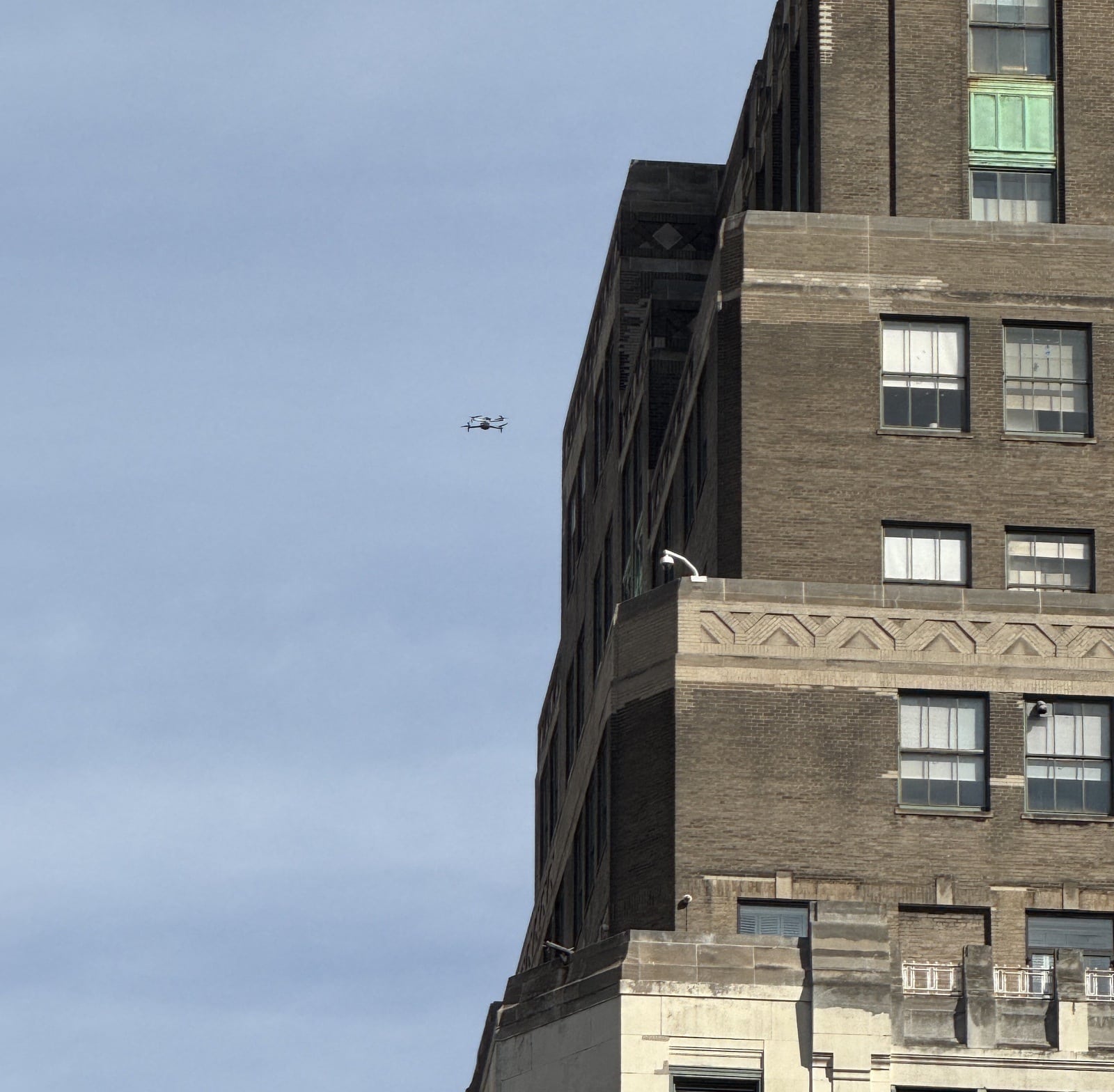
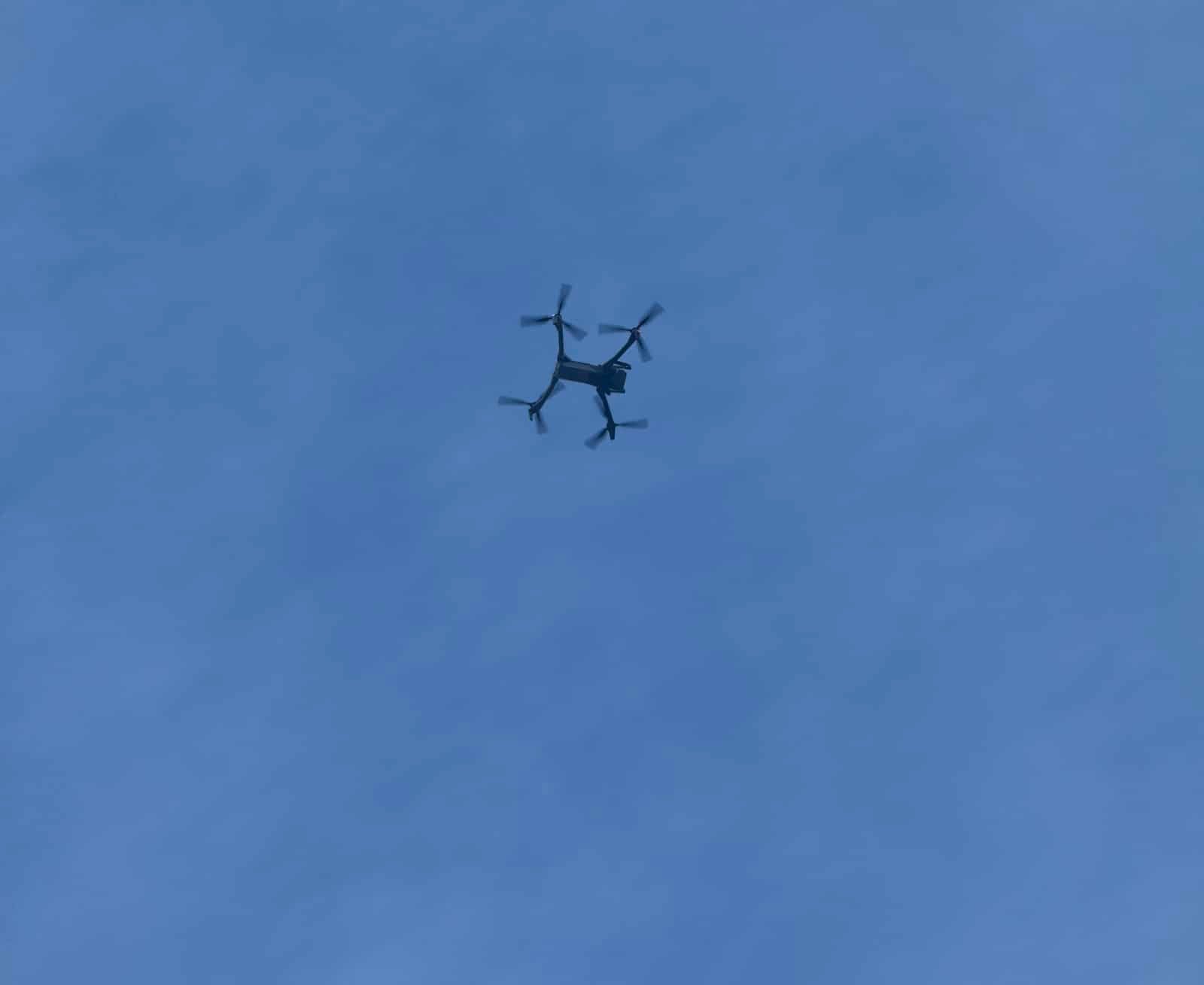
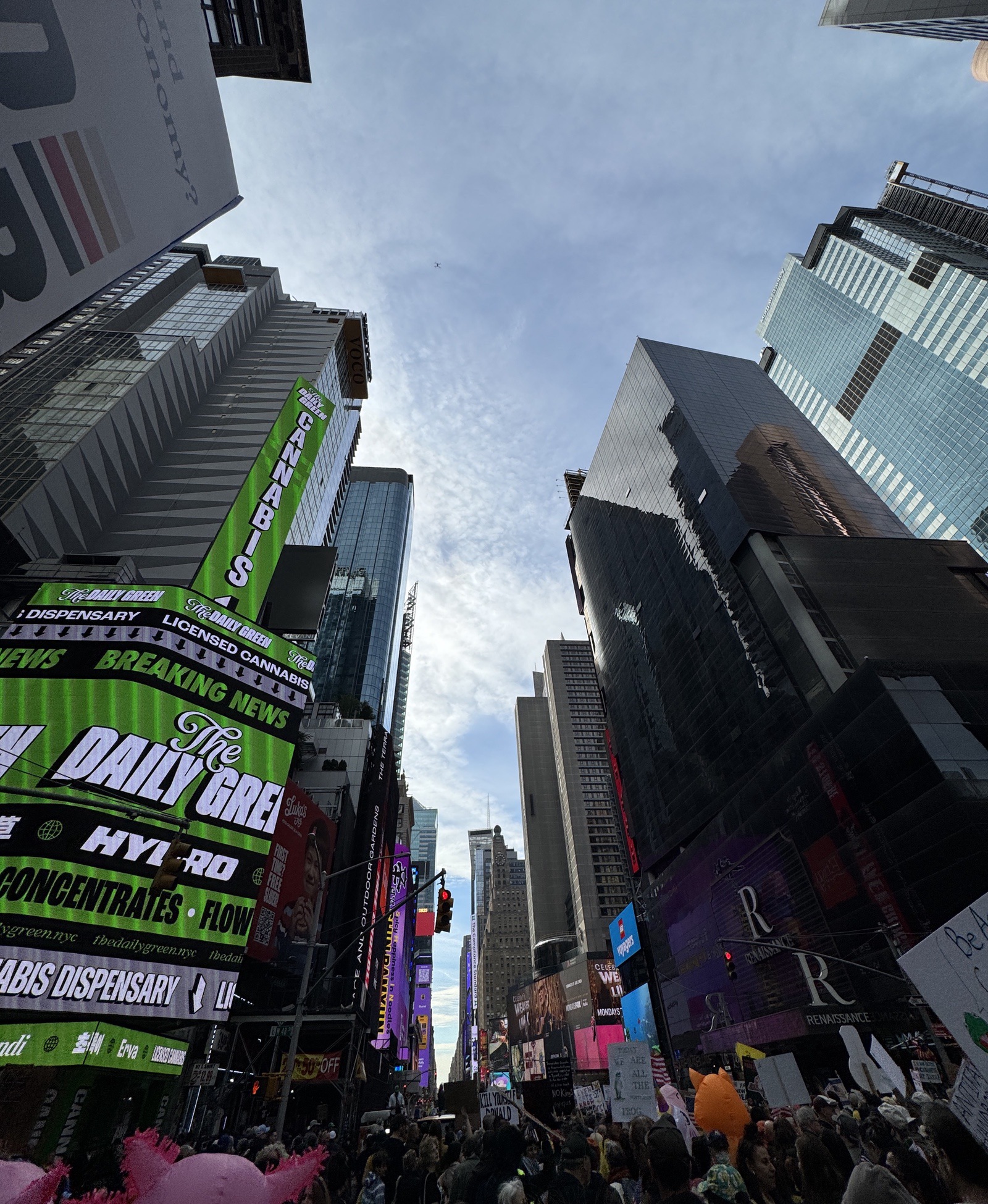
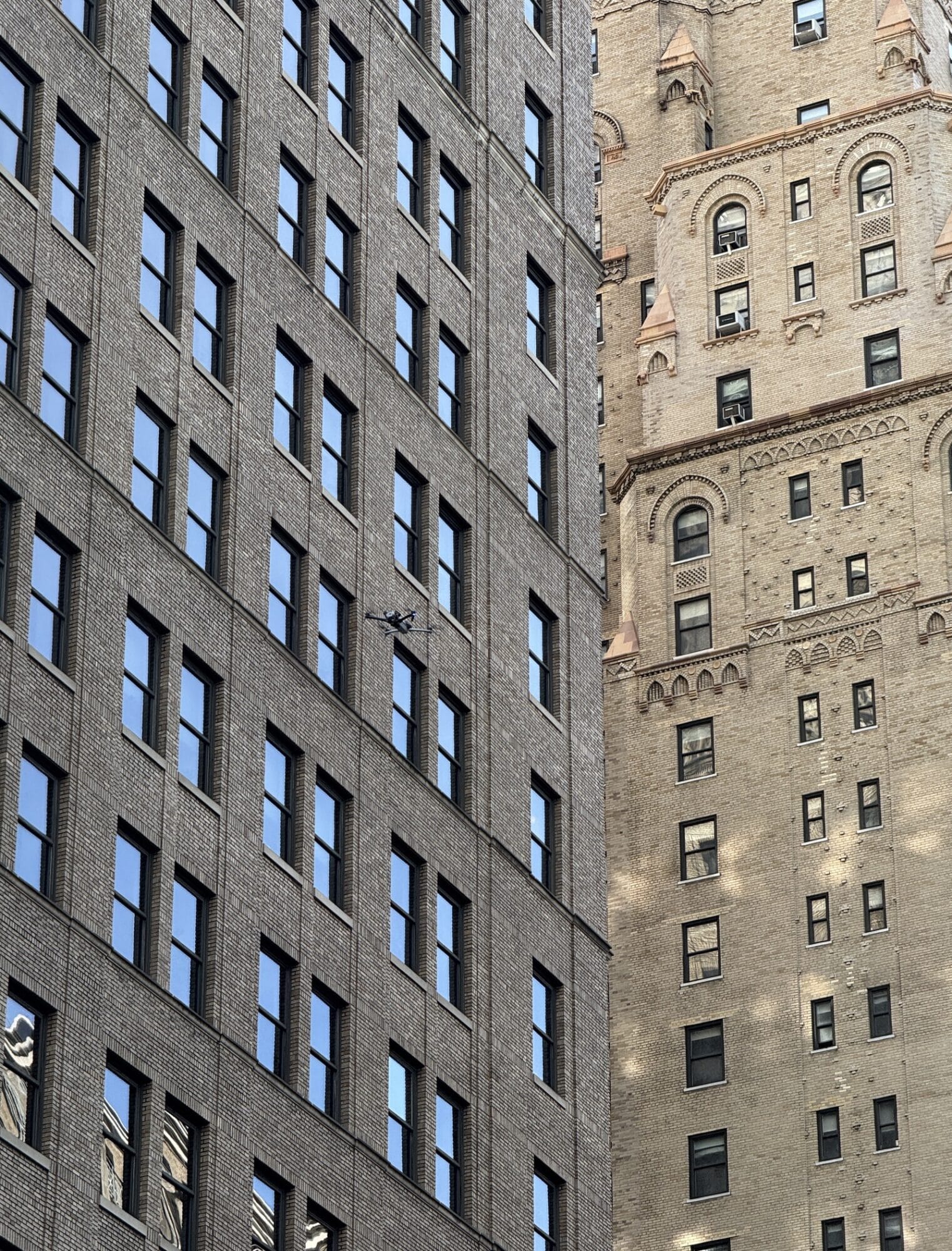
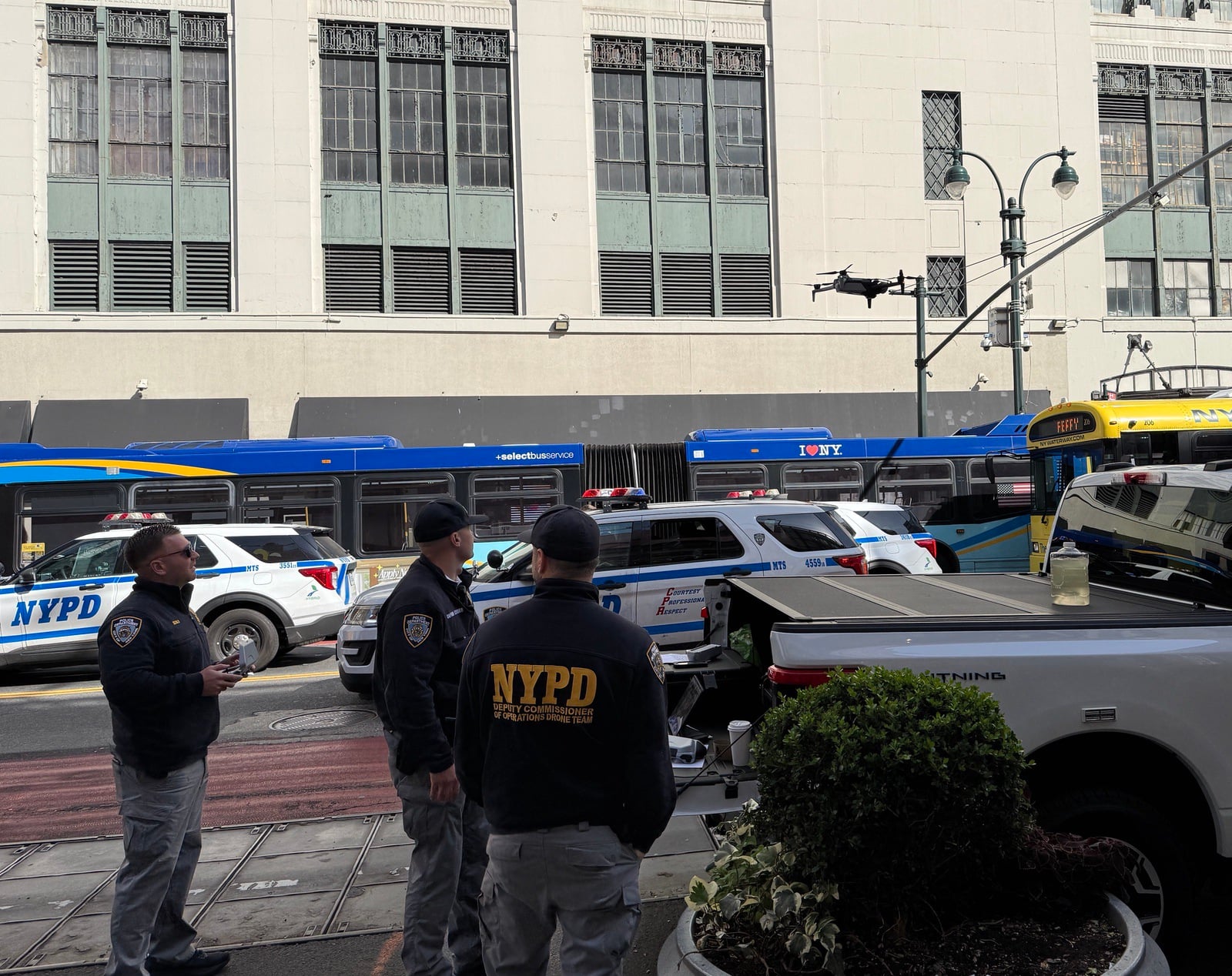
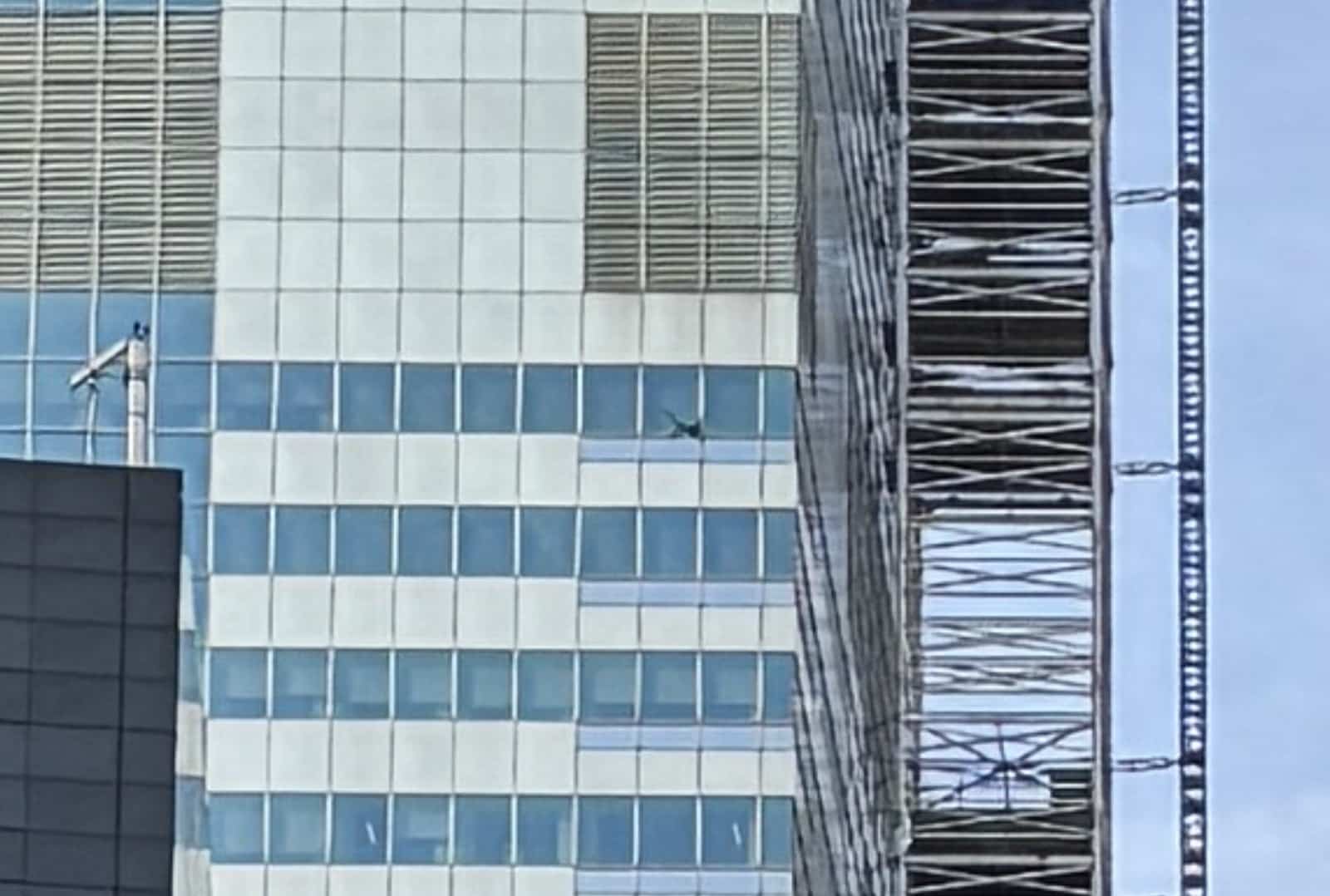
I watched it happen. At New York City’s “No Kings” protests, NYPD Skydio drones did not fly search patterns or respond to incidents. They hovered over the crowds, came down only to swap batteries, and went straight back up to the same spot. That is passive, persistent surveillance of protesters, the precise thing Bry told Decoder his drones do not do. Photos: DroneXL.
DroneXL’s Take
Bry is a good interview, and this was a substantive one. Patel did not let him coast, and Bry mostly engaged rather than dodging, which is more than a lot of defense-adjacent CEOs manage. Give him that. But the headline is the weapons reversal, and it should not get buried under the polish. Skydio still has principles posted that say “we will not put weapons on our drones.” Rather than quietly retire that language, its CEO went on a national podcast to call the impulse behind it dangerously misguided, days after the federal government finished clearing his largest competitor out of the market. The principles are six years old and may no longer reflect company policy, which is exactly the point worth pressing: a company does not get to keep the reassuring language posted while walking the commitment back in interviews. Bry wants maximum freedom to build whatever the military asks for, and he wants DJI gone. He is entitled to both. He is not entitled to have them mistaken for principle.
The surveillance answer collapses the same way, and this one I watched happen. Bry told Patel that Skydio drones are narrow and responsive, “like a flying body camera,” not tools of passive collection. At New York City’s “No Kings” protests, NYPD Skydio drones did not fly search patterns or respond to incidents. They hovered over the crowds, came down only to swap batteries, and went straight back up to the same spot. That is passive, persistent surveillance of protesters, the precise thing Bry said his drones do not do. The line is a good line. It is not what those drones were doing over those crowds.
And then there is the question nobody asked. Did Skydio leave the consumer market for “focus,” or to get early investors a return? Bry admits the consumer product was “awesome” and that DJI still builds better, cheaper hardware. So he exits the market where he has to win on price, and moves into first responder and defense, where buyers are often required by law to buy American. When Patel put it bluntly, that the government “handed you a gift” by banning the competition, Bry did not dispute it. Then he confirms he will not build a cheap consumer drone again and that it is “unlikely it’ll be us” making one. Focus, or returns? He has every reason to tell the focus version. The commercial logic tells another, and it is the question Patel did not put to him. It is the one worth asking next.
Source: The Verge, Decoder with Nilay Patel, June 15, 2026.
DroneXL uses automated tools to support research and source retrieval. All reporting and editorial perspectives are by Haye Kesteloo.


