The UK Civil Aviation Authority has published its Test and Evaluation Annual Report 2025-2026, and the numbers inside are the kind of evidence American operators have been asking the FAA to produce for years.
CAP 3266 documents 1,672 distinct BVLOS flights and over 350 flight hours collected from industry partners between October 2024 and March 2026, with the data feeding directly into the policies that will define routine BVLOS in UK airspace.
The 1,672-Flight Number Behind the Policy
The Test and Evaluation Team inside the CAA is the group running this collection effort. It started gathering structured operational data from authorized BVLOS operators in October 2024, and by March 2026 the cumulative log hit 1,672 flights and just over 350 flight hours.
The volume jumped sharply through the autumn and winter of 2025, then picked up again in February and March 2026 as three last-mile delivery operations started reporting in.
That data is not a press-release headline figure. It is broken out across two parallel programmes, each with a different regulatory route and a different policy purpose. The first is the BVLOS Sandbox. The second is the Atypical Air Environment framework. Together they account for the entire 1,672-flight figure, and each is producing the evidence base for a separate set of upcoming rules.
BVLOS Sandbox: Amazon, Wing, Matternet, NPAS
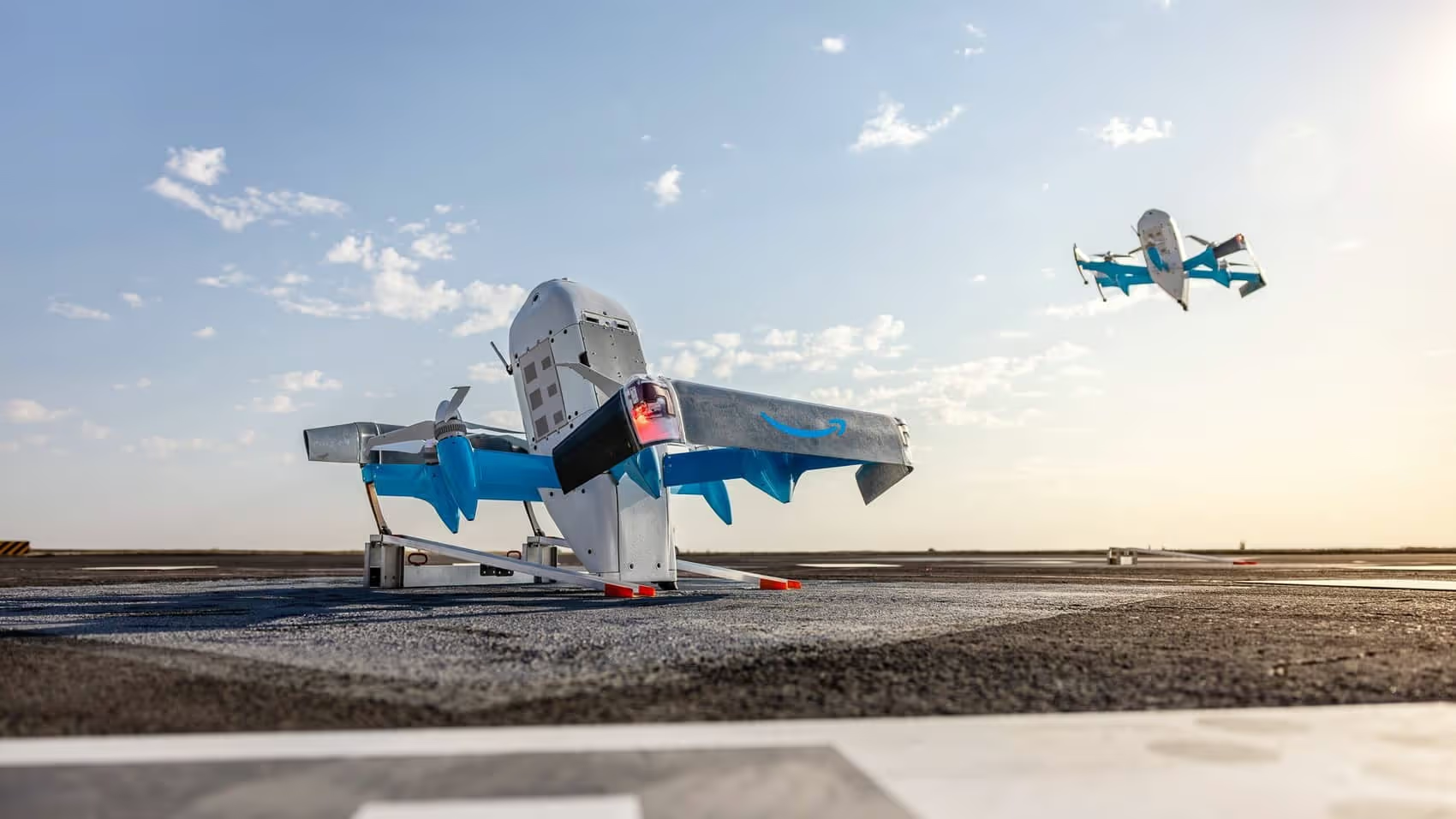
Under the BVLOS Sandbox, which operates inside the regulatory envelopes set by CAP 2533 and CAP 2616, the CAA secured new authorizations this year for Airspection, the National Police Air Service (NPAS), Amazon Prime Air, Matternet, and Wing in partnership with Apian.

As of March 2026, sandbox flights had accumulated over 200 hours in both Class G and Class D airspace, totalling 1,097 flights and more than 150 gigabytes of operational data.

The use cases match UK government priorities: infrastructure inspection, emergency air services, last-mile delivery, and National Health Service deliveries. The CAA is mining the resulting datasets for evidence on ground-based radar performance, airborne detection of crewed aircraft, ADS-B accuracy in urban and non-urban environments, GNSS reliability, and command-and-control link performance using both cellular and direct radio links.
One data point worth pulling out. Across a month of operations from a single sandbox operator, the average horizontal position error between aircraft-reported position and ADS-B reported position came in at 33.93 feet (10.34 m), with a vertical error of ±6.19 feet (1.89 m). The CAA notes the figures are illustrative and do not represent a regulatory threshold. They are the kind of empirical benchmark American operators usually only see in academic papers.
Atypical Air Environment and the Safety Numbers
The Atypical Air Environment framework, governed by CAP 3040 v3, covers operations in environments where the risk of encountering crewed aviation is judged inherently low. Think offshore wind farms, certain rail corridors, and other carefully bounded operating volumes.
There are currently 11 operators authorized under AAE, and the safety data from the past 12 months is the part regulators on both sides of the Atlantic will be reading closely.
Across more than 450 AAE flights and over 100 flight hours, the CAA recorded exactly one instance of an unmanned aircraft departing its planned route. There were zero instances of a drone leaving its approved operating volume, and zero instances of a crewed aircraft entering one of those approved volumes. Eight times another crewed aircraft was detected inside the adjacent monitoring volume, which the CAA treats as a leading indicator rather than a safety event.
That track record was strong enough to expand the AAE policy concept in November 2025 with new annexes covering smoothing methodologies, railway infrastructure, wind farm infrastructure, and operational volume definitions.
CAP 3145 and the Four Pre-Assessed Test Sites
The headline policy output of the year is CAP 3145, the UAS Operations at Test Sites Policy Concept. First published in July 2025 and revised in November 2025, it lets the CAA pre-assess a test site once, then allows individual operators to fold those pre-agreed ground and air risk profiles into their own UK SORA applications.
The intended effect is fewer duplicated risk assessments, faster authorizations, and lower barriers for the SMEs that currently fly trials overseas because UK test infrastructure was scarce.
Four sites have been pre-assessed so far, covering both BVLOS and VLOS operations up to SAIL 2: the National Drone Hub at Predannack, the Snowdonia Aerospace Centre at Llanbedr, the Drone Test and Development Centre at Westcott, and the Drone Certification Agency at Portland.
The CAA is working with the Military Aviation Authority and the Ministry of Defence to publish further guidance covering dual-use testing, UA-to-UA collision testing, flight termination systems, and Light UAS Certificate operations before the end of 2026.
The same report points to three more policy concepts in active development on the back of this dataset: CAP 3140 on Electronic Conspicuity, CAP 3127 on Detect and Avoid, and CAP 3154 on Command and Control Link.
What This Means for US Operators
The gap with the FAA is now hard to ignore. While Part 108 sits in the queue and US BVLOS operators continue to rely on case-by-case waivers, the CAA has built an institutional setup that does three things at once: it authorizes the trial, it ingests the operational data in a standardized format, and it cycles that evidence into named policy concepts on a 4-month revision rhythm.
Waivers wear you down. Physically, mentally, and on the clock. An authorization like this one changes that, and everyone in the game wins when the regulator stops treating each flight as a one-off.
DroneXL’s Take
Here’s what I find genuinely significant. This report is not a position paper. It is an inventory. The CAA is telling industry that policy is being written off a dataset of 1,672 flights, 150 gigabytes of telemetry, eleven AAE operators, and four pre-assessed test sites. That is a very different posture from a regulator publishing a Notice of Proposed Rulemaking and asking the industry what it thinks.
The piece I keep coming back to is the AAE safety record. One route deviation. Zero airspace incursions. That is the kind of evidence that closes arguments in regulatory rooms, and the FAA has not collected it at this scale because nobody at the agency has been resourced to build the equivalent of the CAA’s Test and Evaluation Team.
This report matters for every operator and every manufacturer in the room. It points to a more organized sky, one where all of us can fly without getting in each other’s way.
Photo credit: Prime Air, Wing, CAA.