
DJI Neo 2 vs Hover Air X1 Pro Max Ski Test: One Crashed Repeatedly, One Just Worked

Check out the Best Deals on Amazon for DJI Drones today!
I hate skiing with drones. I love drones. I love skiing. But combining them? It’s mostly just a recipe for hiking back up the mountain to rescue your crashed aircraft. I took both the DJI Neo 2 and the Hover Air X1 Pro Max to the Alps for a head-to-head ski tracking comparison. Same runs, same conditions, same firmware versions, both in their respective ski modes. The results surprised me, and probably not in the way you’d expect.
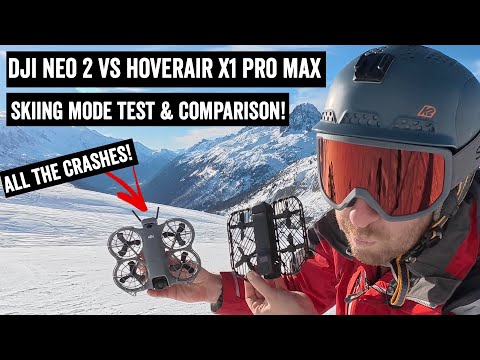
The Hover Air X1 Pro Max Goes First
I chose a desolate, empty run for a reason: if either drone stopped following me, I’d have to hike back up to retrieve it. And I fully expected that to happen with at least one of these units.
The Hover Air locked into ski mode without drama. I started nice and easy, around 30 km/h, just to see how it handled basic turns. It tracked left and right as I carved back and forth, gaining altitude appropriately. So far, so good.
When I pushed to about 45-50 km/h, the Hover Air started falling behind. That’s the reality of these follow drones: their maximum tracking speed is around 40 km/h, and I grew up ski racing. Hitting 80-90 km/h without thinking about it is normal for me. Clearing 100 km/h? Done it plenty of times.
At the bottom of the run, the Hover Air caught up. Not perfect, but it completed the run. No crashes, no drama.
The Neo 2’s First Attempt: Instant Failure
I switched to the Neo 2 and started the exact same run. Same turns, same speed progression. Around the first corner, I kicked it up a bit for fun and… we lost it.
Did it crash? I thought I saw something fall out of the sky. Time to hike.
I found the Neo 2 in the snow. Some helpful skier was standing over it, probably wondering whose drone just faceplanted into the slope. I cleaned off the snow and tried to take off again.
“Unable to take off. Connect to app to see why.”
My guess was snow jammed inside somewhere. There was nothing to do but head to lunch and let it dry out.

Three Hours Later: More Crashes
After lunch and a couple gondola rides to let everything melt and warm up, I tried again. The Neo 2 seemed happy. Launch successful. Put it in ski mode. Here we go.
Immediately, the drone started wandering. It wasn’t quite tracking my line properly. It got awfully low. Then it started bouncing up and down like a rabbit. At least it was clearing obstacles, but it couldn’t seem to find me.
I tried to rescue it from this pickle, but it just kept doing its own thing. Something was clearly wrong with the IMU. I pulled the battery to reset it.
“Collision detected. Aircraft landing automatically.”
I cleaned off all the sensors with my shirt and tried again. Another crash. And another. Three crashes in a row on the same run.
“Unable to take off. Connect to app to see why.”
Yeah, because you killed yourself three times in a row.
Is Altitude the Problem?
Some of you are probably thinking: you’re above 2,000 meters, that’s why it’s having problems. The DJI Neo 2 has a maximum takeoff altitude of 2,000 meters. The Hover Air X1 Pro Max goes up to about 5,000 meters, which simply doesn’t matter for most skiing scenarios.
But here’s the thing: most European ski resorts put you right around 2,000 meters at the top of the lifts. I was at about 1,980 meters, just barely below the limit.
To test this theory, I went up to 2,200-2,300 meters and flew the Neo 2 in manual control. I changed speed while keeping altitude exactly the same, going along some rocks in both normal mode and sport mode. The altitude remained precisely stable. Zero change. I wasn’t touching the altitude stick at all, just forward and back.
I don’t think altitude was the issue, at least not at this roughly 2,000 meter range.
The Hover Air Gets Another Chance
While troubleshooting the Neo 2, I figured I’d do a nicer run with the Hover Air on a more technical section: a narrow chute that would really test the tracking.
The Hover Air followed me just fine through a flat traverse section until it literally flew into the back of my head and fell into my hood. When I moved, it tumbled out and rolled all the way down the chute. I’m not kidding. It rolled end over end like a snowball.
I picked it up and continued down the chute. No problems for the rest of the run. For this test, I had switched from medium distance to far and high. That setting seemed to work better.
The Neo 2 Finally Completes a Run
The sun had moved to a different position, more to my side than directly in front. I decided to give the Neo 2 another try on the exact same chute run.
This time? Success. It followed from behind through the technical sections. It cleared the lip at the top of the chute that I was worried about. It stayed with me through the back-and-forth turns. When I hit about 55 km/h on one section, I gapped away from the drone, but it caught up. It didn’t hit the ridge.
The Neo 2 actually does a better job of staying wider, further, and higher than the Hover Air X1 Pro Max. When I landed it, this was the first time I’d actually completed a run entirely with the Neo 2.
Front Tracking on the Neo 2
For the next run, I tried setting the Neo 2 to front left position for a different look. As soon as I rotated my body, it started moving around to the right, then slowly worked its way back to the front left. This is normal behavior: it tracks you while repositioning.
The issue with DJI drones doing front tracking is that when they fall behind from a speed standpoint, they’ll just switch to rear position. I saw that happen here.
One thing I absolutely love about the Neo 2 is the hand gesture control. I put my hand up and told the drone to go in front of me. Simple as that. It repositioned and I got some beautiful side profile shots with the mountains in the background. Had the sun been hitting that surface later in the day, it would have been even prettier.
One limitation: I can’t change the follow mode on the Hover Air to front in ski mode. You can only follow from behind. That’s a bummer if you want variety in your shots.
The Reality of Skiing with Follow Drones
Here’s the honest truth about both of these drones for skiing:
DJI Neo 2: No beacon system. If your drone gets lost, you need a controller in your backpack to connect and rescue it, and that only works if it’s still in the air. If it crashed, you’re hiking.
Hover Air X1 Pro Max: Has a beacon, which helps with drone recovery. But I didn’t bring mine. You can theoretically use WiFi on your phone to rescue a stuck drone, but unless you’re within about 100 meters, it won’t work.
Both drones share the same fundamental limitation: the 40 km/h tracking speed ceiling. If you’re skiing faster than that for any extended period, you’re back to hiking. That’s painfully slow for anyone who actually knows how to ski.
The sweet spot for these drones is tree skiing, powder days, or anything off-piste where you’re naturally going slower but still looking cool. Groomer cruising at speed? These drones just can’t keep up.
Quick Comparison
| Feature | DJI Neo 2 | Hover Air X1 Pro Max |
|---|---|---|
| Max takeoff altitude | 2,000m (6,562 ft) | ~5,000m (16,404 ft) |
| Ski mode tracking speed | ~40 km/h | ~40 km/h |
| Front tracking in ski mode | Yes (with repositioning) | No (rear only) |
| Gesture repositioning | Yes | No |
| Recovery beacon | No | Yes (sold separately) |
| My test reliability | Multiple crashes at ~2,000m | Completed all runs |
The Bottom Line
If you’re skiing at typical European resort altitudes around 2,000 meters, the Neo 2’s reliability is a real concern. It crashed on me multiple times before finally working, and I never figured out exactly why. The Hover Air X1 Pro Max just worked, even if it once bounced off my head and rolled down a chute.
When the Neo 2 worked, it produced better positioning and more flexibility with front tracking and gesture controls. The footage looked great. But “when it worked” is doing a lot of heavy lifting in that sentence.
For me, skiing with drones remains mostly a recipe for hiking. If you’re committed to getting drone footage of your skiing, go slower than you’d like, use the far and high settings, and bring a way to rescue your drone when it inevitably gets stuck somewhere inconvenient.
What’s been your experience skiing with follow drones? Let us know in the comments below.
Discover more from DroneXL.co
Subscribe to get the latest posts sent to your email.
Check out our Classic Line of T-Shirts, Polos, Hoodies and more in our new store today!

MAKE YOUR VOICE HEARD
Proposed legislation threatens your ability to use drones for fun, work, and safety. The Drone Advocacy Alliance is fighting to ensure your voice is heard in these critical policy discussions.Join us and tell your elected officials to protect your right to fly.

Get your Part 107 Certificate
Pass the Part 107 test and take to the skies with the Pilot Institute. We have helped thousands of people become airplane and commercial drone pilots. Our courses are designed by industry experts to help you pass FAA tests and achieve your dreams.

Copyright © DroneXL.co 2026. All rights reserved. The content, images, and intellectual property on this website are protected by copyright law. Reproduction or distribution of any material without prior written permission from DroneXL.co is strictly prohibited. For permissions and inquiries, please contact us first. DroneXL.co is a proud partner of the Drone Advocacy Alliance. Be sure to check out DroneXL's sister site, EVXL.co, for all the latest news on electric vehicles.
FTC: DroneXL.co is an Amazon Associate and uses affiliate links that can generate income from qualifying purchases. We do not sell, share, rent out, or spam your email.


