Drones Fly Into Fukushima’s Reactor and Find the Bottom
Check out the Best Deals on Amazon for DJI Drones today!
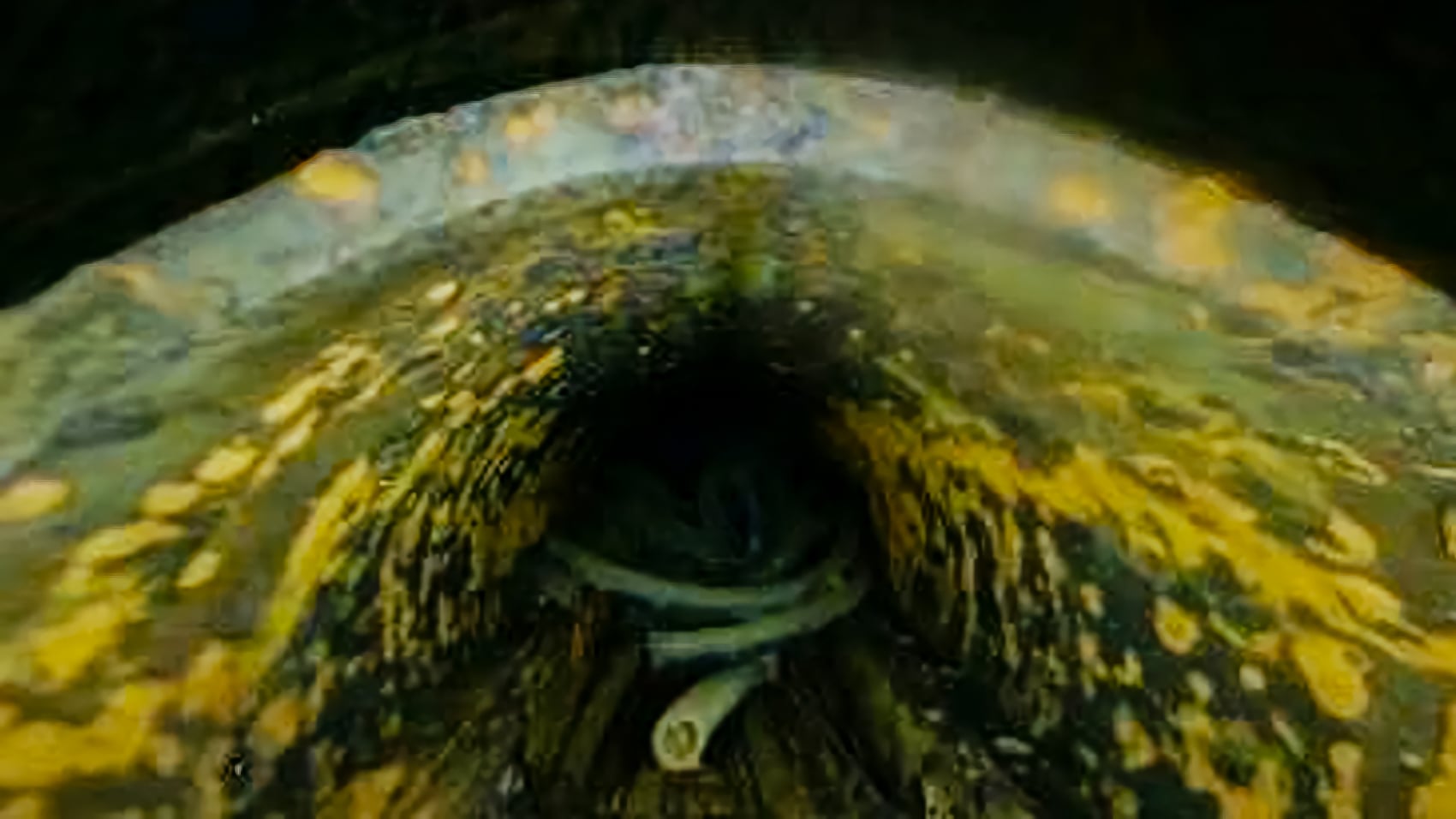
Fifteen years after the earthquake and tsunami that triggered one of the worst nuclear disasters in history, palm-sized drones have flown inside the Unit 3 reactor at Fukushima Daiichi and reached what engineers had been trying to see since the meltdown began: the bottom of the reactor pressure vessel, surrounded by what TEPCO believes is melted fuel debris, control rod guide tubes, and reactor hardware that fell during the disaster and fused into the wreckage below.
The two-week mission concluded March 19. The footage was released the following day. What it shows took 15 years, multiple failed robot attempts, and a drone small enough to fit in a jacket pocket to finally capture, as ABC News reported.
How the Mission Unfolded
The investigation began March 5 with the first micro-drone flights inside Unit 3’s primary containment vessel. The initial phase focused on mapping accessible areas and testing radio communication range before advancing further, because the steel and concrete environment inside a damaged reactor containment degrades radio signals unpredictably and crews needed to know the boundaries before flying blind.
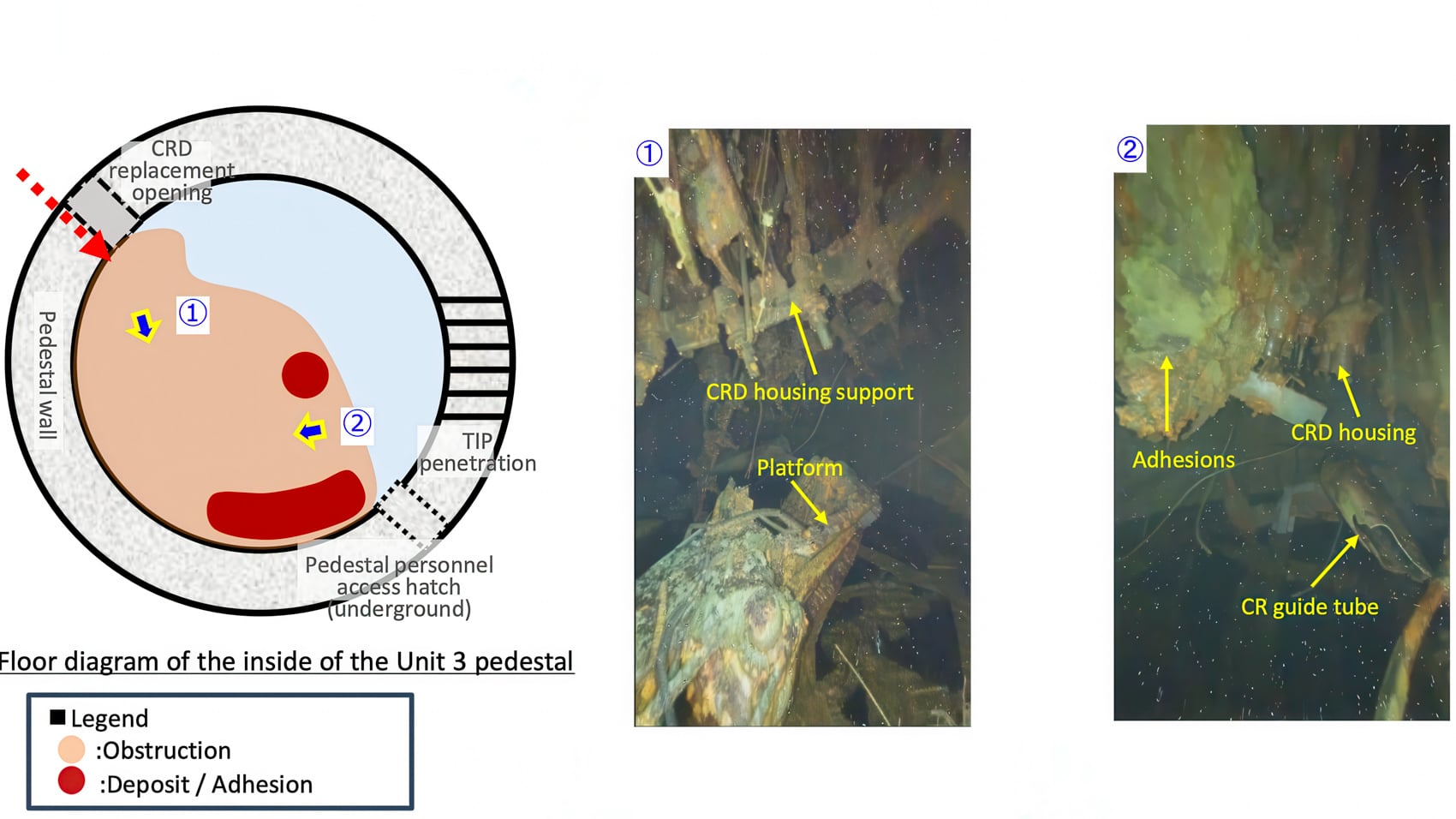
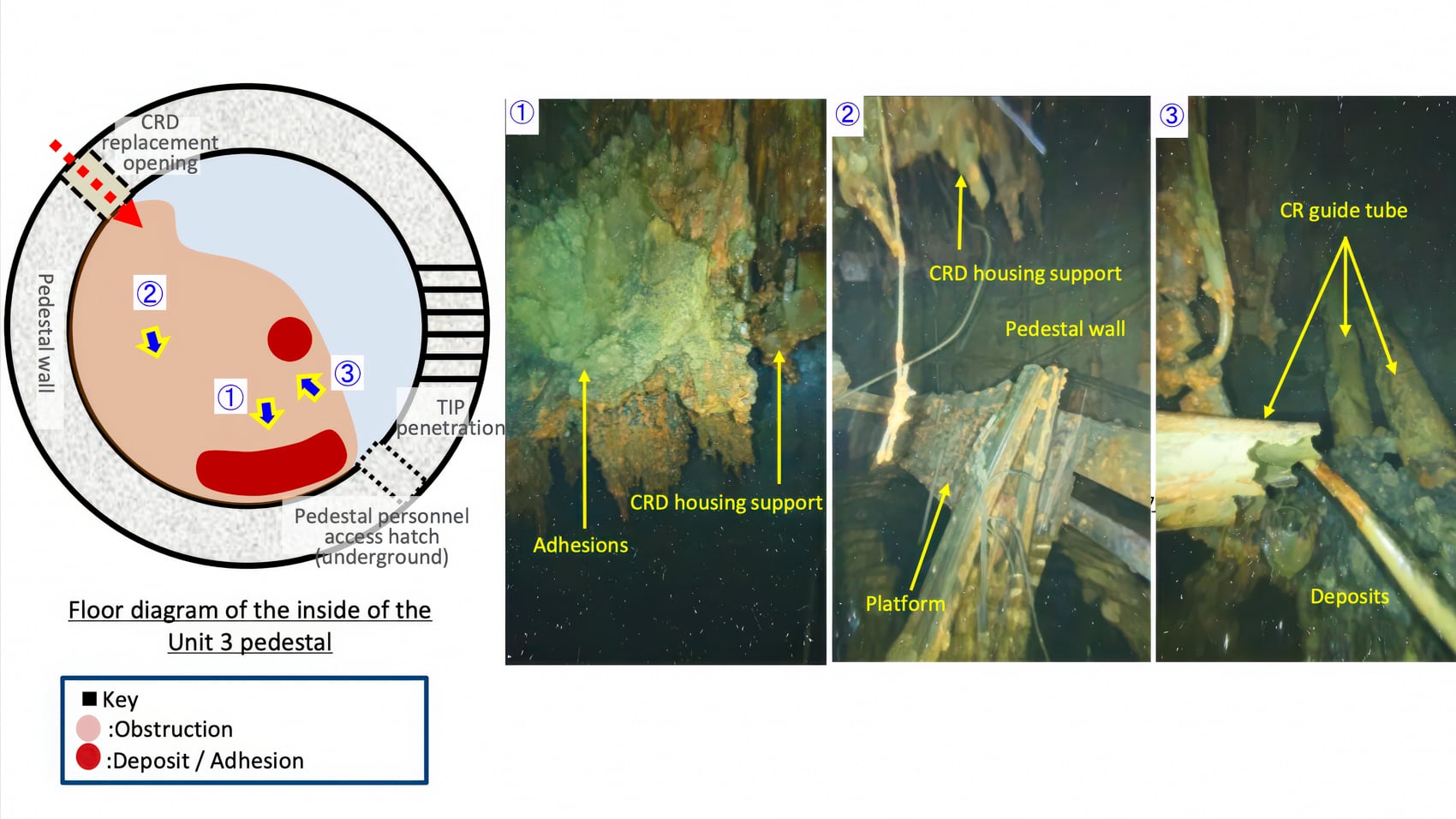
From March 10 onward, the drones investigated the inside of the pedestal, the thick concrete structure that supports the reactor pressure vessel from below. There they found structures they believe fell from inside the vessel during the meltdown, along with adhesions and deposits mapped across multiple zones on the pedestal floor.
The drones flew systematic coverage of the bottom and center of the pedestal across two separate investigation areas, building a picture of what had accumulated there over 15 years.
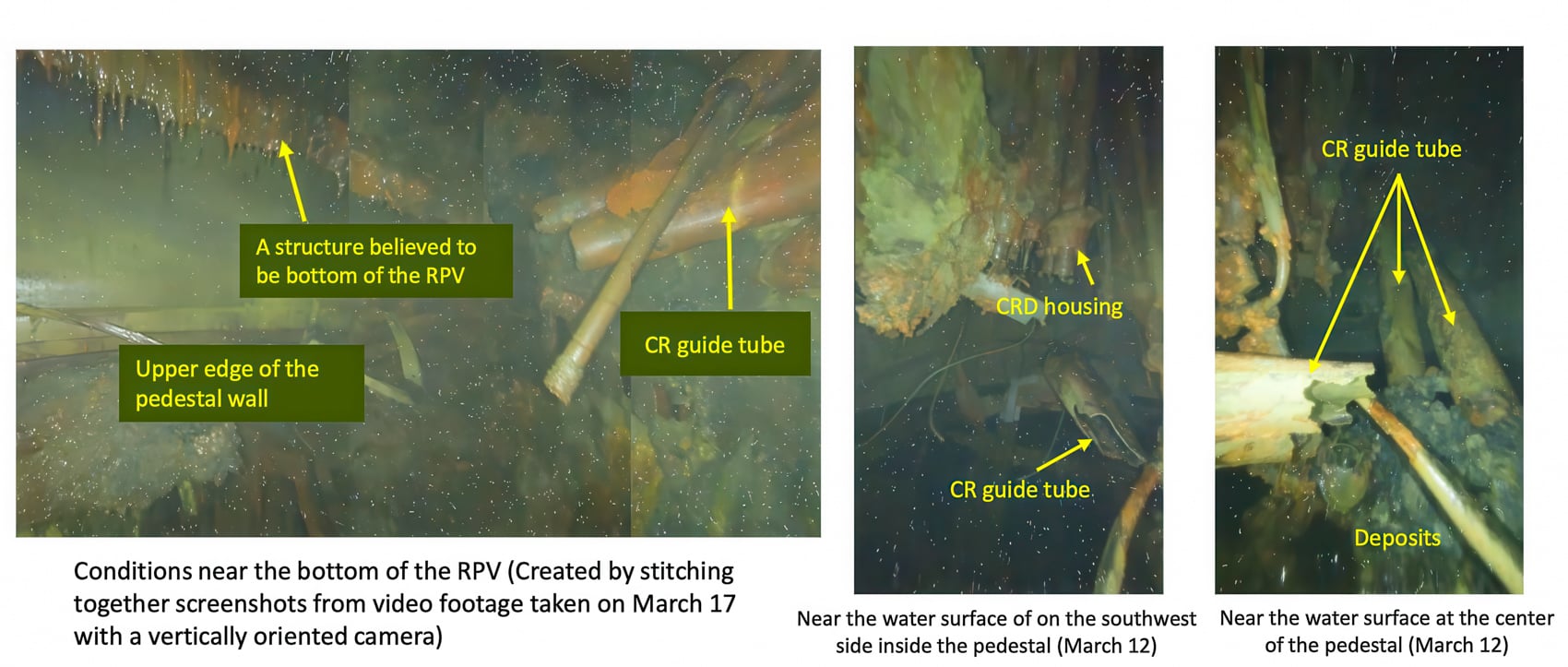
On March 17, the mission reached its primary objective. A drone flying with its camera in vertical orientation captured what TEPCO identified as a structure that appears to be the bottom of the reactor pressure vessel, along with CR guide tubes, CRD housings, and what the company believes is melted fuel debris in the form of hanging deposits and adhesions.
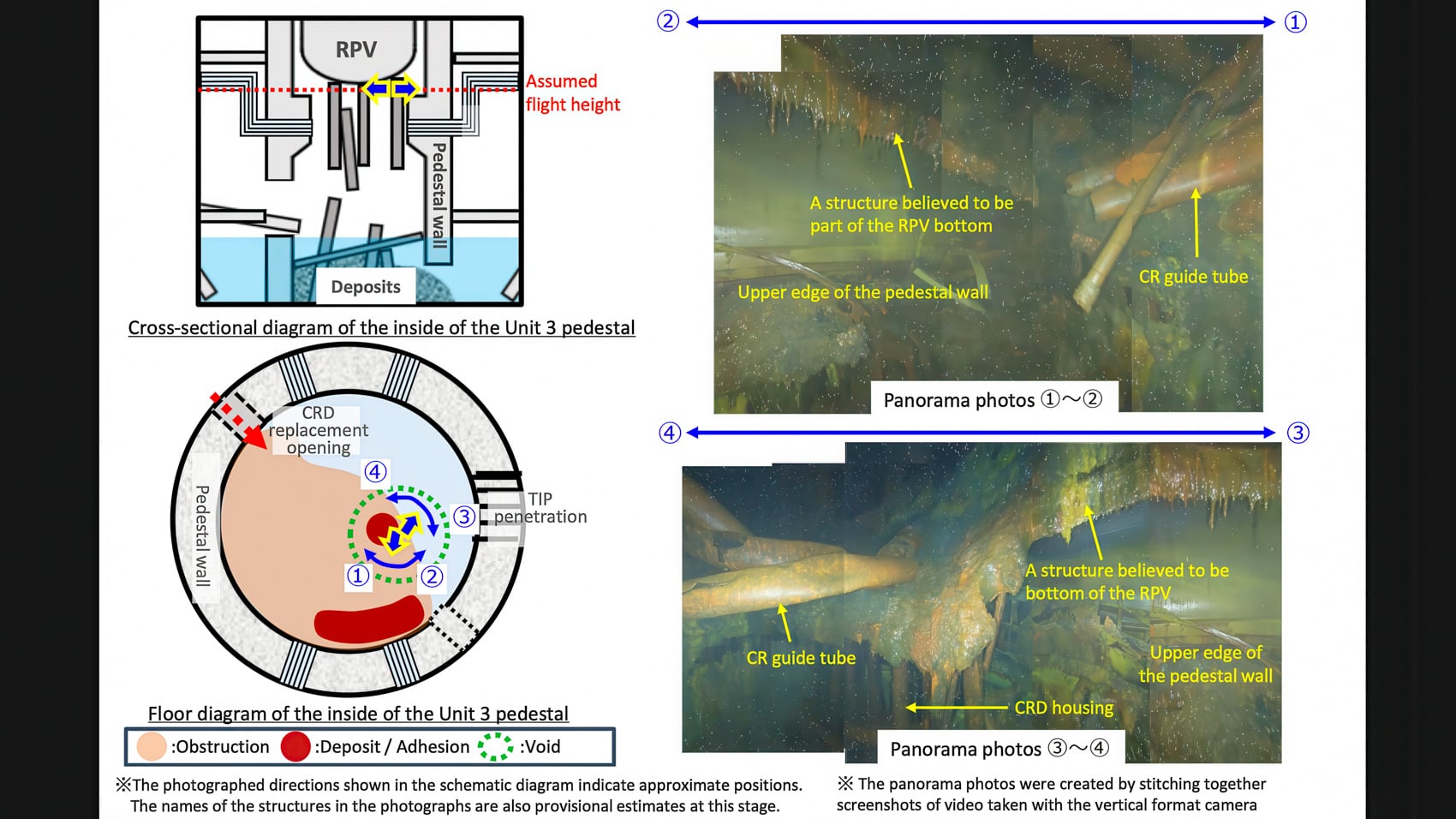
The panorama images were created by stitching together video screenshots taken during that flight. TEPCO is careful with its language throughout the reference document: everything identified is described as provisional at this stage, based on visual estimates rather than confirmed structural analysis.
The investigation concluded March 19 as planned. TEPCO’s next step is point cloud conversion of all the footage, the process that will turn the raw video data into a navigable three-dimensional map of the Unit 3 interior. That map will inform the engineering design of whatever tools eventually go in to retrieve the debris.
What the Drones Are
The micro-drones used in the mission measure 5.1 by 4.7 by 1.6 inches and weigh 3.3 oz including battery. Each carries a 2.7K camera shooting at 60 frames per second with a diagonal field of view of 140 degrees, two LED lights producing 380 lumens total, and radiation sensors.
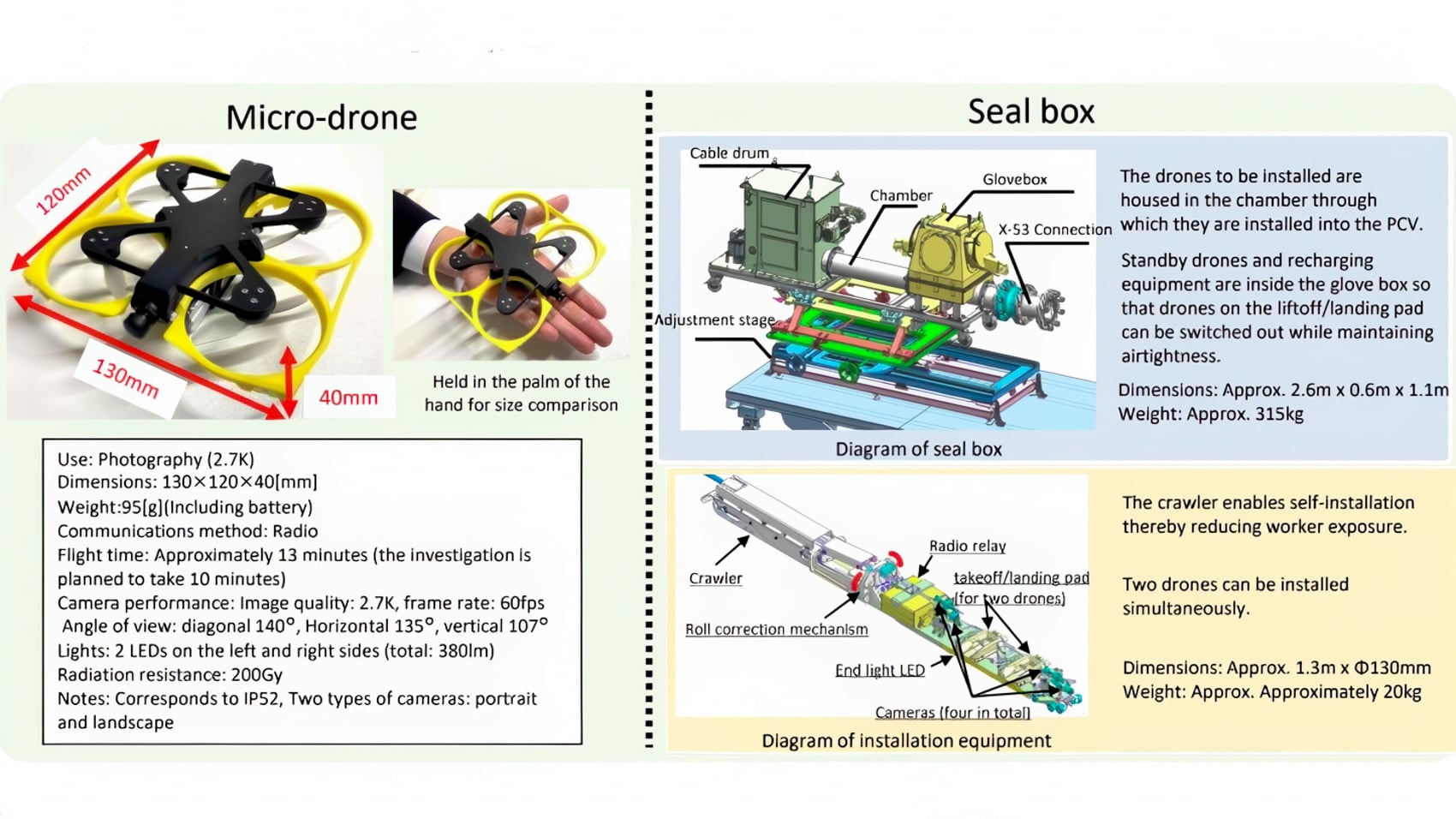
The airframe is IP52 rated and built to withstand up to 200 Gy of cumulative radiation exposure. Two camera orientations, portrait and landscape, allowed crews to capture different viewing angles without repositioning the drone.
Each sortie lasted approximately 13 minutes. The manufacturer has not been publicly disclosed by TEPCO.
Maintaining airtightness throughout the entire operation was a non-negotiable requirement. TEPCO deployed a custom seal box system to house, deploy, and recover the drones without breaching containment at any point.
A crawler carries the takeoff and landing pad into position inside the vessel, and can support two drones simultaneously, weighing approximately 44 lbs and measuring about 4.3 feet long by 5.1 inches in diameter. The seal box assembly itself measures roughly 8.5 by 2 by 3.6 feet and weighs approximately 694 lbs.
Why the CR Guide Tubes Matter
The structures the drones identified inside the pedestal tell a specific story about what happened during the 2011 meltdown. In a functioning boiling water reactor, the control rod drive housings and their associated guide tubes extend downward from the bottom of the pressure vessel into the space below.
During the Unit 3 meltdown, temperatures inside the vessel exceeded the melting point of the zirconium fuel cladding and the steel structural components. What didn’t evaporate or oxidize flowed downward and fell through or around the vessel’s lower structures.
The CR guide tubes and CRD housings the drones photographed lying on the pedestal floor are those structures, displaced from their original positions and now mixed with deposits of what TEPCO believes is resolidified fuel debris.
The deposits hanging from what appears to be the vessel bottom in the March 17 footage are consistent with material that flowed in a molten state and then cooled in place. TEPCO notes explicitly that all structural identifications are provisional estimates at this stage.
The Timeline Ahead
The Unit 3 footage is not the beginning of the end for Fukushima’s cleanup. TEPCO succeeded in extracting tiny melted fuel samples from Unit 2 in November 2024 and again in April 2025, the first physical retrieval of fuel debris since the disaster.
After studying the specific removal method required, the company concluded it would take approximately 12 to 15 years just to prepare for the full debris retrieval operation across all three reactors. The decommissioning process is expected to continue into the second half of this century. The three damaged reactors collectively contain an estimated 880 tons of melted fuel debris.
DroneXL’s Take
I want to be honest about what this story actually is, because it’s easy to read it as a milestone and miss what it’s really saying.
A 3.3-oz drone with a 2.7K camera and two LED lights just did something that billions of dollars of conventional robotics spent 15 years trying and failing to accomplish.
It flew through a destroyed nuclear reactor, survived 200 Gy of cumulative radiation, mapped the pedestal floor across multiple investigation zones, and on March 17 reached the bottom of the reactor pressure vessel and pointed its camera at what 15 years of engineering effort had been trying to see.
Then it came home, was swapped out in the glovebox without breaking airtight containment, and the next one went in.
The engineering accomplishment here isn’t the drone. It’s the system around it: the seal box, the crawler, the glovebox swap procedure, the radio range pre-checks, the decision to orient the camera vertically to capture the panorama shots that produced the clearest images yet of the Unit 3 vessel bottom.
Every one of those decisions was made by engineers who spent years figuring out how to get a small drone into one of the most hostile environments on earth and back out again with usable data.
The cleanup is still going to take decades. The point cloud maps TEPCO is now building from the March footage are the first pages of an engineering document that will run for a generation.
But they finally got to the bottom of the pressure vessel. After 15 years, a drone the size of a paperback book did what nothing larger could.
Discover more from DroneXL.co
Subscribe to get the latest posts sent to your email.
Check out our Classic Line of T-Shirts, Polos, Hoodies and more in our new store today!

MAKE YOUR VOICE HEARD
Proposed legislation threatens your ability to use drones for fun, work, and safety. The Drone Advocacy Alliance is fighting to ensure your voice is heard in these critical policy discussions.Join us and tell your elected officials to protect your right to fly.

Get your Part 107 Certificate
Pass the Part 107 test and take to the skies with the Pilot Institute. We have helped thousands of people become airplane and commercial drone pilots. Our courses are designed by industry experts to help you pass FAA tests and achieve your dreams.

Copyright © DroneXL.co 2026. All rights reserved. The content, images, and intellectual property on this website are protected by copyright law. Reproduction or distribution of any material without prior written permission from DroneXL.co is strictly prohibited. For permissions and inquiries, please contact us first. DroneXL.co is a proud partner of the Drone Advocacy Alliance. Be sure to check out DroneXL's sister site, EVXL.co, for all the latest news on electric vehicles.
FTC: DroneXL.co is an Amazon Associate and uses affiliate links that can generate income from qualifying purchases. We do not sell, share, rent out, or spam your email.