
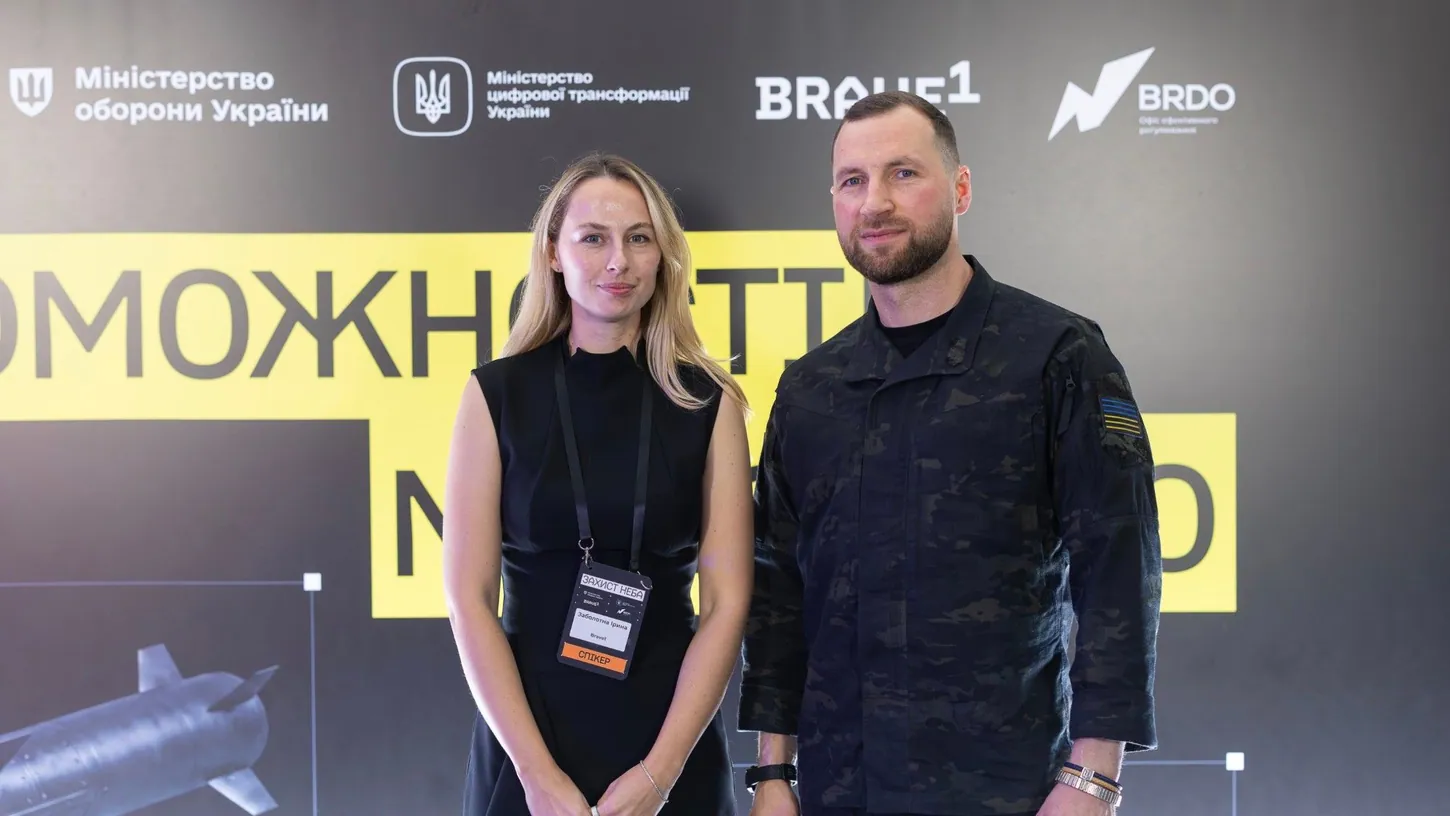
Ukraine is paying its own defense companies to build air-to-air missiles that launch from drones. Brave1, the government’s defense-tech cluster, opened grant competition No. 11 on October 29 with the Ministry of Defence and the Ministry of Digital Transformation, offering up to four grants of as much as ₴75 million (about $1.64 million) each.
A second competition, No. 10, funds a Ukrainian-built tactical radar to detect and track aerial targets, with up to four grants capped at ₴100 million (about $2.19 million). Only companies registered in Ukraine can enter, nobody needs a finished product, and the first stage closes November 5 at 23:59 Kyiv time.
Kyiv already has a cheap answer to the propeller Shahed in interceptor drones like the $2,100 Wild Hornets Sting. Russia’s jet-powered Geran-4 and Geran-5 fly at 310 to 373 mph (500 to 600 km/h).
Jet Shaheds Strained the Interceptor Math, So Kyiv Wants a Missile
The Ministry of Defence says the missile competition exists to cut the cost of intercepting jet-powered drones. Defence Minister Evgeniy Khmara named high-speed drones alongside ballistic missiles, cheap cruise missiles and glide bombs as Russia’s main threats in an address to Brave1 manufacturers published October 30.
Khmara’s announcement on the ministry’s site asked the industry for affordable systems that scale, and he put the ambition bluntly: “We need technologies that change the rules of the game in our favor.” Brave1’s own post on X described missiles deployed directly from drones, “neutralizing jet threats at low cost without risking pilots’ lives.”
Ukrainian intelligence said in May that Russia built the Geran-4 to counter Ukraine’s interceptor drones. In September Zelensky released SBU footage of an interceptor killing a jet Shahed, and Kyiv declined to name the maker, the price or the kill count.
Missiles on unmanned platforms are already in this war on both sides. Russia fitted a Soviet-era R-60 air-to-air missile to a Shahed in December 2025 and a MANPADS about five weeks later. Ukraine’s Magura V7 naval drones carried air-to-air missiles that military intelligence said shot down two Russian Su-30 fighters in May 2025. The rules for competition No. 11 cover missiles launched from drones and from manned aircraft.
Winning Missile Teams Get 16 Months and No Co-Financing Bill
Competition No. 11’s 90-page rules, approved by the Innovation Development Fund’s supervisory board on October 15, give a winning team 16 months from its first grant payment to reach the required readiness level. The grant is non-repayable unless the rules are breached, needs no co-financing, and arrives in two tranches.
Winners must hand finished samples and their technical documentation to a military unit the Defence Ministry picks. After compliance checks, Brave1 opens a 10-working-day window for full applications. An Armed Forces command and a five-member commission, three of them independent experts, score the entries, and the fund’s supervisory board funds no more than four per competition.
The performance targets are confidential under the rules. The public application form still shows what the military will judge a missile on: minimum and maximum range, launch altitude, flight speed in Mach, maximum G-load, and warhead and fuze type.
The radar competition runs on the same structure with an 18-month clock, a 15-working-day application window and the higher cap, and Khmara said the ministry wants Ukrainian radars that can detect low-observable targets. That is the layer Washington has been selling to Kyiv. The State Department’s $2.68 billion package approved September 18 included RPS-202 counter-drone radars.
Foreign-Owned Firms Can Only Enter Through a Ukrainian Company
Both competitions are open only to legal entities registered in Ukraine. State or municipal owners must hold under 25%, and nonprofits are excluded. A Ukrainian LLC with foreign shareholders can apply, but Brave1’s checklist demands registry extracts for every foreign company in its ownership chain.
Companies with branches or subsidiaries in Russia or Belarus are barred, as are firms with sanctioned owners or Russian and Belarusian beneficial owners who do not live legally in Ukraine.
The Prozorro listing shows an application deadline of December 1 at 17:00 at the top of the page. The notice beneath it says any expression of interest filed after November 5 will not be considered, and clarification questions close November 9.
DroneXL’s Take
Paying Ukrainian startups to build a missile a drone can carry is the right bet against the jet Shahed. At about $1.64 million per grant, the cap is sized for small companies. The $2,100 Sting showed that a cheap airframe can change the price of a Shahed kill, and Russia answered with jets. Kyiv’s answer now is to let a missile do the chasing while the launcher stays cheap and unmanned, so no helicopter crew has to close on a Shahed that might shoot back. The competition I’d watch is the turbojet one Brave1 says comes next, because the Geran-4 runs on a Chinese hobby jet that sells for up to $25,000 and a fast Ukrainian missile needs an engine of its own. I suspect engine supply will decide how many of these missiles Ukraine fires, more than any of the up to eight grants on offer this week.
Sources: Prozorro, Brave1 grant competitions No. 10 and No. 11, Ministry of Defence of Ukraine, Brave1 on X, National Bank of Ukraine exchange rate.
DroneXL uses automated tools to support research and source retrieval. All reporting and editorial perspectives are by Haye Kesteloo. Read our editorial standards.


