
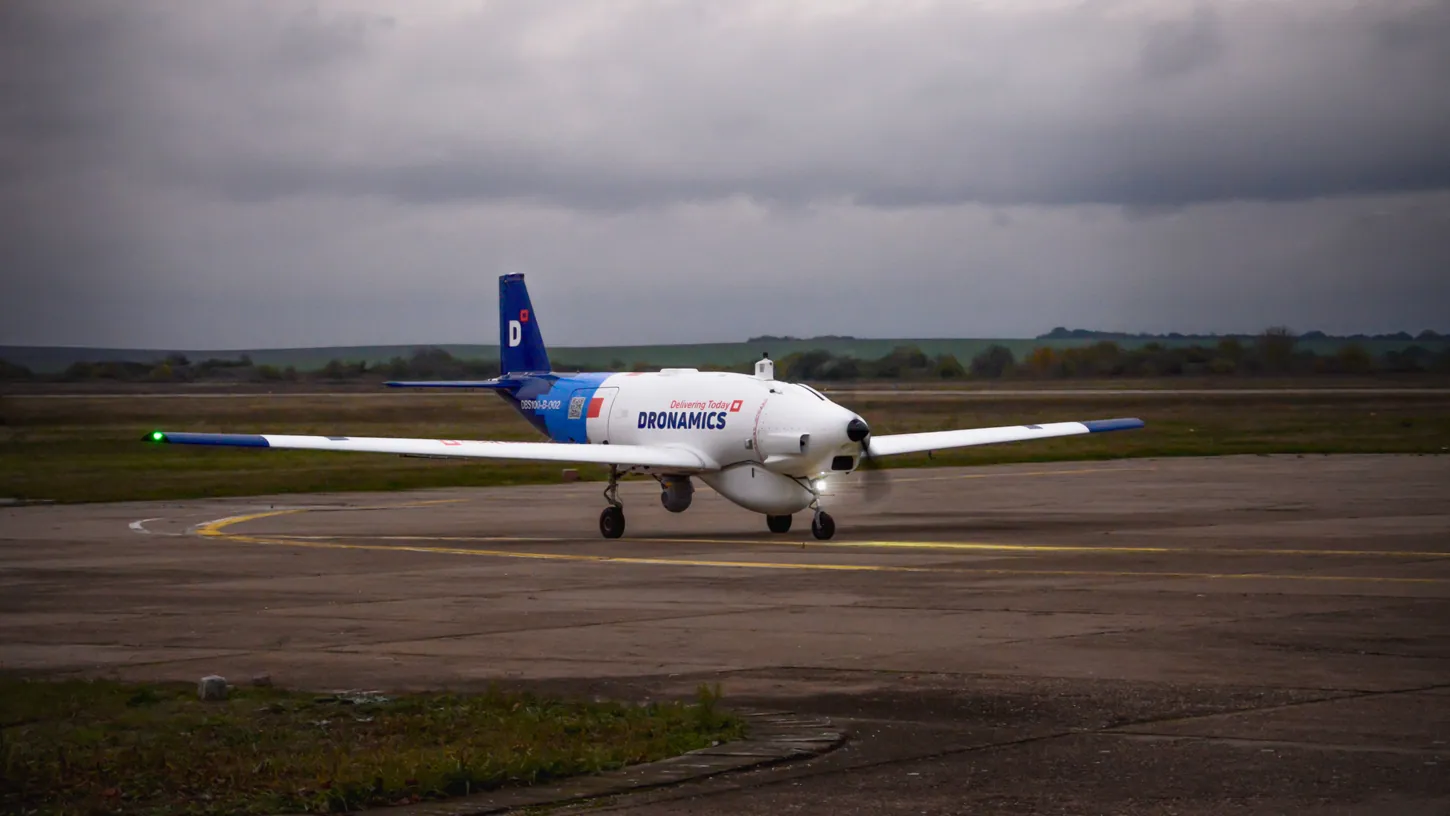
The blank-check company taking Bulgarian drone maker Dronamics to Nasdaq has about $30 million left in its trust account. Shareholders of GP-Act III Acquisition Corp. redeemed $69.5 million at a November 12 vote to extend the company’s deadline, nine days after it agreed to merge with Dronamics, the builder of the Black Swan.
Redemptions on that scale are not new for this company. About 69% of its public shares cashed out at the previous extension in May, before any Dronamics deal existed. But the trust is now below the roughly $50 million that Dronamics’ investor presentation used in its illustrative case, and the merger vote, with another chance to redeem, is still ahead.
Dronamics is targeting about $100 million in net cash at closing. The same week as the vote, it and Germany’s HENSOLDT announced the Black Swan early warning demonstration that DroneXL ran on the Wire.
GP-Act III Holders Redeemed 70% Of The Trust At The Extension Vote
Holders of 6,266,194 GP-Act III Class A shares redeemed them for about $11.10 each at the November 12 extraordinary general meeting, the company’s Form 8-K shows. That took $69,528,381 out of the trust. It left $30,042,232, a drop of about 70% by DroneXL’s arithmetic.
The meeting was not the vote on the merger. According to the filing, shareholders approved moving GP-Act III’s deadline to complete a deal from November 13, 2026 to May 8, 2027, and that vote gave them the right to cash out. GP-Act III and its sponsor had signed non-redemption agreements covering 2,525,000 shares for this meeting, and the sponsor promised those holders 505,000 of its own shares after closing.
The filing gives no reasons for the redemptions, and the company’s proxy statement shows the pattern is older than the Dronamics deal. At the first extension meeting on May 12, holders of 68.8% of the public shares redeemed about $215.4 million and left about $97.8 million. The proxy also set the deadline to tender shares for this vote at 5 p.m. Eastern on November 10. The merger itself goes to a separate shareholder meeting, where the remaining holders keep the right to redeem.
The investor presentation GP-Act III filed with the Securities and Exchange Commission shows what the trust was expected to contribute. Its illustrative case assumed a $99.4 million trust and a 49.7% redemption rate, which would leave roughly $50 million, plus $80 million from a private placement and a convertible loan note. Out of that $130 million, $30 million would go to transaction expenses and $100 million to Dronamics.
The merger agreement requires at least $25 million in net cash at closing. Dronamics said in its merger announcement that part of the convertible loan has been funded and that it is still talking to institutional investors about the private placement. No binding private placement commitment appears in GP-Act III’s SEC filings through November 13.
Dronamics Tells Investors It Has No Meaningful Revenue Yet
The presentation describes Dronamics, founded in 2014 and funded with about $80 million so far, as “a pre-commercialization enterprise” that has not generated meaningful revenue. It anticipates first cargo revenue flights and defense contracts in later periods, and the deal values the company at $400 million before new money.
Most of the demand behind that valuation is not contracted. The presentation counts more than 730 Black Swan aircraft under memoranda of understanding, letters of intent and term sheets, and it states that these are non-binding. The only cargo arrangement it calls binding is a cooperation agreement with Hellmann Worldwide Logistics, which intends to take at least 30% of Dronamics’ cargo capacity, subject to market development and annual re-evaluation. On the defense side the document lists more than $300 million of “identified defense opportunities,” which is the company’s own estimate.
Dronamics does hold assets most drone startups lack. It has a European Union Light UAS Operator Certificate that allows revenue flights on select routes, plus airline codes from the International Air Transport Association and the International Civil Aviation Organization. It has built three full-scale aircraft, and the first flew in 2023.
The Early Warning Demo Drew Interest But No Announced Buyer
Dronamics and HENSOLDT said on November 10 that a full-scale Black Swan flew HENSOLDT’s MissionGrid sensor suite in Bulgaria in front of armed forces and government operators, and they reported customer interest but did not name a customer, announce an order, or give the flight dates or the airfield.
The missions the releases name were on the ground and the water. The 52-foot-wingspan (16-meter) aircraft tracked moving vehicles and stationary assets and detected vessels on the Danube River with HENSOLDT’s PrecISR radar and Argos electro-optical sensor. Neither version lists an airborne target among the demonstrated missions. Dronamics’ version says the system can detect targets in the air, and HENSOLDT executive Dietmar Thelen names the detection of low-flying targets as part of the companies’ shared goal.
The two versions differ on cost. In HENSOLDT’s release, Dronamics co-founder Svilen Rangelov says the system does the job for “a fraction of the price of manned AWACS platforms.” In Dronamics’ own version, the same quote puts the cost well below that of traditional manned platforms, and neither version gives a price.
The partnership dates to February, when the two companies announced the Detect and Defend version of the Black Swan. Dronamics’ release says demonstrations were planned for later in the year.
DroneXL’s Take
The Black Swan is a real aircraft that flies, and it carried a German radar in front of military buyers nine months after the partnership was announced. Dronamics got there on about $80 million, which is small money in aviation, and I give the company credit for that.
I don’t read the redemptions as a verdict on the demo. This SPAC lost 69% of its trust in May too, and holders who cash out get about $11 a share back with no risk, whoever the merger partner is. The effect on Dronamics is the same either way. The trust can now supply less than a third of the $100 million the company wants, and the rest depends on a private placement with no announced commitments.
That makes the valuation hard for me to accept today. When XTEND listed on the NYSE in September it had announced more than $27 million in defense orders by late July, and I still thought the price ran ahead of the record. Dronamics is asking $400 million with no announced defense order. I’d wait for a signed one, or a funded private placement, before taking that number at face value.
Sources: U.S. Securities and Exchange Commission (GP-Act III Form 8-K, proxy statement and investor presentation), Dronamics, HENSOLDT
DroneXL uses automated tools to support research and source retrieval. All reporting and editorial perspectives are by Haye Kesteloo. Read our editorial standards.


