Shahed Drones Now Shoot Back: Russia Arms Kamikaze With MANPADS

Check out the Best Deals on Amazon for DJI Drones today!
We have been tracking the evolution of Russia’s Shahed drones since at least the invasion of Ukraine, and the latest development is the most significant tactical shift yet. Just five weeks after they strapped an R-60 air-to-air missile to a Shahed, they’ve done it again, this time with a MANPADS. This isn’t experimentation anymore. This is a systematic program to turn a $20,000 kamikaze drone into an air defense platform, and it means Ukraine’s helicopter pilots are now hunting drones that can hunt them back.
- What: For the first time, a Russian Shahed drone has been found equipped with a man-portable air-defense system (MANPADS)
- When: January 4, 2026
- Who: Detected and intercepted by the Darknode battalion of Ukraine’s 412th Nemesis Brigade
- Why it matters: This turns a one-way attack drone into a self-defending asset, dramatically increasing the risk for Ukrainian helicopters and aircraft tasked with intercepting them
The initial report came from Ukrainian electronic warfare expert Serhii “Flash” Beskrestnov, who posted on Telegram warning army aviation pilots about the new threat. The images show a downed Shahed with a MANPADS mounted on its airframe, complete with a camera and radio modem for remote operation from Russian territory.
“The enemy continues to look for ways to destroy our aviation,” Beskrestnov wrote. “Today we first encountered a Shahed with a MANPADS installed on board.”

From Kamikaze to Air-to-Air Threat in Five Weeks
This isn’t a random one-off. It’s the second major weapons upgrade to a Shahed in just over a month. On December 1, 2025, we saw the first images of a Shahed armed with a Soviet-era R-60 air-to-air missile. That drone was intercepted by the same Darknode battalion using a Wild Hornets Sting interceptor drone. Ukrainian intelligence later confirmed the R-60 setup included two cameras, a Chinese-made mesh modem, and a standard pylon mounting system.
The MANPADS version is arguably more alarming. MANPADS are designed to be shoulder-fired, making them potentially easier to integrate onto a slow-moving drone platform than a 97-pound jet fighter missile. The R-60 required the entire drone to be aimed at the target before the infrared seeker could lock on. This new setup, with a dedicated camera and radio modem, suggests a more flexible targeting system that allows the drone pilot to act as a remote gunner.
| Weapon | Type | Weight | Max Range | Guidance |
|---|---|---|---|---|
| R-60 (Dec 2025) | Air-to-Air Missile | 44 kg (97 lbs) | ~8 km (5 mi) | Infrared seeker |
| MANPADS (Jan 2026) | Surface-to-Air Missile | ~10-18 kg (22-40 lbs) | ~5 km (3 mi) | Infrared seeker |
The Helicopter Problem
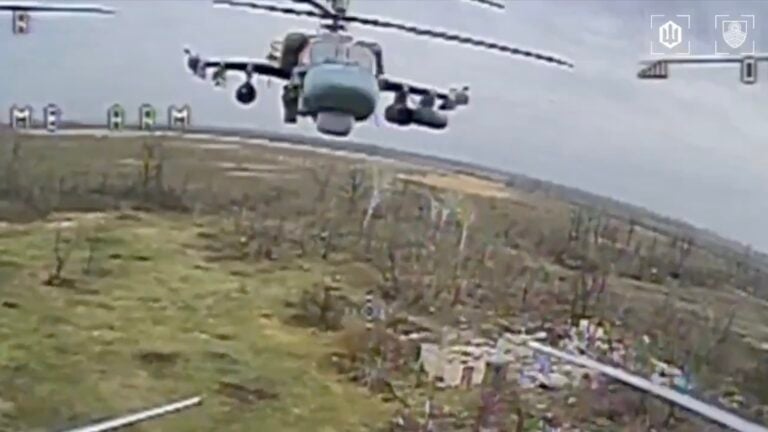
For months, Ukrainian helicopter crews have been the unsung heroes of drone defense. Mi-8 transport helicopters and Mi-24 gunships have racked up dozens of kills, blasting Shaheds out of the sky with PKT machine guns, M134 Miniguns, and even 30mm cannons. It’s risky work, requiring crews to close within hundreds of meters of a flying bomb, but it’s been devastatingly effective.
This development changes that calculus entirely.
Beskrestnov’s warning to pilots was specific: “I ask army aviation pilots to take note of the emergence of this new threat. You should avoid approaching the Shahed head-on and be more careful with those who are flying in a circle.”
That last detail is telling. A Shahed “flying in a circle” suggests a loitering pattern, waiting for an intercept attempt. The drone becomes bait, and the helicopter crew becomes the target.
Russia Copies Ukraine’s Black Sea Playbook
Here’s the irony: Russia is applying a lesson Ukraine taught them.
When Russian helicopters started picking off Ukraine’s naval drones in the Black Sea, Ukraine responded by arming their sea drones with air-defense missiles. The result? A Ukrainian USV armed with an R-73 missile shot down a $50 million Su-30 fighter jet in May 2025, the first time in warfare history that a naval drone downed a combat aircraft.
Now Russia is applying the same logic to the air war. Ukrainian helicopters have been shredding Shahed swarms, so Moscow is making the Shaheds shoot back. It’s asymmetric warfare all the way down.
The Darknode Factor
It’s no coincidence that the same unit keeps intercepting these armed Shaheds. The Darknode battalion of the 412th Nemesis Brigade has become Ukraine’s premier counter-drone force, credited with intercepting over 1,500 enemy strike drones.
Commander Oleksandr Yarmak recently stated: “Interceptor drones are no longer just an alternative to traditional air defense. They’re a game changer.”
The unit is currently at the center of a 1 billion hryvnia ($30 million USD) fundraising campaign, Ukraine’s largest-ever defense fundraiser, specifically for anti-drone systems. The Unmanned Systems Forces confirmed the MANPADS intercept, noting that “the study of the tactics of using the enemy’s new weapon is ongoing.”
What’s remarkable is how quickly Darknode adapted. When they intercepted the R-60 Shahed on December 1, they used a Sting interceptor drone. For the MANPADS variant, the interception method wasn’t specified, but the result was the same: another armed Shahed destroyed before it could threaten Ukrainian aviation.
The Cost-Effectiveness Question
Here’s where Russia’s math gets complicated. A standard Shahed costs roughly $20,000-35,000 to produce. An R-60 missile adds weight and complexity. A MANPADS system is significantly more expensive, potentially adding $10,000-50,000 depending on the variant.
One X user captured the absurdity perfectly: “Instead of making 3x more Shaheds they made one Shahed 3x more expensive.”
The Shahed’s entire strategic value lies in overwhelming Ukrainian air defenses through sheer volume at low cost. Russia has been producing over 200 Shaheds per day, launching waves of 500-700 drones to exhaust Ukraine’s expensive interceptor stockpiles. Arming individual Shaheds with missiles undermines that core advantage.
But here’s the counterargument: Russia doesn’t need to arm every Shahed. If even 5% of a 500-drone swarm carries missiles, that’s 25 potential threats that Ukrainian helicopter crews have to assume could shoot back. The uncertainty alone forces more cautious tactics, which means fewer intercepts, which means more Shaheds reaching their targets.
DroneXL’s Take
Here’s what I expect: This marks the beginning of the end for routine helicopter intercepts of Shaheds. The risk of losing a multi-million dollar helicopter and its crew to a $20,000 drone is now too high for standard operations. If I’m right, Ukraine will be forced to accelerate its reliance on drone-on-drone warfare.
That’s not necessarily bad news. Ukraine’s $2,500 Sting interceptors and mass-produced Octopus drones are already proving devastatingly effective against Shahed swarms, with hit rates as high as 80-90% in the hands of skilled pilots. A $2,500 drone destroying a $35,000 armed Shahed is still a massive win for Ukraine.

This development, while alarming, is the ultimate validation of Ukraine’s drone-first strategy. The future of air combat isn’t just about drones attacking ground targets; it’s about drones fighting drones. Russia just confirmed it.
The real story here isn’t that Russia armed a drone with a missile. It’s that Ukraine’s counter-drone campaign has become so effective that Moscow is willing to sacrifice the Shahed’s core advantage, cheap mass production, just to slow down the interception rate. When your enemy starts making their disposable weapons more expensive specifically to counter your defenses, that’s not a sign of strength. That’s adaptation under pressure.
What do you think this means for the future of air warfare? Is this the end of manned aircraft in counter-drone roles? Let us know in the comments.
Discover more from DroneXL.co
Subscribe to get the latest posts sent to your email.
Check out our Classic Line of T-Shirts, Polos, Hoodies and more in our new store today!

MAKE YOUR VOICE HEARD
Proposed legislation threatens your ability to use drones for fun, work, and safety. The Drone Advocacy Alliance is fighting to ensure your voice is heard in these critical policy discussions.Join us and tell your elected officials to protect your right to fly.

Get your Part 107 Certificate
Pass the Part 107 test and take to the skies with the Pilot Institute. We have helped thousands of people become airplane and commercial drone pilots. Our courses are designed by industry experts to help you pass FAA tests and achieve your dreams.

Copyright © DroneXL.co 2026. All rights reserved. The content, images, and intellectual property on this website are protected by copyright law. Reproduction or distribution of any material without prior written permission from DroneXL.co is strictly prohibited. For permissions and inquiries, please contact us first. DroneXL.co is a proud partner of the Drone Advocacy Alliance. Be sure to check out DroneXL's sister site, EVXL.co, for all the latest news on electric vehicles.
FTC: DroneXL.co is an Amazon Associate and uses affiliate links that can generate income from qualifying purchases. We do not sell, share, rent out, or spam your email.








![Review And Rewrite This Article For Publication. Do All Of The Following: 1. Fact-Check: Verify Dates, Locations, Quotes, Agency Names, And Acronyms. Mark Anything Uncertain With [Verify]. Did The Article Reference And Link To The Original Source? Flag If Missing. 2. Devil'S Advocate: In 3–4 Sentences, Assess Whether The Article Is Factually Sound, Well-Written, And Reads As Human. Be Blunt. 3. Humanize: Fix All Ai Patterns — Break Parallel Sentence Pairs, Remove Em-Dashes Used As Dramatic Pauses, Cut Redundant Consecutive Sentences, Remove Rhetorical Counting Devices. Strip These Words: Crucial, Vital, Key, Significant, Notably, Importantly, Essentially, Arguably, Landscape, Ecosystem, Trajectory, Transformative, Game-Changer, Groundbreaking, Unprecedented, Cutting-Edge, Robust, Seamless, Leverage (Verb), Utilize, Going Forward, In Conclusion, In Summary. Vary Sentence Length. Make The Take Section One Editor'S Sharp Opinion, Not A Summary. 4. Seo: Give 5 Alternative Title Ideas, A Permalink Slug, And A Meta Description (Under 155 Characters). Output Order: Devil'S Advocate Assessment → Revised Article With [Verify] Flags → Seo Block.](https://dronexl.co/wp-content/uploads/2025/02/DJI-Dock-3-and-Matrice-4D-and-4TD-Usher-in-Versatile-Drone-in-a-Box-Solution-for-Remote-Operations-0022.jpg.webp)