Replicator 2 Buys DroneHunter to Guard US Skies

Check out the Best Deals on Amazon for DJI Drones today!
The Joint Interagency Task Force 401 just fired the starting pistol on Replicator 2, and the first runner out of the blocks is not a missile, not a jammer, but a net throwing robot hawk.
On January 11, JIATF 401 announced its first official Replicator 2 purchase, awarding a contract for two Fortem DroneHunter F700 counter drone systems, with delivery expected by April. This is not a science fair demo or a pilot that will gather dust.

This is the opening move in a serious effort to protect US military installations and critical infrastructure from the growing swarm of small unmanned aerial threats.
If Replicator 1 was about scale, Replicator 2 is about control. And control, in the homeland, means stopping bad drones without blowing holes in the neighborhood.
Replicator 2 and the speed of relevance
Replicator was first announced in August 2023 as a way to move faster than traditional defense procurement, which historically moves at the speed of cold molasses in winter. Replicator 1 focused on deploying large numbers of autonomous systems across air, land, and sea. Replicator 2 narrows the scope with laser focus on countering small UAS threats.

JIATF 401, stood up in August 2025, is now the tip of the spear. Its mission is to synchronize counter drone efforts across the War Department and push real capabilities into the field, fast.
Army Brig. Gen. Matt Ross, director of JIATF 401, summed it up bluntly. The task force exists to cut red tape, pull in commercial innovation, and deliver results, not slide decks. One metric matters: getting modern counter UAS tools into the hands of warfighters, at home and abroad.

The DroneHunter purchase is small in quantity but big in symbolism. It signals that Replicator 2 is not waiting for perfect, bespoke military hardware. It is leveraging systems that already work in the real world, with thousands of captures to prove it.
DroneHunter F700, the net with a brain
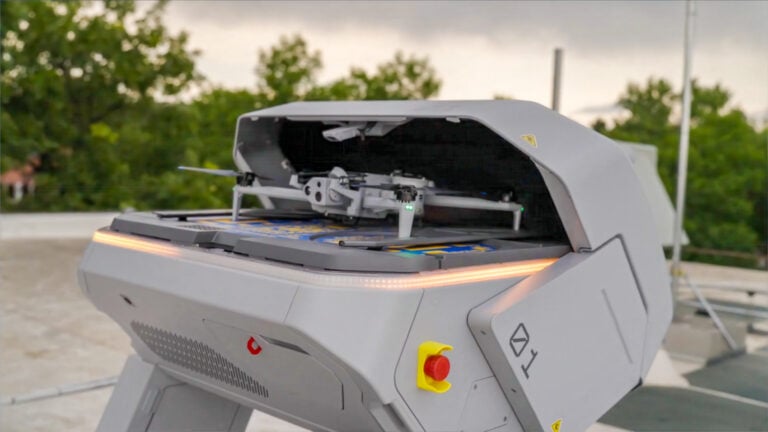
The DroneHunter F700 is not a modified consumer drone with military stickers slapped on. It was engineered from the ground up for one job: chasing down other drones and stopping them safely.
At its core, the F700 is a fully autonomous interceptor guided by onboard radar and artificial intelligence. It does not rely on RF emissions from the target, which is critical because many hostile drones fly pre programmed GPS routes and stay radio silent. No signal, nothing to jam.
Using Fortem’s TrueView R20 radar, the F700 can detect, track, and lock onto small, low altitude drones even in cluttered urban environments. Once it closes the distance, it does not explode, fry, or blind the target. It throws a net.
Yes, literally.

The DroneHunter uses modular NetGun payloads that fire rapidly expanding nets. For small Group 1 quadcopters, a tethered net captures the drone and allows the F700 to tow it to a safe location for forensic analysis. For larger Group 2 drones, the system can deploy a DrogueChute, forcing a slow, predictable descent like a very unwelcome parachute ride.
This matters enormously in the homeland. Lasers, missiles, EMPs, and high power jammers all come with serious collateral risks, especially in cities. A net, by comparison, is refreshingly polite. It removes the threat without turning downtown into a test range.
Fortem claims more than 4,500 real world drone captures, and statistically, only about 15 percent of targets evade the first net. The second shot usually ends the discussion.
Why nets beat noise in urban airspace
A big takeaway from this purchase is what it says about modern counter drone thinking.
Jamming works great against careless hobbyists and teenagers filming fireworks. It works poorly against determined adversaries using autonomous GPS guided drones that emit no RF signal. GPS spoofing can be clever, but it is often limited in range and increasingly easy to defeat with countermeasures.
Directed energy systems, missiles, and EMPs are effective in battlefield conditions, but in cities they are expensive, risky, and politically radioactive.
The DroneHunter occupies a very specific sweet spot. It minimizes collateral damage, operates at long stand off distances compared to ground based systems, and scales economically. Multiple DroneHunters can be launched simultaneously, each assigned to a specific threat, coordinated through Fortem’s SkyDome Manager C2 software.
This also makes the system relevant against multi vector attacks, not just single rogue drones. Think less whack a mole, more coordinated air policing.
The F700 is also designed to integrate into layered defense architectures. If a high altitude, fast moving drone slips past long range missile defenses and descends toward a target, DroneHunters can be cued to intercept during the terminal phase. They are not replacing missiles, but they are an intelligent second line of defense when missiles miss, which they often do.
Add in fast launch times, reloads under three minutes, night and bad weather capability, and an open API for C2 integration, and it becomes clear why JIATF 401 picked this system as its opening move.
This is not flashy sci fi. It is pragmatic, scalable, and very uncomfortable for rogue drones.
DroneXL’s Take
This first Replicator 2 purchase is small in numbers but loud in message. The War Department is done pretending that jammers and paperwork will protect the homeland from autonomous drones. Nets may not sound glamorous, but they are precise, proven, and politically survivable in crowded cities.
The DroneHunter F700 feels like a system designed by people who have actually watched drones misbehave in the real world, not just on PowerPoint slides. If Replicator 2 continues down this path, favoring field proven commercial tech over slow bespoke programs, the skies over US infrastructure may soon feel a lot less permissive for anything flying where it should not be.
For rogue drones, the future looks less like a fireworks show and more like getting tackled mid air and dragged off for questioning.
Photo credit: Fortemtech,
Discover more from DroneXL.co
Subscribe to get the latest posts sent to your email.
Check out our Classic Line of T-Shirts, Polos, Hoodies and more in our new store today!

MAKE YOUR VOICE HEARD
Proposed legislation threatens your ability to use drones for fun, work, and safety. The Drone Advocacy Alliance is fighting to ensure your voice is heard in these critical policy discussions.Join us and tell your elected officials to protect your right to fly.

Get your Part 107 Certificate
Pass the Part 107 test and take to the skies with the Pilot Institute. We have helped thousands of people become airplane and commercial drone pilots. Our courses are designed by industry experts to help you pass FAA tests and achieve your dreams.

Copyright © DroneXL.co 2026. All rights reserved. The content, images, and intellectual property on this website are protected by copyright law. Reproduction or distribution of any material without prior written permission from DroneXL.co is strictly prohibited. For permissions and inquiries, please contact us first. DroneXL.co is a proud partner of the Drone Advocacy Alliance. Be sure to check out DroneXL's sister site, EVXL.co, for all the latest news on electric vehicles.
FTC: DroneXL.co is an Amazon Associate and uses affiliate links that can generate income from qualifying purchases. We do not sell, share, rent out, or spam your email.