DJI Mavic 3 Drones Capture First-Ever Sperm Whale Birth on Film, Revealing Coordinated Group Care

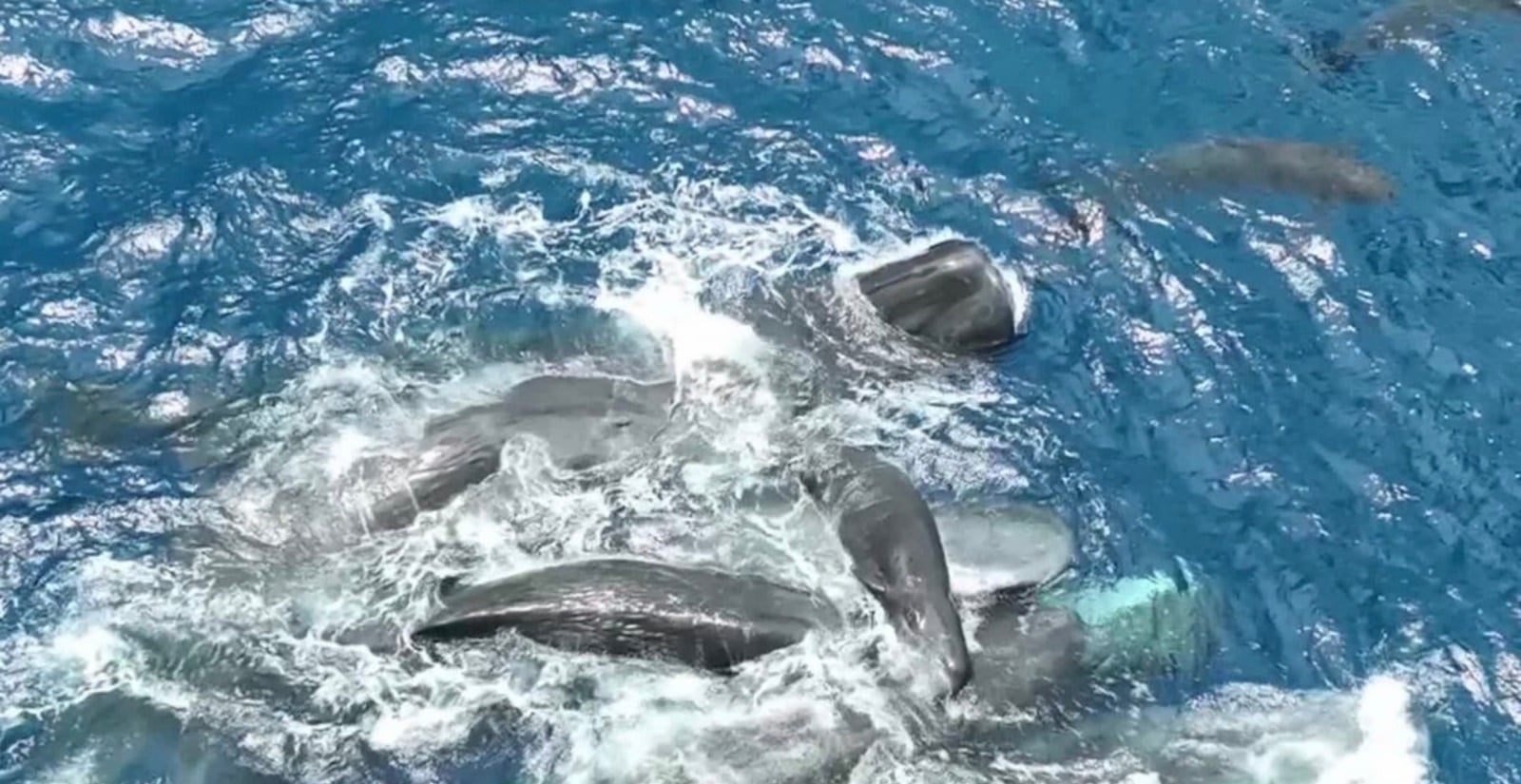
Two DJI Mavic 3 drones hovering at least 25 meters above the Caribbean Sea on July 8, 2023, recorded what scientists are calling the most detailed cetacean birth ever documented: a sperm whale calf entering the world off the coast of Dominica, lifted immediately to the surface by a coordinated group of 11 whales. The footage, captured by researchers at Project CETI (Cetacean Translation Initiative), forms the backbone of two peer-reviewed studies published Thursday in the journals Science and Scientific Reports. The original NYT reporting on the event is available here.
The birth had not been scientifically observed since 1986. The last published record before this footage came from a single distant observation during the commercial whaling era. This time, the drones didn’t miss a frame.
What the DJI Mavic 3 Drones Captured
Project CETI’s field team was running routine research aboard two vessels off Dominica’s leeward western coast when the whales of Unit A began behaving strangely. All 11 members of the family group had surfaced together, heads inward, moving unusually slowly. The team deployed two synchronized DJI Mavic 3 quadcopters, maintaining altitude above 25 meters per Harvard University IACUC Protocol #21-02-379-1, along with shipboard Canon DSLRs and a submerged hydrophone.
The drones recorded the mother, a whale the team had followed since 2005 and named Rounder, roll precisely as her calf’s flukes emerged, pointing the delivery directly up toward the hovering cameras. The full delivery lasted 34 minutes. Within one minute of birth, the surrounding whales clustered under the newborn and lifted it onto their heads and backs so it could breathe. The total documented event ran 5 hours and 22 minutes.
Biology Lead Shane Gero, a National Geographic Explorer who has tracked Unit A for over 20 years across thousands of hours of observation, said he had never been present for a birth before this day. “She didn’t have to roll over just at the time for us to video that from the sky,” he told Popular Science, “but she did.”
The aerial angle made the analysis possible. As Gero noted in comments to Science magazine, traditional proximity-based methods could only establish which whales were near each other. “But with the drones, we’re able to get all of the nuance” in how they actually interact.
Machine Learning Turned Drone Footage Into Scientific Data
Raw aerial video of 11 whales thrashing and diving together is not immediately interpretable. Project CETI fed the DJI Mavic 3 footage into a machine learning model that analyzed body orientation, movement coordination, and physical contact patterns for each individual animal across the entire event window. The model could separate individual whale movements automatically; identifying which whale was Rounder, Lady Oracle, or Fruit Salad still required manual annotation from Gero, who knew every animal by sight.
The analysis, published in Science, found statistically significant patterns in how the group oriented toward the mother during labor and then shifted orientation toward the newborn after delivery. A core trio, Rounder, her half-sister Aurora, and an unrelated juvenile named Ariel, spent the most time physically supporting the calf. Every whale in the group acted as a primary supporter at some point, including a 15-year-old sub-adult male named Allan who was already years into separating from the natal unit, as male sperm whales typically do.
The Scientific Reports paper analyzed acoustic data from the hydrophone running in parallel. The team recorded statistically significant shifts in coda click patterns at key moments: the start of labor, the delivery itself, and a separate interaction with short-finned pilot whales that arrived shortly after. Those vocalizations could be detected across hundreds of feet of open water.
Half of the attending whales were not related to Rounder. That cross-family participation is what makes the behavioral findings significant. It points to social reciprocity rather than purely genetic motivation as a driver of cooperative behavior in the species. “Their social bonds are built on something more than just close familial ties,” said Alaa Maalouf, a machine learning researcher at Project CETI, in comments to Science magazine.
Drones Have Transformed Sperm Whale Research Off Dominica
This birth documentation is the latest in a series of breakthroughs driven by aerial observation of the same whale population. As we reported in August 2025, Project CETI also pioneered FPV drone-based “tap-and-go” acoustic tagging off Dominica, using custom-engineered drones to press suction-cup hydrophone tags directly onto sperm whales’ backs. That system, detailed in a PLOS One study, succeeded in more than half of 20 attempts, with each deployment completed in under seven minutes. And as we covered in November 2025, DJI drones have fundamentally reshaped how researchers study large cetaceans, replacing aircraft and reducing stress on animals while generating data quality that earlier methods could not match.
The birth footage reinforces a point that keeps coming up in marine biology: behaviors that were theoretically possible but never confirmed become documentable the moment a drone is overhead long enough. The sperm whale birth was not a rare event. Births happen. What was rare was having two synchronized aerial platforms, acoustic gear, and two decades of individual identification data all present at the same moment.
DroneXL’s Take
The detail that keeps pulling me back in this story is the altitude constraint: 25 meters minimum, approved under a Harvard IACUC protocol, with drone operations logged against a Dominica government research permit. That’s the regulatory and ethical infrastructure that made this footage publishable in Science. The team didn’t just show up with DJI Mavic 3s and start filming. They built a framework for non-invasive aerial observation that meets the evidentiary standards of peer review. That’s worth noting every time someone asks whether drone regulation is compatible with good science. Here, it was the precondition for it.
We’ve covered drone-based whale research for years at DroneXL, from the SnotBot collecting blow samples to FPV platforms pressing tags onto sperm whale backs. The trajectory is consistent: each new tool opens a window into behavior that was always happening but invisible to researchers. Iain Kerr once said he had seen more new whale behavior in a few years of drone work than in the three decades before it. This birth footage is another data point in that same pattern.
Expect Project CETI to publish follow-on analysis within 18 months focusing on the pilot whale interaction recorded immediately after the birth. Those vocalizations shifted the acoustic pattern, the short-finned pilot whales showed up, and nobody on the team yet knows why. That gap in the data, with hydrophones and drone footage in hand, is exactly the kind of open question this research program is built to answer.
DroneXL uses automated tools to support research and source retrieval. All reporting and editorial perspectives are by Haye Kesteloo.
Discover more from DroneXL.co
Subscribe to get the latest posts sent to your email.