The Bird, the Nest, and the Soldier Who Lost His Arm

Check out the Best Deals on Amazon for DJI Drones today!
On June 2, Yuriy Kokhan was clearing a safe passage for his unit through woodland near a reservoir north of Toretsk when he spotted something on the ground that stopped him.
It was a bird’s nest. And it wasn’t right.
“That’s an Interesting Decision This Bird Has Made”
Kokhan, 33, is a civil engineer by training, a former plumber, and a soldier with Ukraine’s 12th Special Forces Brigade Azov. His callsign is “Mario,” after the video game character. He grew up in a village near Izyum in Kharkiv, and while birds were never his hobby, he knew what a nest was supposed to look like.
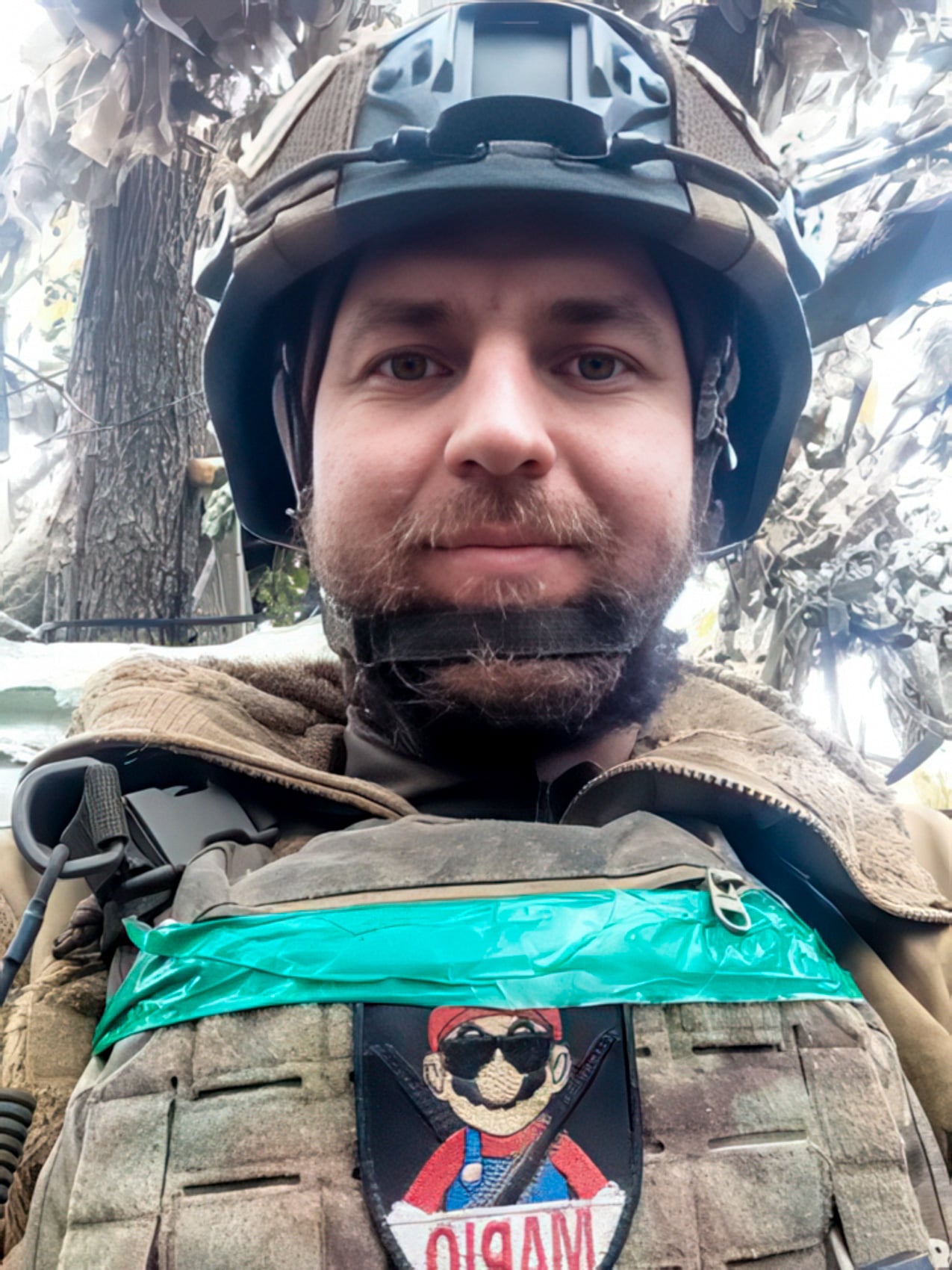
Photo credit: Yuriy Kokhan
This one was lined with what looked like fishing line — thin, glinting, unmistakable to anyone who’s spent time near the front. It was fiber-optic cable, the same material that trails behind the new generation of FPV drones as they fly toward their targets.
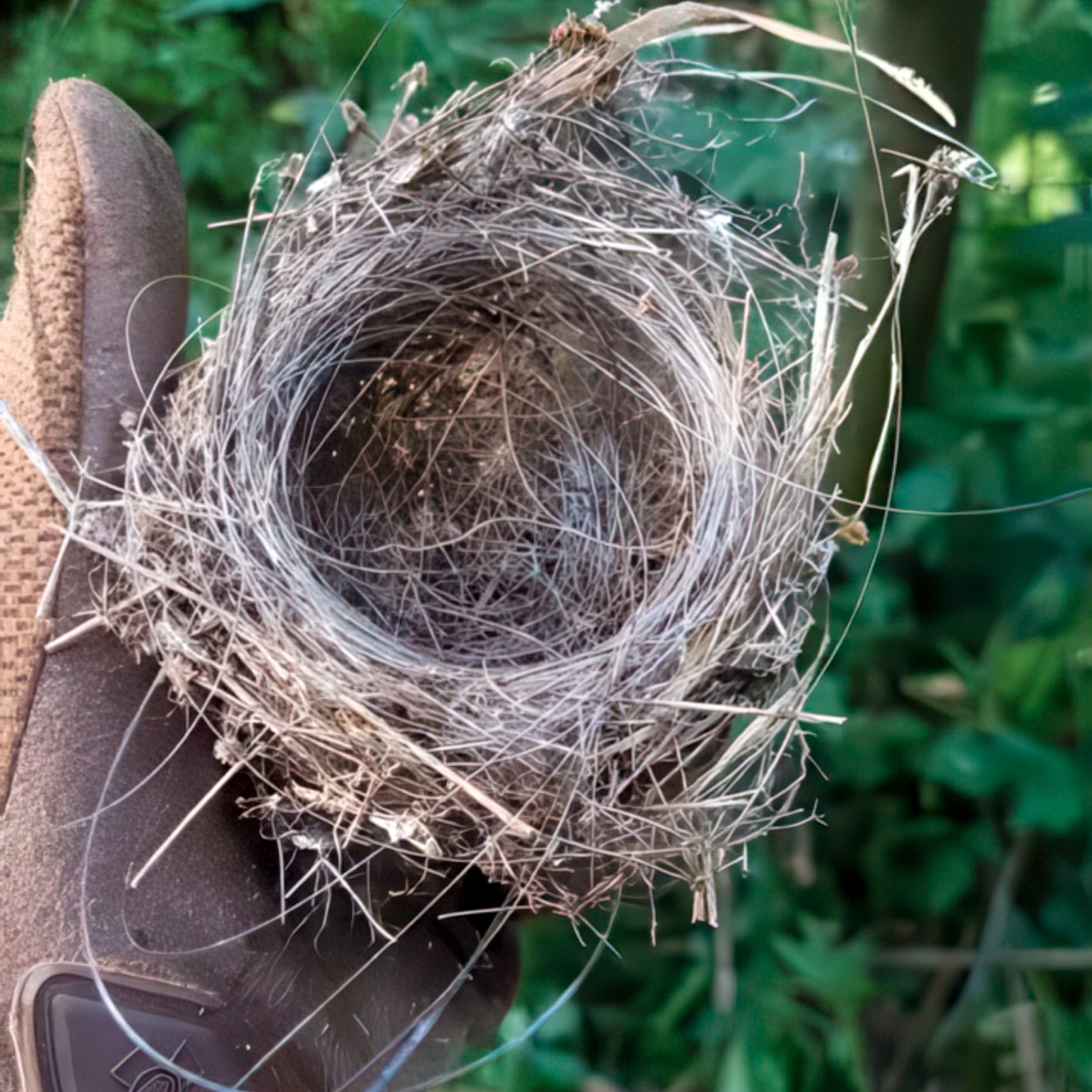
He held the nest in his left palm, making sure the insignia of the Ukrainian National Guard was visible on his glove, and took a photo. Then he put the nest back exactly where he’d found it. “It wasn’t mine to take,” he said.
From an engineering standpoint, he was impressed. “When I saw this nest, I was thinking from an engineering point of view, ‘That’s an interesting decision this bird has made,'” Kokhan said. “Nature was adapting to the war, using a mix of natural and unnatural materials.” He sent the photo to his brother-in-law, a fellow Azov fighter, who posted it to the Brigade’s Telegram channel and it was reported by The Times.
He had no idea the image was about to travel 2,000 miles.
The Cable That Won’t Wash Away
Fiber-optic FPV drones operate differently from everything else in Ukraine’s airspace. Instead of transmitting control signals and video via radio frequencies — which enemy electronic warfare systems can jam — these drones trail a physical cable from a spool as they fly.

Each spool holds between 3.1 and 12.4 miles (5 and 20 km) of line, sometimes up to 31 miles (50 km). The cable carries both the operator’s commands and a first-person video feed in real time, right until the moment of impact.
The result is a weapon that electronic warfare simply cannot touch. Ukrainian military estimates put drones at between 70 and 80 percent of casualties on both sides of the conflict.
The Russians introduced fiber-optic systems in early 2024; Ukraine followed quickly. Both sides now produce them at industrial scale, and both sides leave the same thing behind: mile after mile of thin, polymer-clad silica thread draped across fields, rooftops, and treetops.
Volodymyr Novak has watched this happen from both roles he occupies at the front. He’s 58 years old, an electronic warfare operator in the 63rd Separate Mechanized Brigade, and also a biologist and member of the Ukrainian Society for the Protection of Birds. He’s been trying to understand what this material means for the nesting season now underway.
“Last year’s nesting season was practically the first when FPV drones with fiber were widely used,” Novak said. “In this nesting season, when fields and forest remnants are covered with fiber, the probability of birds using it is quite high.
How exactly the fiber will affect birds, we will find out in a few years. There is a danger of chicks becoming entangled in it, which may lead to their death.”
It’s not just the cable. The anti-drone nets Ukraine has strung across roads and positions to catch incoming FPV drones have become traps of their own. Last summer, a young soldier named Ihor Shvachuk sent a photo to the bird protection society of himself freeing a light blue European roller from a net in Kherson.

He wrote that over several days he freed others — a magpie, a starling, a thrush, and two birds he couldn’t name. “We risked our lives to save them,” he wrote, “because it was dangerous there during the day, so everything had to be done very quickly.”
A Nest From Two Wars
Kokhan’s photograph found its way to Douglas Russell, 53, senior curator at the Natural History Museum in Tring, Hertfordshire. The Tring collection holds 5,000 historic bird’s nests and 300,000 clutches of eggs.
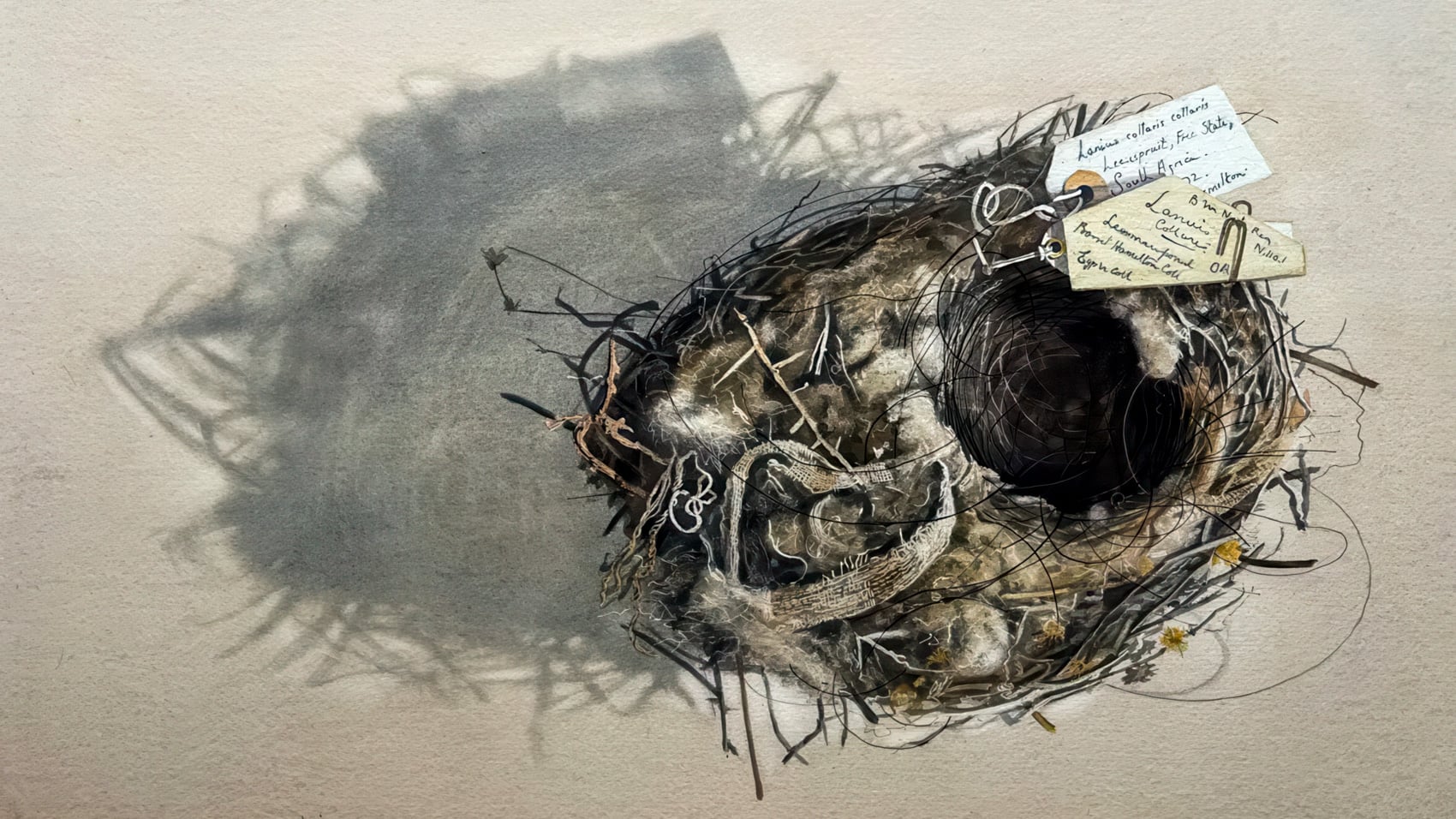
Russell had been collaborating with Lillias August, a 70-year-old Royal Institute watercolour painter from Suffolk, on a series of paintings depicting nests from the collection — nests showing how birds have always incorporated whatever material surrounds them, throughout human history.
The earliest painting in the series was a southern fiscal nest recovered during the Boer War in 1902, lined with horsehair and cloth — almost certainly scraps of battlefield bandages. When Russell saw the Ukrainian nest photo, he knew immediately where it belonged.
August has now painted it. The fiber-optic line forms a precise circle in the composition, then springs out at the top with what she describes as its own momentum. “Like the conflict, it seems out of control,” she said.
Russell’s reaction to the nest was starker than August’s. “Each of those fibers was designed with one purpose, to maim and kill,” he said. “You couldn’t ask for a more ironic contrast to a nest, which is purely about life.”
The first tranche of paintings, including the Ukrainian nest, was exhibited at a British Ornithologists’ Union conference in Nottingham. August and Russell hope to show the full series in London next year.
The nest’s journey didn’t stop there. After Kokhan’s photo went public on Telegram, it was copied and posted on a Russian TikTok account — with the Ukrainian National Guard insignia on his glove cropped out — and presented as the discovery of a Russian soldier. “One of the biggest problems we are facing is this cognitive war,” a spokesperson for the 1st Azov Corps said. “The enemy is trying to rewrite the history of the war.”
What Mario Lost
In October, Kokhan was undertaking infantry duties south of Toretsk. He and his unit were leaving a position when an artillery shell landed close enough. Shrapnel took his left arm.
The arm he was photographed holding the nest.
He’s recovering in a hospital in western Ukraine. He’s right-handed, so he’s been learning to use a specially adapted gaming mouse — he hopes, eventually, to return to work as a civil engineer. He wants to start a family with his wife. When the war is over, he wants to go home to Kharkiv.
When told about August’s painting and the exhibition in Nottingham, he said he felt genuinely moved. “It shows that people want to know the original source and the real story,” he said. “It is also very cool that you want to pay attention to our smallest citizens, our birds.”
He offered a morbid joke about his photo. “From that photo, there is nothing left — no nest and no hand.”
And then he explained what the nest had meant to him in the first place. He thought about the people in front-line villages who refuse to evacuate — who choose to stay in their homes despite everything. “It’s like the bird and the nest,” he said. “It’s their home, and they gave all their force to build it.”
DroneXL’s Take
Here’s what I actually think: this story belongs to Yuriy Kokhan, not to the technology.
The fiber-optic drone is one of the most consequential military innovations of this conflict. It’s unjammable, it’s lethal, and it’s already being studied by every military on the planet. Its environmental footprint — miles of polymer cable blanketing Ukrainian forests and fields — will outlast the war by centuries. All of that matters, and DroneXL will keep covering it.
But the nest, and the hand that held it, and the arm that’s no longer there — that’s the part that stays with you. A civil engineer from Kharkiv, callsign Mario, stopping in the middle of a clearance mission to appreciate what a bird had figured out. Putting the nest back because it wasn’t his to take.
The drone industry builds systems to win wars. The engineers working on fiber-optic FPV platforms did exactly what they were asked to do. Nobody designed the nest. Nobody planned for a biologist in the 63rd Brigade to spend his off-hours worrying about chicks tangled in polymer thread. That’s not how these things get thought through. Maybe it should be.
Kokhan is learning to use a mouse with his right hand. A painter in Suffolk is finishing a watercolor. And somewhere near Toretsk, birds are building nests again this spring.
Photo credit: Yuriy Kokhan
Discover more from DroneXL.co
Subscribe to get the latest posts sent to your email.
Check out our Classic Line of T-Shirts, Polos, Hoodies and more in our new store today!

MAKE YOUR VOICE HEARD
Proposed legislation threatens your ability to use drones for fun, work, and safety. The Drone Advocacy Alliance is fighting to ensure your voice is heard in these critical policy discussions.Join us and tell your elected officials to protect your right to fly.

Get your Part 107 Certificate
Pass the Part 107 test and take to the skies with the Pilot Institute. We have helped thousands of people become airplane and commercial drone pilots. Our courses are designed by industry experts to help you pass FAA tests and achieve your dreams.

Copyright © DroneXL.co 2026. All rights reserved. The content, images, and intellectual property on this website are protected by copyright law. Reproduction or distribution of any material without prior written permission from DroneXL.co is strictly prohibited. For permissions and inquiries, please contact us first. DroneXL.co is a proud partner of the Drone Advocacy Alliance. Be sure to check out DroneXL's sister site, EVXL.co, for all the latest news on electric vehicles.
FTC: DroneXL.co is an Amazon Associate and uses affiliate links that can generate income from qualifying purchases. We do not sell, share, rent out, or spam your email.