
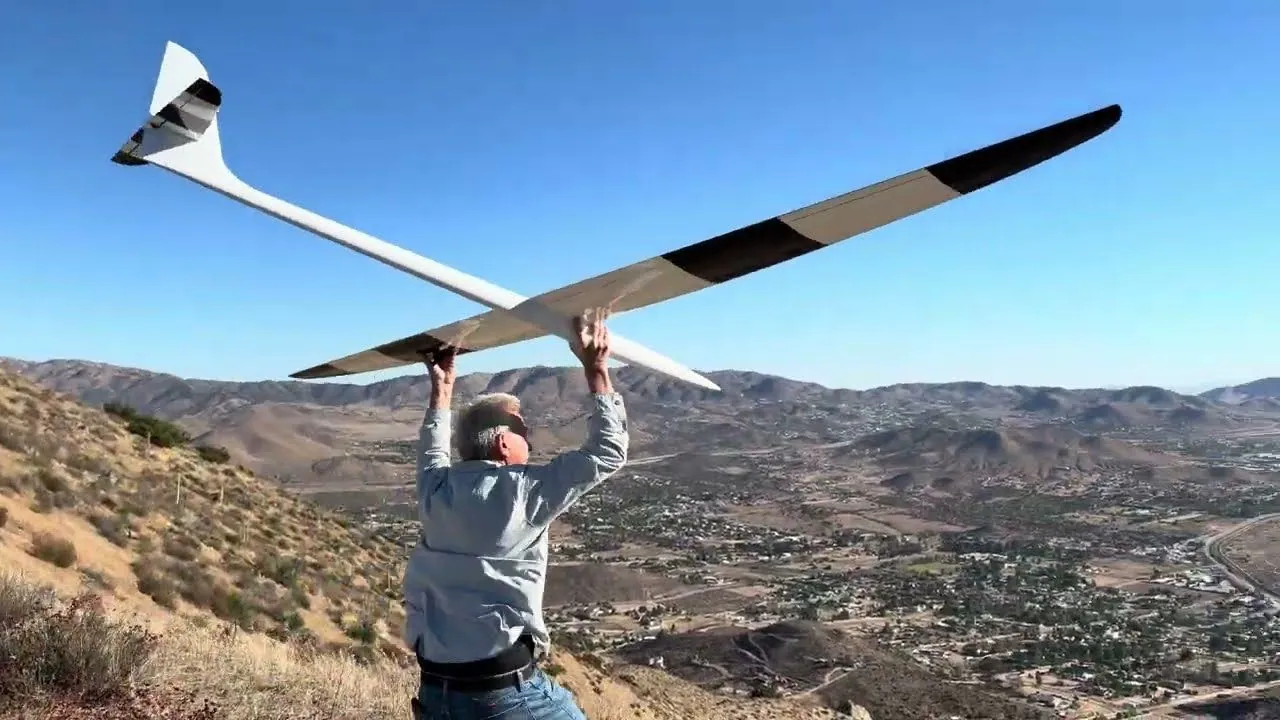
Joe Manor’s Endgame 130, a radio-controlled glider with a 130-inch (3.3-meter) wingspan, hit 474 mph (763 km/h) on the speed readout over Parker Mountain near Acton, California, on October 16. At the end of that flight he flew it into the hillside. Manor posted the run and the wreckage the next day on his Manorcraft YouTube channel, where the video has passed 60,000 views.
The Endgame 130 was the first airframe out of a new set of molds, and it had no engine and no propeller. The fastest jet-powered RC model on record, Niels Herbrich’s turbine-powered Inferno, was clocked at 465 mph (749 km/h).
Dynamic Soaring Pulls Glider Speed Out Of A Ridge’s Wind Shear
A glider with no engine reaches 474 mph through dynamic soaring. Wind pouring over a ridge leaves slower air on the downwind side, and the pilot flies tight loops across the boundary between the two layers. Each crossing adds energy, so the glider accelerates far past the wind’s speed.
RC pilots found it by accident, at the same hill Manor crashed on. The Royal Aeronautical Society’s history of the discipline credits glider pilot Joe Wurts, whose foam model strayed into the lee of Parker Mountain in the 1990s, dived, and came back much faster than it should have. Albatrosses use the same physics over the ocean, and it is the trick a startup called Alteon raised $2.5 million to build a year-long drone around in September.
The loads explain why these airframes look the way they do. Between 1998 and 2003, model gliders reached 150 to 250 mph and often broke apart from wing bending and flutter. Spencer Lisenby measured 120 g on one of his gliders, the limit of the sensor he carried.
The Unpowered Record Has Climbed To 567 MPH Since 2021
Bruce Tebo holds the dynamic soaring record at 567 mph (912 km/h), flown at Bird Spring Pass, California, in April 2026. Spencer Lisenby set the two marks before it, 548 mph at Parker Mountain in January 2021 and 564 mph at Bird Spring Pass in February 2023.
Manor was at the same April session. The post announcing Tebo’s run, from DS pilot Steven Welsh and relayed to an Albuquerque soaring list, lists Manor’s Endgame at 534 mph (859 km/h) that day and pilot Jason Lilly at an even 500. Lilly posted video of the 567 mph run. So the 474 mph crash was a shakedown flight on a new airframe, not a record attempt.
Every one of these numbers is unofficial. They come from a handheld radar gun on the ridge, because GPS loses its satellite lock at around 4 g, and pilots usually take the reading on the slower upwind leg of the loop. The readout in Manor’s video shows bare numbers, and his earlier video titles give his speeds in mph. Lisenby told the RC Soaring Digest that measuring his 564 mph run on the down leg would have shown a ground speed over 600 mph, putting the peak near Mach 0.84.
Manor Flies Each New Glider Until It Shows Him A Weakness
Manor flies the first airframe from every new set of molds to check its balance point, wing bending, tail boom flex and flutter before building more. The crashed 130 needs extra spar cap so its wings bend less. The first Endgame 100, a 100-inch model, needs no changes.
Manor expects his next test to break a glider too. He built an ultralight Endgame 180 to see what a light layup could do, decided he no longer needs it, and added tip weight so he can fly it faster. “It’s probably going to fail somewhere in the mid 500s,” he says in the October 17 video. His channel says he is setting out to break the sound barrier with an unpowered RC glider.
That rules him out of Boom Supersonic’s Boom Prize, which offers $750,000 in cash and $50,000 in Boom stock for the first amateur supersonic RC airplane. The prize names his discipline in its official rules: gliders and soaring aircraft, “including dynamic-soaring designs, are not eligible.” The transonic acceleration must also be flown level or climbing, so a run that gains speed by descending is disqualified.
DroneXL’s Take
The fastest remotely piloted aircraft in the hobby have no motor, and the drone speed race should measure itself against them. Luke Bell’s Peregreen V4 holds the Guinness quadcopter record at 408.6 mph. The Mach Initiative students are building KingChaser to beat Herbrich’s 465 mph jet record. The glider numbers come off a radar gun rather than a certified course, but even read on the slow leg of the loop, Tebo’s 567 sits about 100 mph above that jet record. Boom wrote dynamic soaring out of its prize by name. I read that as a compliment, because a jet company writing a prize for propulsion had to shut the door on the people already flying near Mach 0.8 on nothing but wind.
Sources: Manorcraft, “High Speed Flight Testing Crash” (YouTube), RC Soaring Digest, Royal Aeronautical Society, Boom Prize rules, Jason Lilly (YouTube)
DroneXL uses automated tools to support research and source retrieval. All reporting and editorial perspectives are by Haye Kesteloo. Read our editorial standards.


