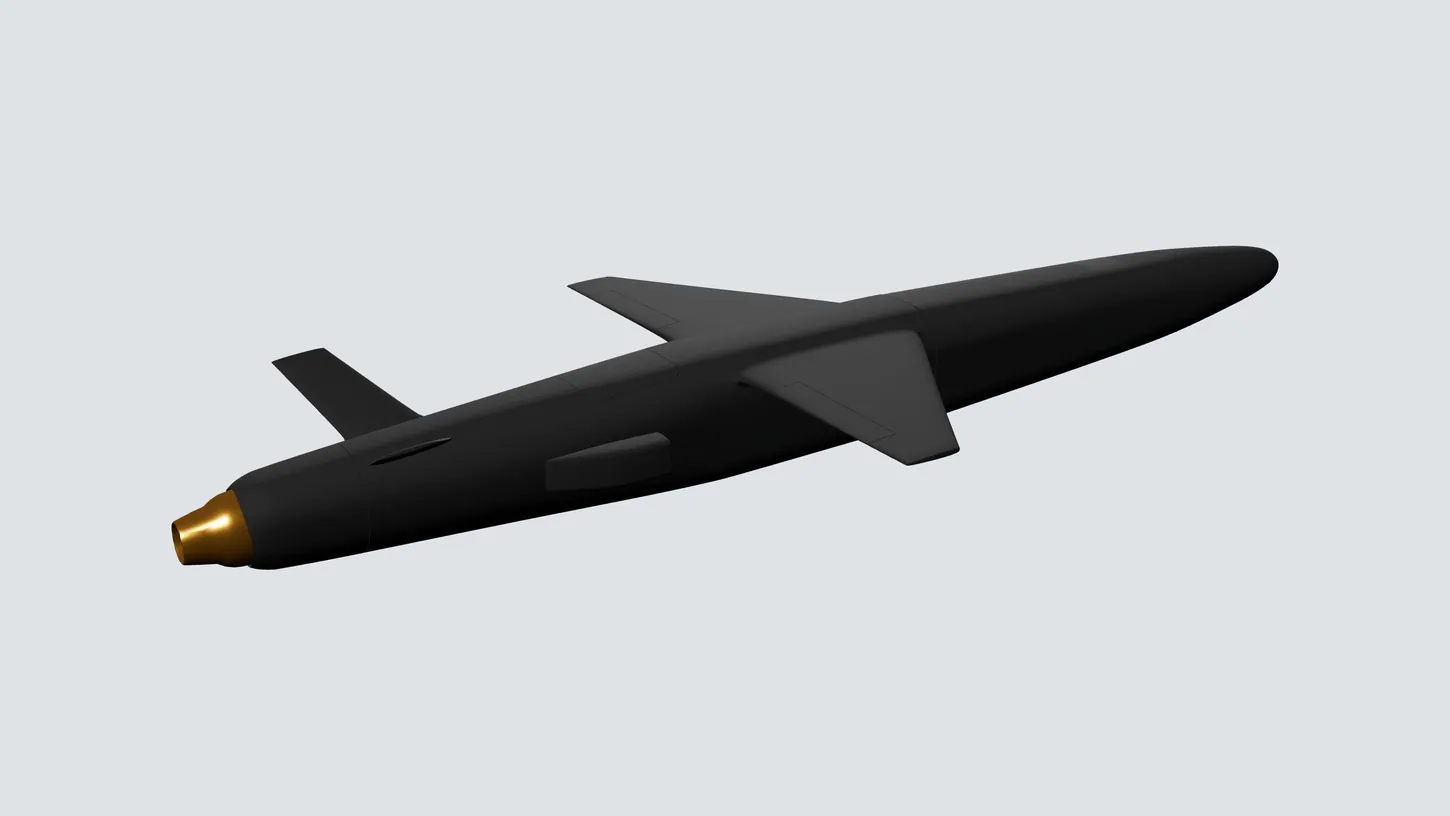
Ukraine’s military intelligence agency HUR published a teardown on November 9 of the Geran-5 K5-K, a shorter and faster version of Russia’s jet-powered attack drone, and counted 93 foreign-made electronic parts inside it. Fifty-two came from US manufacturers, and 23 of those were made by Texas Instruments.
Russia started firing the K5-K at Ukrainian cities in early autumn, according to HUR. The agency examined one that came down almost intact in a field, and it now files the weapon as a small cruise missile rather than a drone.
HUR’s page for the original Geran-5, the version DroneXL first reported on in January, lists 16 foreign parts.
The Geran-5 K5-K Is 8 Feet Shorter and Climbs 3,300 Feet Higher
The K5-K is 13.1 feet (4 meters) long, against 21.3 feet (6.5 meters) for the original Geran-5, and its wingspan shrank from 10.5 to 9.8 feet. HUR lists a ceiling of 19,700 feet (6 km), up from 16,400 feet, and a cruise speed above 280 mph (450 km/h).
HUR’s statement on the teardown adds that the K5-K can reach 620 mph (1,000 km/h) during some maneuvers. That figure was carried by RBC-Ukraine and UNITED24 Media, but it does not appear in the specification table on HUR’s own portal. Range is unchanged at about 620 miles (1,000 km), and the warhead still weighs 198 pounds (90 kg). The airframe HUR examined carried a TBBCh-90 thermobaric warhead.
HUR lists a TRD-200 turbojet as the engine, assembled at Russia’s Alabuga plant in Tatarstan, the same site where teenagers build Shaheds, from Chinese components. The original Geran-5 flew on an imported Telefly TF-TJ2000A. HUR deputy chief Vadym Skibitsky put the price of each Chinese turbojet at $35,000 to $40,000 in August, Militarnyi reported.
Texas Instruments Made 23 of the 93 Foreign Parts in the K5-K
The parts list on HUR’s War&Sanctions portal names 52 components made by US companies. The rest are 10 Chinese, 10 Swiss, three Japanese, two British and one German, with 15 unidentified. Texas Instruments alone made 23, including voltage regulators, CAN bus transceivers and two digital signal processors.
Analog Devices follows with six, counting a Maxim Integrated transceiver, then Vishay with four and onsemi and CTS Corporation with three each. The Swiss column is seven microcontrollers and a voltage regulator from STMicroelectronics, which HUR files under Switzerland because the company is headquartered in Geneva, plus two u-blox satellite navigation modules.
HUR says Russia keeps trying to remove the markings from imported parts, and it names Texas Instruments signal processors and Murata inertial modules. Both TI processors appear on the portal as “DSP” with no part number, and the Murata module has none either. The first Geran-5 taken apart in January held six Texas Instruments chips and CTS clock oscillators built in 2024 and 2025. The three CTS oscillators in the K5-K are newer still: their markings read 2517, 2539 and 2603, which as year-and-week date codes put them between April 2025 and January 2026.
Texas Instruments told Bloomberg in December 2023 that it stopped selling into Russia in 2022, and that because its chips can last decades, some found there may have been in inventory before sanctions. TI vice president Shannon Thompson told a Senate subcommittee in September 2024 that the company works to prevent the illicit diversion of its parts into Russia. Western parts have reached Russia through resellers in third countries before, the route that put German parts in Gerans and that a GRU officer ran out of Tokyo.
A Chinese Raspberry Pi Clone Steers the K5-K by Matching Photos
The K5-K checks its route with Susanin, an optical-electronic correlation system HUR first found in the Geran-4. It compares pictures from an onboard camera with reference images stored on a microcomputer, and in this airframe that computer is a Chinese Coke Pi in a labeled plastic case.
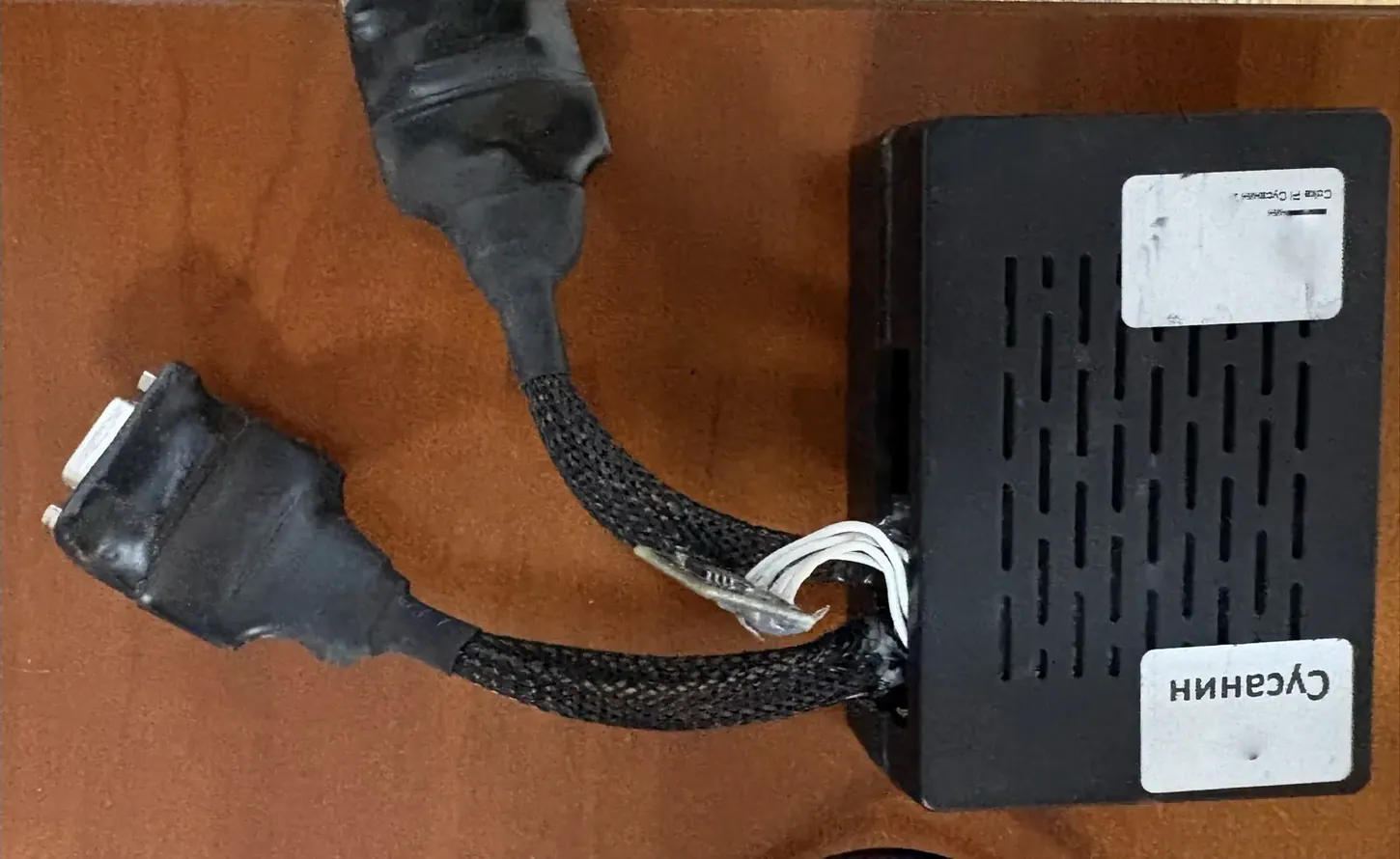
The camera is dual-band rather than a plain optical sensor, and HUR could not identify its maker. The parts list also carries a genuine Raspberry Pi 4 Model B, filed under Britain. HUR found a similar Coke Pi unit, labeled “Sosiska,” in the Gerbera-2 drone it published on November 2, where it detects and tracks interceptor drones.
The rest of the avionics match the latest Geran-4 Seeker: a flight controller, a SADRA Seeker inertial navigation system with a DISMAG magnetic compass module, a tracker, a mesh modem and a Russian copy of the 16-element Harxon GI-006 anti-jamming antenna. HUR’s breakdown of the original Geran-5 shows no image-matching unit: it navigated with a Kometa-M12 satellite receiver and a MINSOO inertial unit. Jamming satellite navigation is one of Ukraine’s standard defenses against Shaheds, and matching photos needs no satellite signal.
Russia Builds 4,000 Jet Gerans a Month as Ukraine Stops 76% in One Raid
Russia builds about 4,000 Geran-4 and Geran-5 jet drones a month, up from about 3,000 in August and twice its output of propeller Geran-2s, HUR told NV in October, while Ukraine’s Air Force says it shot down or suppressed 59 of 77 jet drones in one October attack.
The production figure comes from Militarnyi’s report on HUR’s interview. Air Force spokesperson Yurii Ihnat said that attack lifted the jet-drone rate to 76%, from about 60% the month before, Odessa Journal reported. Interceptor drones are closing the gap. The upgraded ZIRKA brought down a Geran-5 at about 250 mph (400 km/h) and 11,500 feet (3,500 meters), Militarnyi reported on November 1, after the SBU released the first video of a jet Shahed kill in September. Ukraine’s Brave1 cluster is also paying companies to build drone-fired air-to-air missiles.
On October 29 a jet-powered drone got through and hit a platform at a railway station in Dnipro where a train to Zaporizhzhia was waiting, killing 14, according to regional officials and Ukrainian Railways, Ukrainska Pravda reported. Neither said which Geran variant it was.
DroneXL’s Take
The old-stock explanation that Texas Instruments offered in 2023, chips bought before sanctions and still sitting in Russian warehouses, gets harder to apply with every teardown. The CTS oscillators in this K5-K were made as recently as January, so at least part of the Western supply feeding Alabuga is new production.
I don’t think TI or CTS are selling to Russia, and nothing on HUR’s list says they are. My read is that export controls on commodity electronics fail at the distributor and reseller level. A voltage regulator that ships by the million passes through enough hands that the maker loses sight of it long before it reaches a Russian assembly line, which is how the German parts and the Tokyo pipeline worked too.
In September I argued that sanctions aim at the wrong end of the Geran, at the Western parts instead of the Chinese engine. The K5-K shows the Western end still leaking with new parts, and Washington should put at least as much pressure on the distributors that move these reels as on the chipmakers whose logos HUR photographs.
Sources: HUR War&Sanctions portal, UNITED24 Media, RBC-Ukraine, Militarnyi, Odessa Journal, Ukrainska Pravda, Bloomberg
DroneXL uses automated tools to support research and source retrieval. All reporting and editorial perspectives are by Haye Kesteloo. Read our editorial standards.