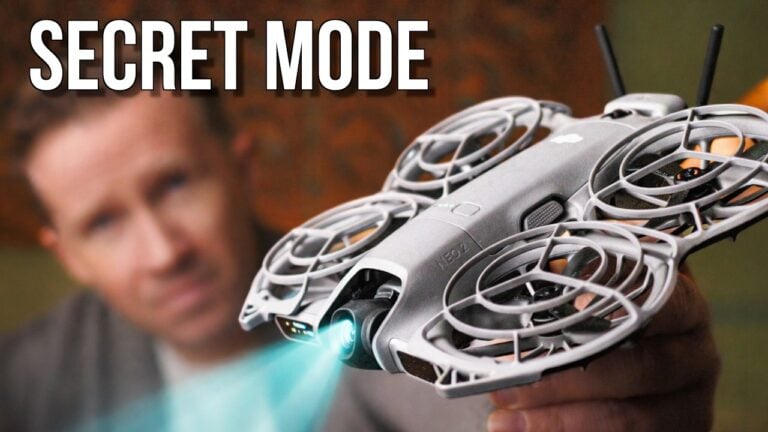
DJI Neo 2 Gauntlet Test: From Tight Trails To Abandoned Resorts At 48 km/h

Check out the Best Deals on Amazon for DJI Drones today!
I put the DJI Neo 2 through an absolute gauntlet, and the results genuinely surprised me. We’re talking tight forest trails, cliffsides, high-speed road descents pushing 48 km/h, and an abandoned resort run all the way down to the ocean. This is the kind of testing that breaks drones, and that’s exactly the point.
Here’s what you need to know:
- What: Multi-stage active tracking gauntlet testing the Neo 2’s limits
- Speed tested: Up to 48 km/h (30 mph) on road descents
- Key finding: Tracking solid to 43 km/h, struggles beyond, but smartly reacquires when you slow down
- Limitation discovered: Moving orbit requires a controller, not available with gestures or phone

The Gauntlet Structure
I designed this test with multiple stages specifically to push different aspects of the Neo 2’s tracking capabilities. The gauntlet starts with a slightly downhill section to the ocean, perfect for demonstrating the different positioning modes. From there, we dive into tight trails with increasingly challenging obstacles. If the drone survives that, it’s time for high-speed testing on paved roads. The final challenge? An abandoned resort descent all the way to the sea.

The beauty of testing the Neo 2 this way is that you don’t need anything other than the drone itself. No controller, no phone as a control device. I had the phone mounted purely as a preview screen so you could see what the drone sees. The tracking happens entirely through the drone’s onboard intelligence.

Gesture Control Changes Everything
The gesture control system on the Neo 2 is genuinely impressive. Mid-ride, I can simply raise my hand, and the blue light confirms the drone sees me. From there, I can tell it where to position: go up, move left, swing around to the front. When I’m done adjusting, I make a fist and we’re back to tracking.
I will say the whole gesture bit always amazes me. The engineering and effort DJI has put into avoiding the need for a beacon or remote control is mildly insane. But it works. Being able to reposition the drone from behind me to in front of me without stopping, without pulling out a phone, without touching anything other than waving my hand is super cool.

Trail Performance: The Obstacle Avoidance Philosophy
One critical thing to understand about the Neo 2 compared to something like the Hover Air drones is the fundamental difference in tracking philosophy. The Neo 2 does obstacle avoidance, which is both good and bad. The Hover Air drones follow your exact track and try to do that super, super well, assuming that if you can make it through, they can make it through.
The Neo 2’s approach means it won’t blindly follow you into a tree. But it also means it sometimes takes wider paths or gets confused when you thread through gaps it deems too risky. Through the tree tunnel sections running at about 20 km/h, the Neo 2’s omnidirectional obstacle avoidance kicked in repeatedly, dipping below branches, going around obstacles. Kudos to DJI on that.
When tracking from the front gets tricky, DJI drones are designed to fall back behind you. The Neo 2 executed this perfectly multiple times. It would briefly lose the front tracking angle, automatically reposition to rear follow, then find its way back to the front once clearance improved.

The Speed Test: 43 km/h Is The Real Ceiling
DJI claims the Neo 2 can follow at 43 km/h (27 mph). I tested this on a road descent, and here’s what actually happens:
At 25 km/h, no problems. At 30 km/h, still solid. At 35-40 km/h, tracking was holding reasonably well. But as I pushed through 40, 42, 43, 44, 45 km/h, it started to pull back. At 47-48 km/h, the drone was totally gone behind me.

But here’s what impressed me: when I slowed down, it caught back up. The tracking algorithm is smart enough to reacquire you once speeds drop back into range. If I had maintained a consistent speed just under 43 km/h, it would have been fine. This is a massive improvement over the original Neo, which topped out around 22-28 km/h depending on conditions.
| Speed | Tracking Performance |
|---|---|
| 20-30 km/h (12-19 mph) | Solid tracking, no issues |
| 35-40 km/h (22-25 mph) | Good tracking, occasional lag |
| 43 km/h (27 mph) | At the limit, starts falling behind |
| 47-48 km/h (29-30 mph) | Loses tracking completely |
| Slowdown recovery | Catches up and reacquires |
The Moving Orbit Disappointment
I have to be honest about one disappointment. You cannot do a moving orbit with the Neo 2 using just gestures or your phone. You need the controller for that feature. Without the controller, you’re limited to a single stationary circle.
I had planned to do a cool cliffside orbit shot while moving along the trail. The drone started its orbit painfully slowly, then just stopped. For the dynamic orbit shots I wanted, this was a bummer. Something to keep in mind if moving orbits are important to your workflow. You’ll need to invest in a compatible controller like the RC-N3 to unlock that capability.
Designed To Crash: The Durability Reality
The Neo 2 crashed multiple times during this test. Into trees. Into bushes. Into concrete at the abandoned resort. And here’s the thing: this drone is designed to crash.
This is the critical difference between the Neo 2 and something like a Mini 5 or Mavic. Those drones are not designed for repeated impacts. The Neo 2 absolutely is. I’ve tested the original Neo, the Hover X1, and now the Neo 2 in these active track environments. I’m estimating 200 to 250 crashes across my Hover X1 testing alone. Almost every run ends in some sort of crash. And that’s totally fine. That’s what these caged drones are designed for.
I threw the Neo 2 back in the air repeatedly after crashes, and it kept working without issue. Some concrete marks on the shell, but functionally perfect. Over and over again, I can do this without any problems at all.

Pocket Fit For Cyclists And Runners
For those of you wondering about portability, the Neo 2 fits in a cycling jersey back pocket with zero problems. Takes about 2 seconds to stow. If you have cargo bibs, it slides right into that cargo pocket too.
The little antenna pod on the back pops off with a couple of screws. You only need it if you’re flying with a remote control, so if you’re running autonomous tracking only, take it off and it’ll simplify getting the drone into your pockets.
Even for running, I had zero problems fitting it into generic running shorts. Nothing fancy about the shorts, no special pockets. And weight-wise, it’s actually lighter than a GoPro. Weight isn’t an issue in the running shorts or the jersey pocket.
The Abandoned Resort Challenge
The final test pushed the Neo 2 into truly challenging territory: an abandoned resort running all the way down to the ocean. Tight bushes, random obstacles, structural elements, and eventually attempting to follow me through doorways.
When I had to hike my bike around a downed tree, the drone surprised me. I expected it to give up. Instead, it figured out a path around, over, and through. High five moment right there.
The real test came when I tried to lead it through building doorways. The drone recognized the gap was too tight and descended rather than attempting to squeeze through. Smart behavior, though it did trigger the collision detection and auto-land sequence when I tried to manually bump it through a particularly tight spot.
Going through one wider doorway? No problem. Following me under low-hanging structures? Nailed it. The tracking intelligence knew when to push through and when to back off.

What Cyclists And Runners Should Know
If you’re specifically looking at the Neo 2 for cycling or running content, here’s the practical reality:
For cycling, the 43 km/h tracking limit works for most recreational riding. Road cyclists pushing hard on descents will outrun it. Mountain bikers on technical terrain will find the obstacle avoidance helpful but occasionally conservative. The 8-direction tracking repositioning means you can get creative shots without stopping.
For running, you’ll never outpace this drone. Trail runners will appreciate the obstacle avoidance, though tight switchbacks can confuse it momentarily. The gesture controls are genuinely useful when you need to reposition mid-run.
For both activities, the durability factor is huge. Crashes happen. With the Neo 2, that’s a minor inconvenience rather than an expensive repair.

The Bottom Line
The DJI Neo 2 handled my gauntlet impressively. Multiple crashes, challenging environments, high speeds, and tricky tracking scenarios. It kept coming back for more. The gesture controls are genuinely useful for repositioning without stopping. The durability is exactly what you need for active sports. And the tracking intelligence, while not perfect, is smart enough to reacquire you after temporary losses.
The 43 km/h speed ceiling is real, not marketing fiction. The moving orbit limitation without a controller is disappointing. But for the core use case of following cyclists and runners through varied terrain, the Neo 2 delivers.
If you want to see how well this performs in 50 km/h winds, including out over the cliffs, I’ve got that video coming too. And stay tuned for more drone testing, including the anti-gravity drone from Insta360 and the Hover Aqua for aquatic adventures.
Check out Ray’s video above and subscribe to DC Rainmaker on YouTube for more sports tech and drone testing.
Discover more from DroneXL.co
Subscribe to get the latest posts sent to your email.
Check out our Classic Line of T-Shirts, Polos, Hoodies and more in our new store today!

MAKE YOUR VOICE HEARD
Proposed legislation threatens your ability to use drones for fun, work, and safety. The Drone Advocacy Alliance is fighting to ensure your voice is heard in these critical policy discussions.Join us and tell your elected officials to protect your right to fly.

Get your Part 107 Certificate
Pass the Part 107 test and take to the skies with the Pilot Institute. We have helped thousands of people become airplane and commercial drone pilots. Our courses are designed by industry experts to help you pass FAA tests and achieve your dreams.

Copyright © DroneXL.co 2026. All rights reserved. The content, images, and intellectual property on this website are protected by copyright law. Reproduction or distribution of any material without prior written permission from DroneXL.co is strictly prohibited. For permissions and inquiries, please contact us first. DroneXL.co is a proud partner of the Drone Advocacy Alliance. Be sure to check out DroneXL's sister site, EVXL.co, for all the latest news on electric vehicles.
FTC: DroneXL.co is an Amazon Associate and uses affiliate links that can generate income from qualifying purchases. We do not sell, share, rent out, or spam your email.