The 3 Biggest Fears Every Drone Pilot Has (And How to Overcome Them)

Check out the Best Deals on Amazon for DJI Drones today!
I got a question for you. Why haven’t you flown that drone yet? You just purchased one for yourself for the holidays, but it’s still sitting in the box. What’s holding you back? Why haven’t you launched it into the air and started having fun with it? I’ll tell you why. Because you’re terrified to launch it up into the air because there are so many things that could go wrong and you’re just not ready to fly it yet.
What I want to do with this article is help you get over that initial anxiety. The first few flights when you get a drone are really stressful because if you’ve never flown before, there’s so much to know. There are so many things that could possibly go wrong. You have so many questions. So, I want to give you some tips that I wish I had known when I first started flying a drone — some things that people don’t talk about very much: the anxiety that comes with flying a drone for the very first few times.
I have three things today that I want to talk about that hopefully will help relieve some of that stress and anxiety so you can get that drone out of the box, get it activated, get it up in the air, and start having fun with it.
Evaluate what’s actually causing your stress
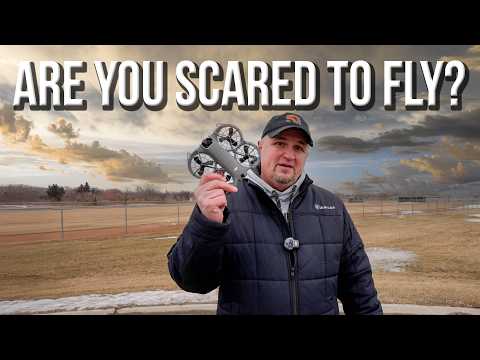
The very first thing that needs to happen before you can overcome your fear of flying that drone for the first few times is to evaluate what is actually causing all of that stress. What are you most concerned about? Is it crashing the drone into something? Is it hitting a manned aircraft or an aircraft hitting you? Or maybe it’s the fear of being judged by people around you as you fly.
There are many things that can contribute to first flight anxiety, but in my experience, the number one factor that prevents new pilots from enjoying their drone is the fear of the unknown. So many things can happen and the human mind is just wired to fear what it doesn’t fully understand. It becomes a collection of what-ifs that stops people from even taking the drone out of the box or out of their case and launching it for the first time.
For a lot of people, that fear centers around crashing the drone — whether it be losing control, experiencing a flyaway, or something like that. Drones are expensive. That’s a lot of money up in the air. And when you’ve just spent that much money on something, the idea of destroying it in seconds can be pretty overwhelming. Then you start thinking about the horror stories that you’ve seen online and suddenly it feels like a disaster just waiting to happen.
Modern drones are smarter than you think
What’s important to understand is that modern drones are incredibly intelligent compared to what they used to be. The technology has advanced in ways that make flying safer and more predictable than ever. Strong GPS, return to home, low battery failsafes, obstacle avoidance is becoming amazing, and multiple redundant systems are all working in the background to help keep you out of trouble.
That doesn’t mean that crashes never happen, but most crashes happen when pilots push themselves too fast or they fly in environments or conditions that they aren’t ready for yet.

Start slow and fly in wide open spaces
The best thing that you can do early on, at least in my opinion, is to keep things slow and simple. Fly in wide open areas with no trees, no power lines, no fences, no buildings, no nothing. When I get a new drone, I always bring it out to an open area to fly it for the first time because there are no obstacles. And yes, I’ve been flying for a long time, but I still like to try new drones I’ve never flown before in a nice wide open space.
Find a space like that for yourselves — a baseball field, soccer field, football field, a park with a wide open meadow, or even drive out in the country, park on the side of the road, and fly it over a field. Find that space where there are no obstacles and that will basically eliminate any stress you have about hitting something like a tree or a power line.
Practice your stick movements one at a time
After you’ve worked up enough courage to get that drone up in the air, here’s what you need to do. You need to try different moves with the drone, but only using one stick at a time. Don’t combine your stick movements. Try the up and down. Try the yaw, which is the rotation. Work on your left stick first — get used to moving the drone in rotation and up and down. Then move over to the right stick and start going laterally, left and right, forwards and backwards.
Once you’re comfortable with how the drone reacts to your inputs, then you can start gradually combining both sticks. Maybe go down and forward at the same time. Or up and backwards, sideways and down — simple combinations to get used to how the drone moves when you’re controlling the sticks.
Your goal during those first few flights is not to get cinematic footage. It’s not to explore. Your goal is to build trust. Trust in the drone, trust in the technology, and eventually trust in yourself.
Master the reversed controls
I’ve said this many times before in other videos over the past eight years, but one of the most difficult things to get used to is when you’re flying a drone and it’s facing you. How you move the sticks — the movement of the drone is going to be the opposite. I recommend practicing that 20 times or more. Every day, practice. Have the drone face you, then use your right stick, move it to the right, and it’s going to go to your left. Move your stick to the left, and it’s going to go to the right.
Practice that so much because when you’re flying the drone and it’s coming back towards you, you have to remember that your controls are going to be reversed. It’s one of the hardest things to get used to when you first start flying a drone.
As for flyaways, they are far less common than people think, and they’re usually tied to skipping pre-flight checks or flying in poor conditions — most of the time, wind. It’s very common where people take off without enough satellites locked on, or they ignore the warnings that pop up on the screen, or they panic when the drone doesn’t behave exactly how they expect it to. Experience replaces panic and repetition builds confidence. So get out there, fly your drone a little bit at a time, and each time you go, it gets a little bit easier.
The fear of hitting manned aircraft
Another big fear for new pilots is the idea of hitting a manned aircraft or an aircraft hitting you. This is a fear that should be taken seriously, but it isn’t one that should paralyze you. If you’re following the rules — you stay under 400 feet, you maintain visual line of sight, and you avoid restricted areas — the chances of a close encounter are extremely low.
Over time, something interesting happens. You won’t believe it, but eventually, you’re going to become more aware of your surroundings without even thinking about it. You recognize aircraft sounds. You instinctively descend when you hear something nearby. That spike of anxiety that you feel early on slowly disappears and gets replaced with calm, responsible decision-making.
I think the fear of hitting a manned aircraft is absolutely the number one fear of all new drone pilots, even experienced drone pilots, because it’s terrifying. When I first started flying drones, if I had my drone up in the air at all — like, if it was hovering at eye level and I heard an airplane — I would lose my mind. My thumbs would start shaking. I would literally go into full panic mode and just put the drone down, which is good. That’s what you’re supposed to do. But I would do that when I would hear a helicopter that was so far away you couldn’t even see it.
Trust me, that’s going to happen to you. You’re going to be flying your drone and you’re going to hear an aircraft, and you’re going to freak out. Don’t freak out. Here’s what I’m going to tell you: the more you fly, the more you start getting into those situations where you’re hearing an aircraft, it gets better. Over time, it gradually decreases where you don’t go into panic mode — you go into responsible mode.
Now, eight years later, when I hear an aircraft and I have my drone up in the sky, I check where it’s at, I check its heading, and I make sure it’s far enough away. Even if it is, I still lower my drone slowly. I’m always below 400 feet, but if I’m at 400 and an airplane is taking off at the airport, I still get nervous. But just know that that feeling goes away. The more you fly, you get used to it and you start to recognize the sounds and where aircraft are going to be, especially if you fly in the same place all the time.
Dealing with the fear of what other people think
Finally, there’s a fear that a lot of people don’t talk about enough, and that’s the fear of what other people think. Flying a drone can make you feel exposed. You worry about being judged or questioned or even confronted. You worry that people think you’re doing something wrong even when you aren’t.
Here’s what I want to say about flying around people and having that anxiety: the more you do it, just like the other two things, the easier it gets. But here’s the thing about onlookers and people that are worried about what you’re doing. The most important thing by far that you can do is be confident when you’re flying. Because if you look like you’re nervous or unsure of yourself, that’s what’s going to put people on edge. People are going to be really cautious of you if they look at you and you look like you’re hiding and you look like you don’t know what you’re doing.
Even if you don’t know what you’re doing, try to look like you know what you’re doing. That will take away the uncertainty on spectators’ minds. They’ll be like, “Oh, that guy’s flying a drone. That’s pretty cool. He’s doing a good job.” And who knows, they might come visit with you, learn about the drone. You can teach them. You can be a good advocate for the hobby. You might make a friend. You might bring someone new into the hobby.
No matter what, when you are flying around people or where people could potentially come when you’re flying, look like you know what you’re doing. Look professional. Look like you’ve been doing it for years. That’s the most important thing for flying in public.
Test yourself. Go out to an area where there are just a few people. I come to the dog park all the time and fly, and at the most there’s maybe five people out there. That’s a good situation to practice. Understanding the rules and knowing you’re flying legally gives you peace of mind. It makes it easier to ignore the anxiety and enjoy the experience of actually flying.
Every confident pilot started where you are now
Every confident pilot that you see today started exactly where you are now — feeling unsure, cautious, and a little bit nervous. If there’s one thing that I want you to take away from this, it is this: feeling fear doesn’t mean that you’re bad at flying a drone. It means that you care. And that fear fades away with time, experience, and repetition. Every flight builds confidence. Every successful landing builds trust. And every calm decision replaces uncertainty with experience.
Bonus tip: the best beginner drone right now
I have one bonus tip. This is for those of you who haven’t purchased a drone yet. You’re shopping for one, you’re not quite sure what to get, and you want something that’s not too expensive yet capable and fun. The DJI Neo 2 is the best drone for people that want to get into the hobby. I just started flying this, and it is a hundred times better than the original Neo. The tracking is so much better. The video quality is better. It’s so durable.
For those of you who are worried about crashing your drone, don’t worry about it. It is completely protected. You can fly it indoors. You can fly it with your phone, with a controller, without anything — by itself. It can track you. You can fly it with the goggles and the motion controller. It is incredible. I just bought this one off Amazon and it was really cheap. This is the way to go if you’re looking for an inexpensive drone that you don’t have to stress about. Nothing even comes close.
Written by Russ from the 51 Drones YouTube channel.
Discover more from DroneXL.co
Subscribe to get the latest posts sent to your email.
Check out our Classic Line of T-Shirts, Polos, Hoodies and more in our new store today!

MAKE YOUR VOICE HEARD
Proposed legislation threatens your ability to use drones for fun, work, and safety. The Drone Advocacy Alliance is fighting to ensure your voice is heard in these critical policy discussions.Join us and tell your elected officials to protect your right to fly.

Get your Part 107 Certificate
Pass the Part 107 test and take to the skies with the Pilot Institute. We have helped thousands of people become airplane and commercial drone pilots. Our courses are designed by industry experts to help you pass FAA tests and achieve your dreams.

Copyright © DroneXL.co 2026. All rights reserved. The content, images, and intellectual property on this website are protected by copyright law. Reproduction or distribution of any material without prior written permission from DroneXL.co is strictly prohibited. For permissions and inquiries, please contact us first. DroneXL.co is a proud partner of the Drone Advocacy Alliance. Be sure to check out DroneXL's sister site, EVXL.co, for all the latest news on electric vehicles.
FTC: DroneXL.co is an Amazon Associate and uses affiliate links that can generate income from qualifying purchases. We do not sell, share, rent out, or spam your email.