Teledyne and STORM Team Up on Vehicle Drone Launch Systems

Check out the Best Deals on Amazon for DJI Drones today!
A U.S. defense tech firm and a Norwegian startup just signed an agreement to put autonomous drone deployment on any military vehicle. The hardware is already proven. The question is how fast it can scale.
Two Drones, One Box, Any Vehicle
On March 2, 2026, Teledyne FLIR Defense and Norway’s STORM Adapt Group signed a memorandum of understanding at EnforceTac 2026 in Oslo to explore pairing Teledyne’s drone systems with STORM’s modular Rapid Adapt and Deploy System, better known as RADS.
The RADS concept is straightforward and smart. It is a modular mounting platform compatible with nearly any pickup truck or tactical mobility vehicle, turning standard ground transportation into a mobile drone launch and recovery station.

No specialized vehicle required. No permanent modifications. Bolt it on, connect it, and the vehicle gains an organic drone capability it did not have before.
Two Teledyne systems are being evaluated for integration with RADS. Each solves a different part of the battlefield surveillance problem.
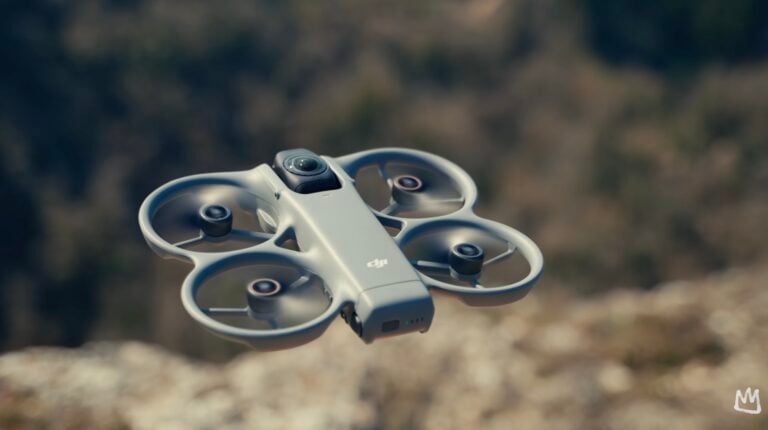
The first is the Black Recon. Unveiled at DSEI 2023 and developed by Teledyne’s Norwegian team in collaboration with the Norwegian Defence Research Establishment, this micro-drone weighs just 12.3 oz and flies for over 45 minutes per sortie.
Its operational radius extends 2.3 miles from the host vehicle. The launch box holds three drones and cycles them automatically as batteries deplete. When one returns, the cradle arm autonomously captures it and queues the next one for launch. One box, three drones, continuous eyes-on coverage without the vehicle stopping or the crew stepping outside.
The Black Recon carries electro-optical and infrared cameras, navigates through GPS jamming using onboard computer vision, and is designed to operate ahead of advancing armored columns at the speed the vehicles themselves are moving. That last point is critical. Most small drones are too slow to scout effectively for fast-moving ground forces. Black Recon was engineered specifically for that problem.
The SkyCarrier: Bigger Drone, Same Philosophy
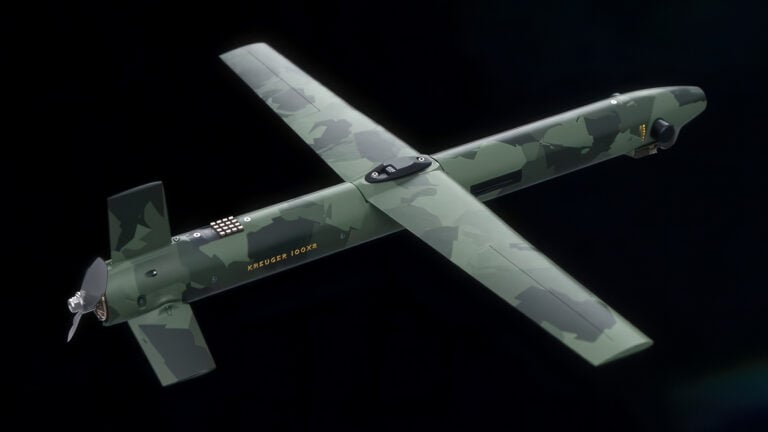
The second system is the SkyCarrier, debuted at DSEI 2025 in London. Where Black Recon is built for stealth and endurance, SkyCarrier is built for payload versatility and multi-mission flexibility.
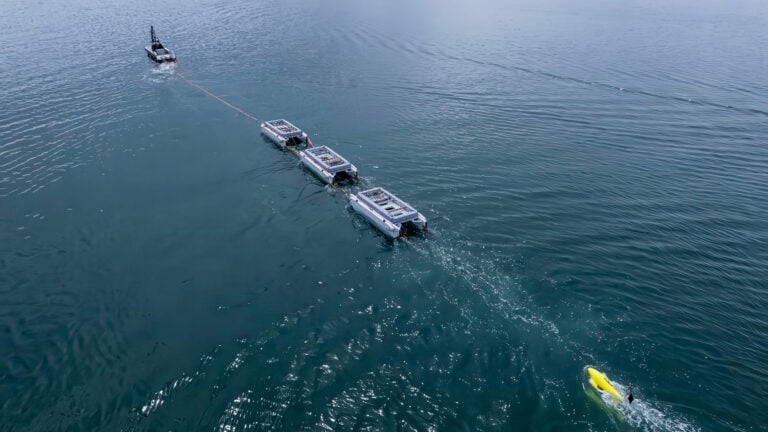
SkyCarrier is a ruggedized drone-in-a-box platform designed to autonomously launch and recover Teledyne’s larger quadcopters from vehicles, ships, or fixed installations even while moving. The container opens to unfold an articulating landing pad that actively compensates for up to 20 degrees of vehicle tilt, meaning it can recover drones on rough terrain or moving vessels without manual assistance.
It navigates returning drones back to the pad using near-infrared landing beacons and visual markers rather than GPS alone. That matters in contested environments where GPS jamming is expected. One operator can manage up to 16 SkyCarrier-linked aircraft in coordinated missions. Recharging with extended batteries takes under 40 minutes.
On ground vehicles, SkyCarrier has been tested at speeds up to 31 mph across rugged terrain. On maritime vessels it has been tested aboard rigid hull inflatable boats and fast attack craft. It supports free flight or tethered operations and can carry payloads spanning thermal imaging, electronic warfare, signals intelligence, and communications relay.
Put simply, it turns any sufficiently large vehicle into a persistent aerial surveillance and response platform that requires minimal operator input.
Why STORM and Norway Make Sense for This Partnership
STORM Adapt Group is a Norwegian defense technology company focused on modular, vehicle-mounted systems designed for rapid deployment in complex environments.

Andreas Rist, EVP of STORM Adapt Group, framed the partnership clearly: integrating Teledyne FLIR’s proven ISR and unmanned expertise into RADS creates a highly flexible, mission-ready solution that empowers operators to deploy drone technology faster, safer, and with more operational impact.
That is not marketing language for its own sake. Norway has been a long-term partner in Teledyne FLIR’s drone development history. The Norwegian Defence Research Establishment co-developed the Black Recon from the start. Norwegian forces have operated Black Hornet nano-drones extensively. The Norwegian Ministry of Defense was among the first to test the SkyCarrier on land and at sea.
This partnership is not two strangers meeting at a trade show. It is the continuation of a deep technical relationship between American drone engineering and Norwegian operational experience, now focused on a modular deployment architecture that could scale across NATO allies.
Targeted mission sets include mobile intelligence, surveillance, and reconnaissance, rapid-response unmanned teams, border security and critical infrastructure protection, and tactical military and homeland security operations. Joint technical evaluations begin following EnforceTac, with collaboration activities planned throughout the year.
DroneXL’s Take
The thing that stands out to me about this partnership is not the drones. They are already excellent. It is the RADS concept.
Most military drone programs build capability into dedicated platforms: specialized vehicles, fixed installations, purpose-built ships. STORM’s approach is different. Make the drone system modular enough to fit anything. A pickup truck, a Humvee, an armored carrier, a patrol boat. Suddenly every vehicle in a theater becomes a potential drone launch platform without a procurement program to replace the fleet.
That is a fundamentally scalable idea. And in a world where Ukraine has demonstrated that drone density wins engagements, scalability is the whole game.
Here is the honest part. This is still an MOU. Technical evaluations begin now and the path from evaluation to fielded system runs through certification, integration testing, procurement bureaucracy, and budget cycles that can stretch for years. The technology is ready. The institutional machinery is slower.
But the Norwegian angle gives me confidence this one moves faster than most. Norway operates this hardware already. The relationship between Teledyne FLIR and Norwegian defense institutions is not new. When partners already speak the same technical language, integration work compresses.
Watch this one. The hardware combination is compelling and the deployment concept is genuinely innovative.
Photo credit: Teledyne
Discover more from DroneXL.co
Subscribe to get the latest posts sent to your email.
Check out our Classic Line of T-Shirts, Polos, Hoodies and more in our new store today!

MAKE YOUR VOICE HEARD
Proposed legislation threatens your ability to use drones for fun, work, and safety. The Drone Advocacy Alliance is fighting to ensure your voice is heard in these critical policy discussions.Join us and tell your elected officials to protect your right to fly.

Get your Part 107 Certificate
Pass the Part 107 test and take to the skies with the Pilot Institute. We have helped thousands of people become airplane and commercial drone pilots. Our courses are designed by industry experts to help you pass FAA tests and achieve your dreams.

Copyright © DroneXL.co 2026. All rights reserved. The content, images, and intellectual property on this website are protected by copyright law. Reproduction or distribution of any material without prior written permission from DroneXL.co is strictly prohibited. For permissions and inquiries, please contact us first. DroneXL.co is a proud partner of the Drone Advocacy Alliance. Be sure to check out DroneXL's sister site, EVXL.co, for all the latest news on electric vehicles.
FTC: DroneXL.co is an Amazon Associate and uses affiliate links that can generate income from qualifying purchases. We do not sell, share, rent out, or spam your email.