
DJI Avata 360 Teaser Shows 8 Creative Shots You Can’t Get From A Regular Drone
Check out the Best Deals on Amazon for DJI Drones today!
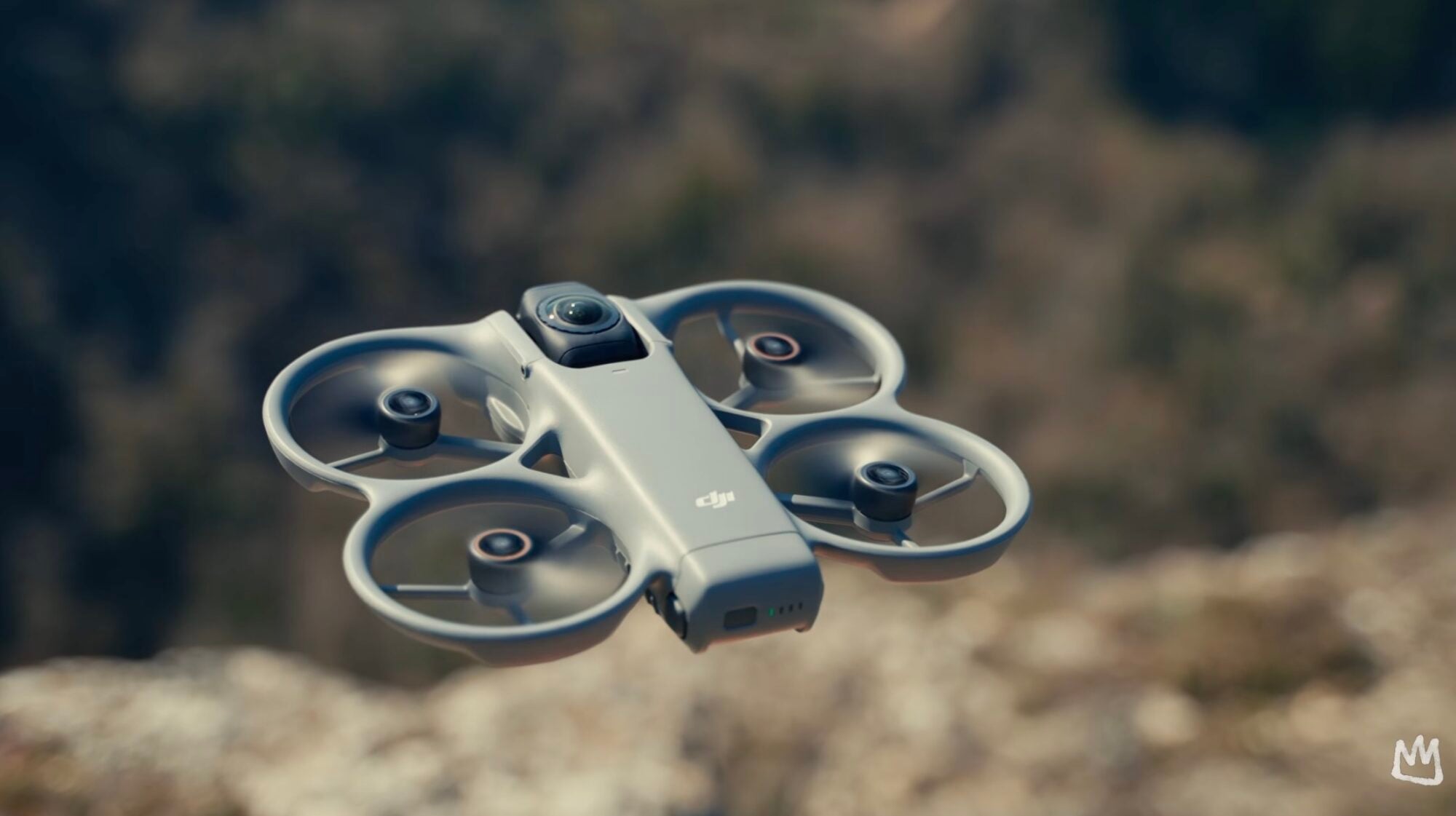
With the DJI Avata 360 set to launch on March 26, DJI published a short video this week walking through eight distinct shot types the drone can produce. The clip runs under a minute, it’s titled “Guess the full potential of a panoramic drone!”, and the footage was captured over what appears to be a dramatic volcanic landscape — basalt cliffs, thundering waterfalls, lava fields. Each clip is labeled with its shot name. No specs, no pricing, just raw visual proof of concept.
The shot names are worth paying attention to. They tell you exactly what DJI is selling here: creative freedom, not image quality.

The 8 Shot Types DJI Revealed
The DJI Avata 360‘s 360-degree camera captures everything around the drone simultaneously, letting pilots reframe footage in post-production rather than composing shots in real time. The video demonstrates eight specific shot types that result from that workflow — some familiar from traditional drones, some only possible with a 360 system.
- Forward Shot — A standard forward-facing perspective, similar to any camera drone. The difference: it’s extracted from a full spherical capture after the fact.
- Top-Down View — A straight-down nadir shot. No tilting the gimbal during flight; you just reframe to look straight down in post.
- Rear View — Looking back at where the drone came from. Normally impossible without a physically rotating camera. Here it’s a simple reframe.
- Tracking Shot — The drone follows a subject and the 360 capture keeps them locked in frame regardless of drone orientation.
- Side Spin — The drone rotates while the camera locks on a subject or point of interest, producing a dramatic orbit-style effect.
- Front/Back Flip — A full vertical rotation. The 360 capture means the subject stays visible even as the drone flips completely over.
- Juicy Flick — A quick directional snap that creates a disorienting perspective shift. The name is clearly aimed at social media creators.
- Asteroid — The classic Tiny Planet effect: the world curls into a sphere around the drone. A one-tap post-production trick that 360 cameras have offered for years, now from the air.
360 Drones Trade Image Quality for Creative Range
The DJI Avata 360 shoots 8K spherical video using dual 1/1.1-inch CMOS sensors. On paper that sounds competitive with the best camera drones on the market. In practice, 360 footage works differently. Because the full sphere is captured simultaneously and reframed in post, you’re always cropping into the image. A 4K export from an 8K 360 capture is not the same as native 4K from a directional drone camera like the Air 3S or the Mavic 4 Pro. The sharpness, dynamic range, and low-light performance of a single well-optimized lens pointed at a scene will beat a dual-lens 360 system at equivalent resolution every time.
That’s a real trade-off. If you need clean, color-graded footage for a commercial project or a wedding, the Air 3S or Mavic 4 Pro are still the better tools. The 360 format is not trying to win that comparison.
What the Avata 360 offers instead is shots that skilled pilots spend months learning to execute — and often still miss. Tracking a motocross rider through rough terrain, for instance, is brutally hard with a conventional drone. You need fast FPV skills, precise stick control, and good luck with framing under pressure. With a 360 camera, the subject is always in the frame. You just need to not crash. The reframe happens later, at your desk, when you’re not also trying to fly.
The Avata 360 Enters a Market Antigravity Created
The DJI Avata 360 is a direct competitor to the Antigravity A1, which launched in December 2025 as the world’s first purpose-built 8K 360 drone. The A1 is backed by Insta360 and launched at $1,599. Leaked pricing puts the Avata 360 drone-only at roughly €459 in Europe — well under a third of the A1’s original price — with a Fly More Combo estimated around $999 for the US. Official pricing gets confirmed at the March 26 launch.
One key difference between the two: the A1 weighs 249 grams and requires no FAA registration for recreational pilots. The Avata 360 reportedly comes in at 400 grams, which means FAA registration and Remote ID compliance are required regardless of how you fly it. For casual users who just want to experiment with 360 aerial footage, that registration requirement adds a step the A1 sidesteps entirely.
The Avata 360 also has a tiltable camera module that switches between 360-degree capture and a standard FPV mode — an option the A1 doesn’t offer. For pilots who want both formats from one drone, that’s a meaningful advantage.

DroneXL’s Take
The teaser does what it needs to do. Eight named shots, all over a dramatic volcanic landscape, all clearly difficult to nail consistently with a traditional drone unless you’re a very skilled FPV pilot. DJI is making a simple argument: stop worrying about framing during the flight, figure it out afterward.
That argument works best for action sports. Motocross, mountain biking, snowboarding, skiing — any fast-moving subject in a chaotic environment where a conventional drone operator either loses the shot or gets too close. The 360 drone doesn’t care where the subject is pointing. It sees everything. That’s genuinely useful, and it’s something no amount of automation on the Air 3S can replicate.
The image quality comparison to directional cameras like the Air 3S and Mavic 4 Pro will be a recurring criticism after launch, and it’s a fair one. But it’s also the wrong frame. Nobody buys a wide-angle lens because it’s sharper than a prime. You buy it because it captures things the prime can’t. The Avata 360 is that wide angle — the shot insurance that means you come home with something usable even when the flight didn’t go exactly as planned.
Antigravity already read the room. As of March 16 — ten days before the Avata 360 launches — the A1 is 20% off, dropping the Standard Bundle from $1,599 to $1,279. That’s the biggest discount since launch, and the timing is not a coincidence. The real question now is whether $1,279 is enough of a gap to close against a drone that may land at $499 drone-only. If DJI’s leaked pricing holds on March 26, Antigravity has a harder decision ahead.
Editorial Note: AI tools were used to assist with research and archive retrieval for this article. All reporting, analysis, and editorial perspectives are by Haye Kesteloo.
Discover more from DroneXL.co
Subscribe to get the latest posts sent to your email.
Check out our Classic Line of T-Shirts, Polos, Hoodies and more in our new store today!

MAKE YOUR VOICE HEARD
Proposed legislation threatens your ability to use drones for fun, work, and safety. The Drone Advocacy Alliance is fighting to ensure your voice is heard in these critical policy discussions.Join us and tell your elected officials to protect your right to fly.

Get your Part 107 Certificate
Pass the Part 107 test and take to the skies with the Pilot Institute. We have helped thousands of people become airplane and commercial drone pilots. Our courses are designed by industry experts to help you pass FAA tests and achieve your dreams.

Copyright © DroneXL.co 2026. All rights reserved. The content, images, and intellectual property on this website are protected by copyright law. Reproduction or distribution of any material without prior written permission from DroneXL.co is strictly prohibited. For permissions and inquiries, please contact us first. DroneXL.co is a proud partner of the Drone Advocacy Alliance. Be sure to check out DroneXL's sister site, EVXL.co, for all the latest news on electric vehicles.
FTC: DroneXL.co is an Amazon Associate and uses affiliate links that can generate income from qualifying purchases. We do not sell, share, rent out, or spam your email.






The A1 is reportedly getting a software/functionality upgrade with more automation and voice control features; depending on what the A360 specs and abilities are at launch, there may still be a competitive edge for the A1 with anyone who isn’t already inside the DJI ecosystem. Whenever the subject of price comes up, I see DJI’s only current advantage being ‘drone only’ for those who already have all of the controllers/goggles from previous purchases. I’d like to see a more honest comparison for pilots who are starting from ground zero with no prior equipment.