Varta Put a Shotgun on a Drone. Ukraine’s Frontlines Say It Works.
Check out the Best Deals on Amazon for DJI Drones today!
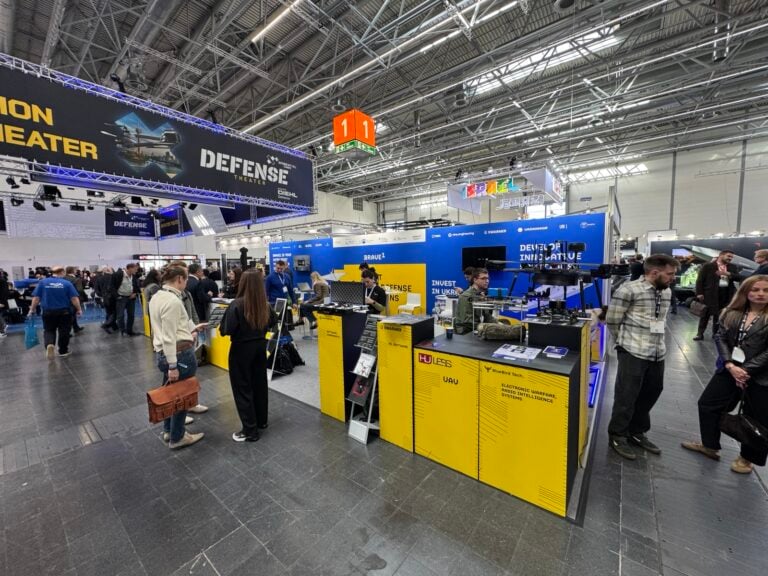
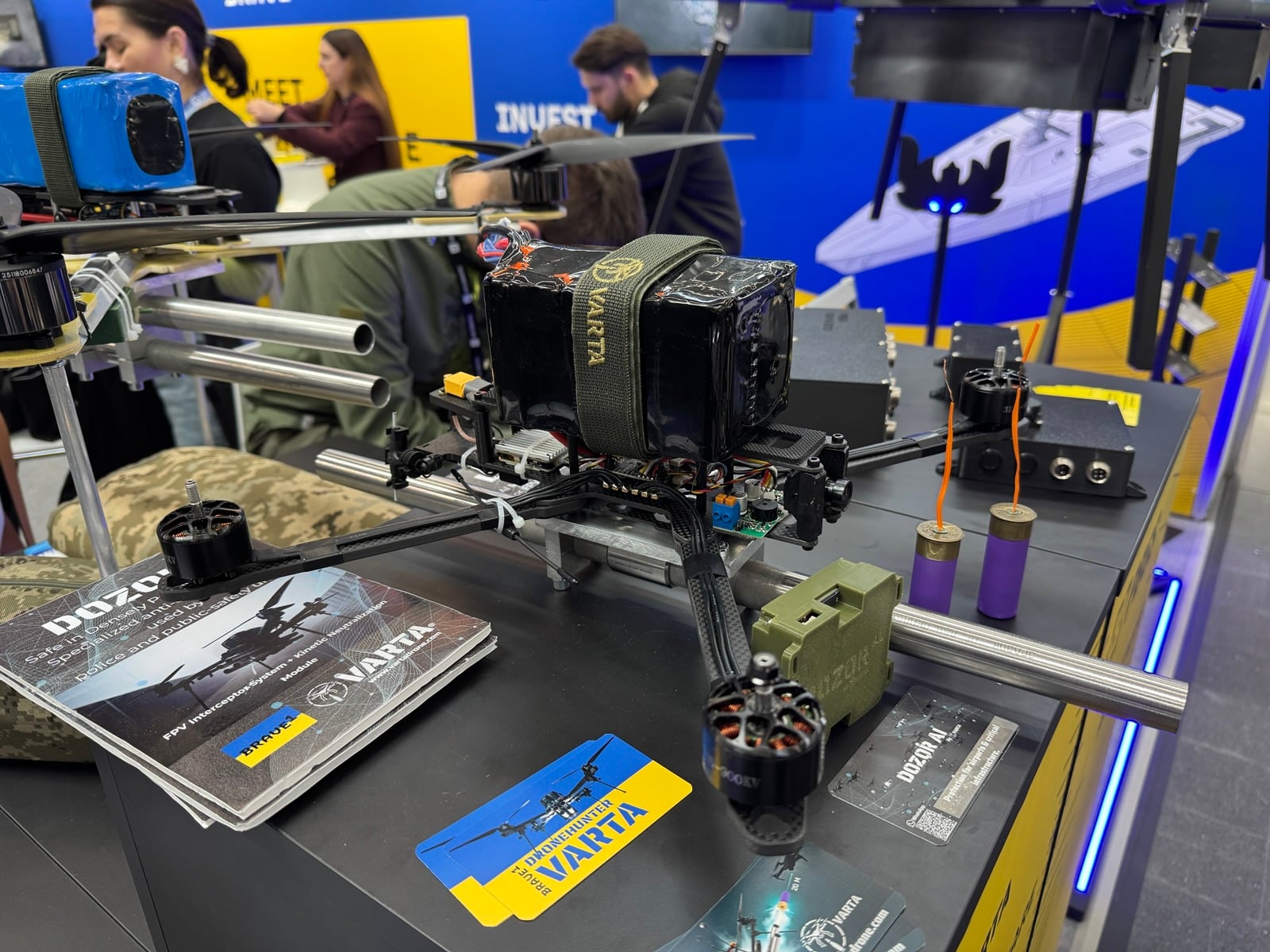
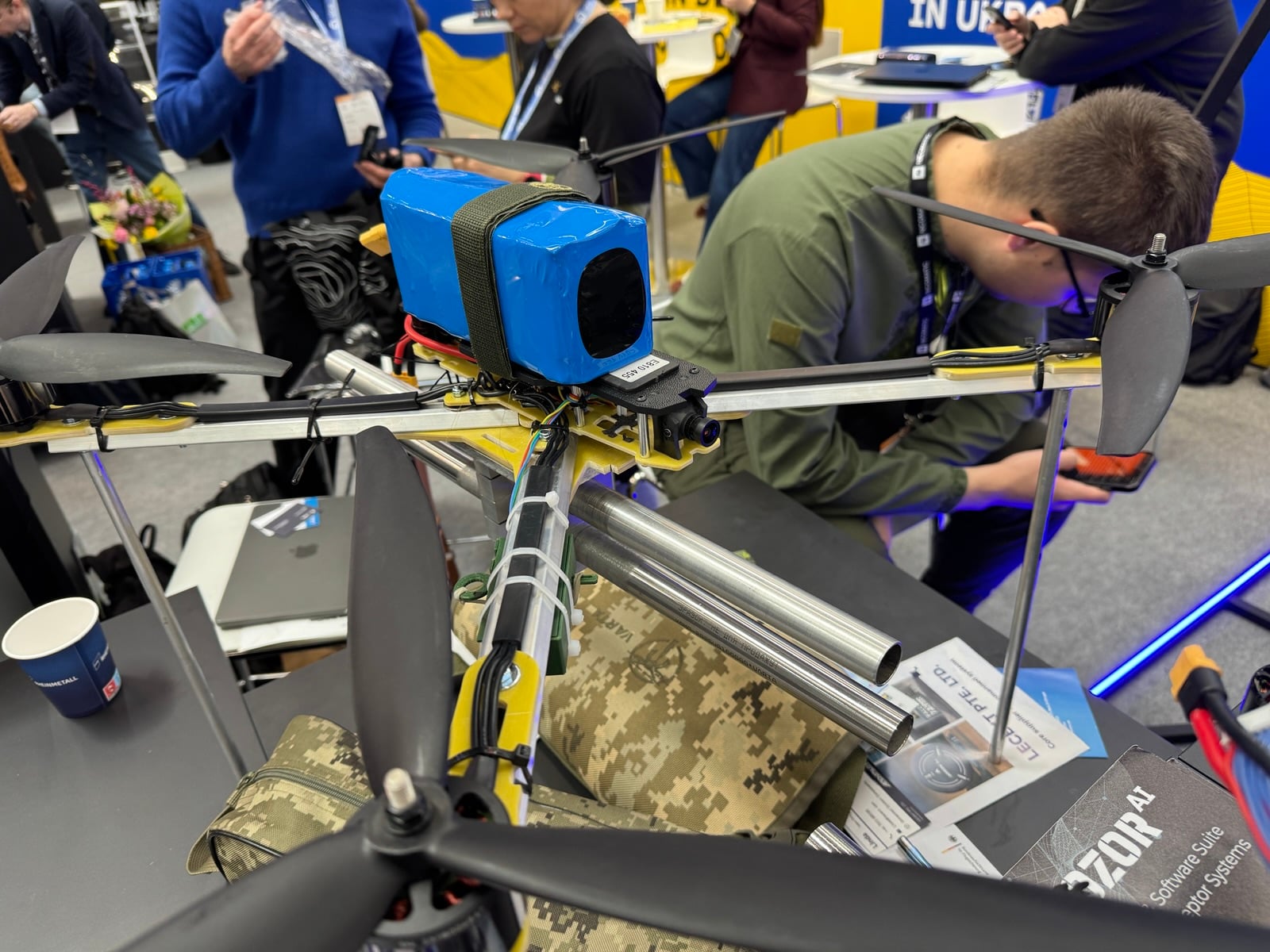
On the table at the Brave1 pavilion at XPONENTIAL Europe 2026 in Düsseldorf sat a drone unlike anything else on the floor. The frame was large — arms stretched wide, propellers big enough to move serious air. Strapped to the body was a black housing with the VARTA logo and a prominent blue battery pack. Alongside it on the table: a green military-spec ammo box, cylindrical purple rounds with orange initiation tips, and product literature for the Brave1 Dronehunter Varta and the Dozor AI system.
This is a drone with a shotgun. Not figuratively. Literally a 12-gauge shotgun, mounted on a multirotor airframe, designed to chase down enemy drones and shoot them out of the sky. It costs $300 for a starter kit including 12 rounds. Over 20 Ukrainian frontline units are operating it in combat.
Why a Shotgun on a Drone
The video the Varta team showed me at the booth told the story better than any spec sheet. A Ukrainian DroneHunter closes in on a Russian reconnaissance drone from behind, flying significantly faster than its target. As the interceptor reaches close range, it fires. The Russian drone tumbles out of the sky. Chase, shoot, kill. That’s the operational concept.
Russian reconnaissance drones are the eyes of Moscow’s war machine. They find Ukrainian positions, direct artillery strikes, guide loitering munitions, and conduct battle damage assessment. Kill the recon drone and you blind the systems that depend on it — the artillery battery loses its spotter, the strike planner loses his picture, the follow-up attack never comes. The problem is that recon drones are hard to kill. They fly too high for rifles, they’re too small and cheap to justify expensive surface-to-air missiles, and electronic warfare is unreliable against systems increasingly designed to resist jamming. A soldier on the ground has almost no good options.
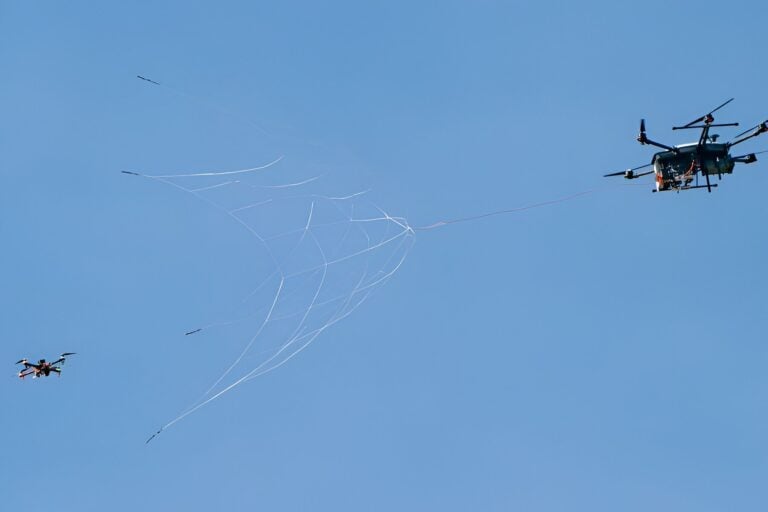
Varta’s answer is a kinetic interceptor. Send up a faster drone, run it down from behind, and put a shotgun blast through it at close range. No jamming to circumvent, no expensive missile to waste, no operator standing exposed on the ground. You can’t jam a shotgun blast, and a $300 interceptor destroying a reconnaissance platform worth many times more is the kind of exchange rate that scales. FPV and reconnaissance drones now account for the majority of frontline equipment losses — taking out the enemy’s eyes before they can direct those strikes changes the math at the small unit level.
How the System Works
The DroneHunter Varta module is a compact kinetic counter-UAS payload that bolts onto existing FPV and multirotor airframes. The system uses electrically-initiated 12-gauge anti-drone cartridges produced in Ukraine. Two barrels fire simultaneously in opposite directions — the counter-shot configuration is deliberate, using recoil balance to keep the carrier drone stable during firing. The unit weighs 2.3 kg, compatible with 7 to 15-inch drone frames. The effective engagement envelope runs from 5 to 20 meters — the interceptor closes to near point-blank range before firing, just as the booth video demonstrated.
The Varta Bulava is the four-barrel upgrade version, delivering a denser shot pattern and reserves for a second shot or multiple-target scenarios. The four-tube launcher uses the same electronically-initiated 12-gauge cartridges with an effective defeat envelope of up to 20 meters — optimized for the final moments of a high-speed tail chase. Varta recommends a 15-inch carrier drone for the Bulava given the additional payload weight.
The ammunition itself is purpose-built. Varta’s SPEZPATRON rounds come in variants designated SPYS20 through SPYS2K, with effective ranges from 5 to 100 meters depending on the variant. These are not repurposed consumer cartridges — they are Ukrainian-developed, electrically-initiated anti-drone rounds, and Varta does not sell the module separately from calibration and integration support. Military units send in their drones for factory setup before deployment.
Dozor AI: The Detection Layer
The shotgun module is the kinetic layer. Dozor AI is the autonomous detection and targeting layer that tells it where to go and what to shoot. Dozor AI can detect and recognize drones at approximately 126 meters — enough standoff to identify an inbound reconnaissance drone and vector the interceptor onto a pursuit course before the target passes through the defended area. The system integrates with Ukraine’s DELTA digital battlefield management network, which means detection cues can come from a broader sensor picture rather than just the interceptor’s own onboard camera.
The operational concept that emerges from this combination is a localized air defense layer against enemy ISR: one operator managing five to seven Dozor AI-cued DroneHunter drones simultaneously, covering a section of frontline or positioned around a high-value target — a bridge, an ammunition depot, a brigade command post. When a Russian recon drone enters the zone, the system vectors an interceptor to chase it down and destroy it, without requiring a human operator to manually fly the engagement. That’s the same force-multiplication logic driving Swarmer’s swarm coordination platform: reduce the number of operators needed per drone, increase the number of threats handled per operator.
Combat Record and Western Trade Show Strategy
More than 20 Ukrainian frontline units are operating the DroneHunter system in combat conditions. The module has been integrated onto more than a dozen different Ukrainian UAV types. Varta first publicly unveiled the system at the Drone Summit 2025 in Riga, then demonstrated it at CES 2026 in Las Vegas, and brought it to XPONENTIAL Europe 2026 in Düsseldorf — a deliberate progression through Western trade show circuits that mirrors the path other Ukrainian defense startups have followed. Ukraine’s defense industry is not waiting for Western buyers to come to Kyiv. It is bringing hardware to the rooms where procurement decisions get made.
The system is available through the Brave1 Marketplace, Ukraine’s direct defense procurement platform. Varta has also built a dedicated training simulator — the Ukrainian Fight Drone Simulator (UFDS), described as the world’s first FPV interceptor training software — that lets operators practice aerial combat interception scenarios before deployment. The simulator integrates directly with Brave1, and top-performing pilots can earn hardware through the platform’s points system.
DroneXL’s Take
I’ve been covering counter-drone systems for years and I have never seen anything quite like this on a trade show floor. The Varta DroneHunter is the most physically direct answer to the reconnaissance drone threat I’ve encountered: no jamming, no netting, no interception by ramming — a gun, on a drone, chasing down another drone and shooting it out of the sky. The video they showed me at the Brave1 booth made the concept instantly tangible. A Ukrainian interceptor runs down a Russian recon drone from behind, fires, and the target drops. That’s not a concept render. That’s combat footage from a system 20+ units are already fielding.
What strikes me about the Düsseldorf presentation is how far the system has matured. This wasn’t a prototype on a stand with a render. A Ukrainian soldier was actively adjusting hardware. The ammo box was open on the table. The purple rounds with orange tips were visible to anyone who stopped for thirty seconds. Varta brought the actual operational configuration to Germany to show it, and the footage to prove it works.
The Pentagon and Gulf states are already buying Ukrainian interceptor technology. The kinetic close-in category — drone-mounted hard-kill systems that physically chase down and destroy enemy aircraft — is the next logical procurement conversation, because reconnaissance drones are not a uniquely Ukrainian problem. Every military in the world faces the same ISR threat. By the end of 2026, a Western military or security agency will likely have a formal evaluation contract for the DroneHunter or a direct equivalent. The $300 price point makes the economics impossible to ignore.
DroneXL uses automated tools to support research and source retrieval. All reporting and editorial perspectives are by Haye Kesteloo.
Discover more from DroneXL.co
Subscribe to get the latest posts sent to your email.
Check out our Classic Line of T-Shirts, Polos, Hoodies and more in our new store today!

MAKE YOUR VOICE HEARD
Proposed legislation threatens your ability to use drones for fun, work, and safety. The Drone Advocacy Alliance is fighting to ensure your voice is heard in these critical policy discussions.Join us and tell your elected officials to protect your right to fly.

Get your Part 107 Certificate
Pass the Part 107 test and take to the skies with the Pilot Institute. We have helped thousands of people become airplane and commercial drone pilots. Our courses are designed by industry experts to help you pass FAA tests and achieve your dreams.

Copyright © DroneXL.co 2026. All rights reserved. The content, images, and intellectual property on this website are protected by copyright law. Reproduction or distribution of any material without prior written permission from DroneXL.co is strictly prohibited. For permissions and inquiries, please contact us first. DroneXL.co is a proud partner of the Drone Advocacy Alliance. Be sure to check out DroneXL's sister site, EVXL.co, for all the latest news on electric vehicles.
FTC: DroneXL.co is an Amazon Associate and uses affiliate links that can generate income from qualifying purchases. We do not sell, share, rent out, or spam your email.