RCTESTFLIGHT Builds 41-Inch Variable Pitch Quadcopter That Outperforms Direct Drive on Efficiency
Check out the Best Deals on Amazon for DJI Drones today!
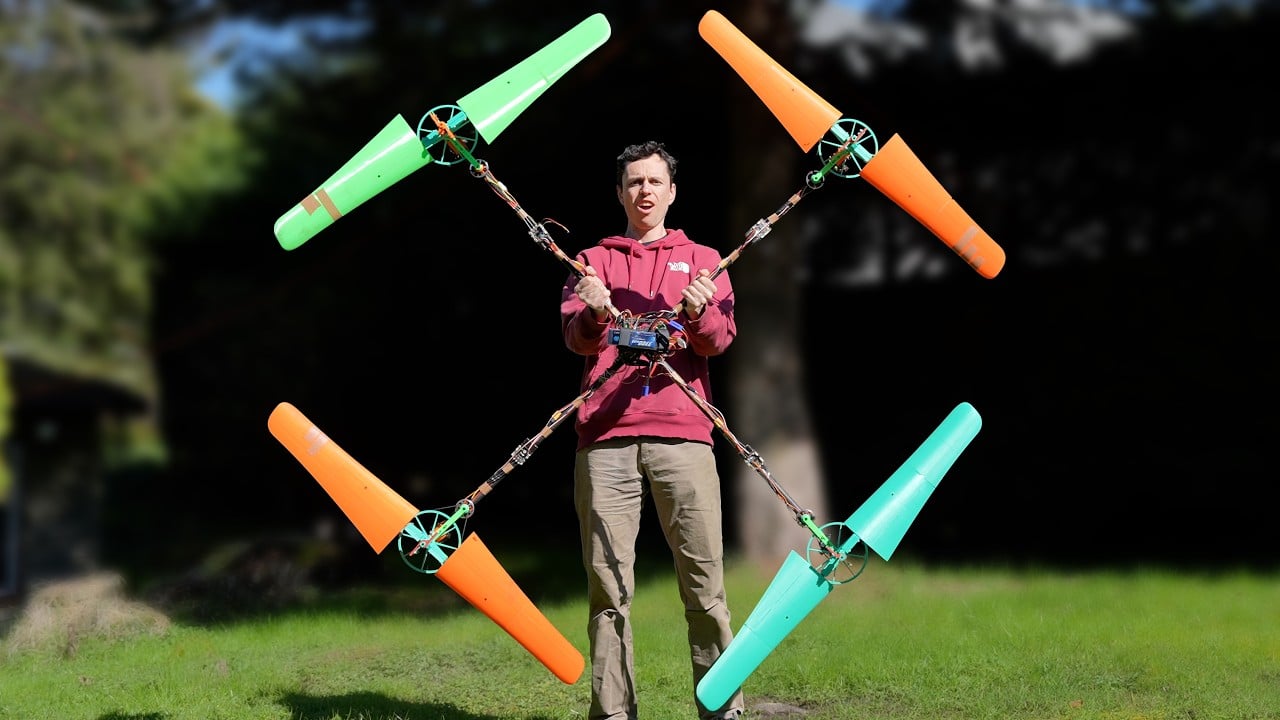
Daniel Riley, the engineer behind the RCTESTFLIGHT YouTube channel, has published a new video documenting a years-long project to build a large-format quadcopter with variable pitch rotor blades, belt-drive reduction, and fixed-RPM motors. The result is a 41-inch, gear-reduced quadcopter that achieved 18.1 grams of thrust per watt in hover and hit 33 grams per watt in bench testing. Those figures, as Riley demonstrates with his own load cell data, outperform several direct-drive motors from established manufacturers at comparable thrust levels. You can watch the full build on RCTESTFLIGHT’s YouTube channel.

The Efficiency Problem Riley Set Out to Solve
Rotor efficiency in multirotors comes down to disc loading: the ratio of rotor disc area to aircraft weight. FPV freestyle drones have small propellers and relatively high weight, which means each square inch of disc area supports more load and wastes more energy. Long-endurance platforms flip this by using large, slow-turning rotors. The problem is that large propellers have high rotational inertia, and a conventional quadcopter relies on rapid motor speed changes to stabilize itself. Big props respond too slowly for that. Riley’s solution was to decouple stabilization from motor RPM entirely, running all four motors at a fixed rotational speed and adjusting blade angle for both throttle and attitude control. As DroneXL covered when reporting on the endurance drone built by Luke Maximo Bell, the same principle drives the most efficient multirotors being built today: maximize disc area, minimize weight, and keep RPMs as low as the physics allow.
Belt Drive, 3D-Printed Blades, and a Five-Year Shelf Life
Riley started the project roughly five years ago, then shelved it until recently. The core propulsion unit pairs a 5010 360KV motor with an HTD3M timing belt reduction driving a 15mm carbon tube propeller shaft. A 22-tooth pulley on the motor side drives a larger pulley on the prop shaft. He tested six driven pulley sizes ranging from 132-tooth to 216-tooth to find the best gear ratio, and landed on a 165-tooth driven pulley as the most efficient option. The efficiency difference between the smallest and largest pulleys turned out to be only about 1.5 grams of thrust per watt, but the 165-tooth configuration edged out the others consistently enough to use on all four arms.
The 41-inch blades were 3D printed in two sections using PETG on a Prusa Core 1, glued together with carbon rod alignment pins, and built around a 10mm carbon fiber tube spar. Most structural parts came out in PC blend filament, chosen for its stiffness-to-weight ratio. The blade pitch control runs through a hollow propeller shaft: a push rod slides down the center and connects to individual blade control horns, allowing a servo to adjust all blades simultaneously while the entire rotor assembly spins. The flight controller sees the servos as motor outputs, with low throttle mapping to flat pitch and high throttle mapping to positive pitch.
Bench Numbers That Hold Up Against a Purpose-Built Motor
On a load cell thrust stand, Riley measured nearly 2.5 kg of thrust at just under 500 RPM. At lower thrust levels, efficiency peaked at 33 grams of thrust per watt at 350 grams of thrust. When he compared the variable pitch assembly directly against conventional direct-drive propellers using the same 5010 motor, the gear-reduced system outperformed every prop in his test set. He also added T-Motor thin-stator reference data to the graph, specifically data for a 30-inch propeller on that motor. The 41-inch variable pitch assembly still beat it at overlapping thrust levels. The propeller size difference (41 inches vs. 30 inches) explains part of the gap, but Riley’s blades carry a rough PETG surface finish that adds aerodynamic drag, and the belt drive introduces mechanical losses. Even with those penalties, the gear-reduced approach came out ahead.
The Variable Pitch Quad Is Quiet, Controllable, and Prone to Shaking Itself Apart
In flight, the quadcopter was immediately quieter than any conventional drone Riley had flown. With motors spinning at a fixed RPM and blade pitch handling all control inputs, the primary sounds are the propellers and the servos twitching to make corrections. There is no PWM motor whine. At hover, the variable pitch quad consumed 5 to 10 watts less than a comparison quad equipped with 18-inch propellers that weighed 700 grams less. On a thrust-per-watt basis, that translated to 18.1 g/watt versus the conventional quad’s 11.8 g/watt, a 1.5x efficiency advantage in hover. Riley acknowledges the comparison is imperfect: the conventional quad carried larger motors with payload capacity the variable pitch quad lacks entirely.
Vibration was the persistent problem throughout development. Dynamically balancing 41-inch 3D-printed blades by hand, using tape and feel, never fully resolved the oscillation. Riley found a minimum viable RPM for stable flight: enough rotor speed to climb and stabilize, but below the threshold where resonance became uncontrollable. He also tested the aircraft with negative blade pitch, intending to demonstrate an autorotation-style descent. The drone floated down slowly with negative pitch applied and motors still running, though true autorotation would require the motors to coast freely. In a final test, Riley cut throttle to zero. The flight controller stopped stabilizing, the airframe tipped, and the drone inverted and broke apart mid-air.
DroneXL’s Take
Riley’s project stands out from typical DIY drone content because the data is honest. He calibrated his thrust stand, acknowledged the apples-to-oranges limits of his hover comparison, and documented every crash on camera. That rigor matters when the underlying claim is serious: a garage-built, 3D-printed, belt-driven rotor assembly is outperforming commercially tested direct-drive motors on efficiency. DroneXL has covered the same efficiency logic before, most recently in the Mono Mothra hubless concept analysis, where the conclusion was that aesthetic drone engineering usually fails when it meets physics. Riley’s project arrives from the opposite direction: ugly, mechanically violent, and the physics are working.
The noise profile is where this gets commercially interesting. Zipline, Wing, and Amazon Prime Air all face public acceptance problems tied directly to propeller noise. Longer, slower blades at fixed RPM produce a fundamentally different acoustic signature than high-RPM direct-drive props, and Riley’s footage makes that audible. The efficiency advantage he measured survives a significant engineering improvement penalty and still beats conventional direct drive. A single-rotor or coaxial helicopter form factor, as Riley himself suggests, would sidestep the vehicle-size scaling problem that makes large-blade quadcopters impractical at delivery scale. By the end of 2027, at least one commercial developer will have a belt-drive or geared-reduction propulsion system in active testing for a delivery or inspection platform. The data Riley has published for free makes that case more publicly than anything a well-funded startup has put out.
DroneXL uses automated tools to support research and source retrieval. All reporting and editorial perspectives are by Haye Kesteloo.
Discover more from DroneXL.co
Subscribe to get the latest posts sent to your email.
Check out our Classic Line of T-Shirts, Polos, Hoodies and more in our new store today!

MAKE YOUR VOICE HEARD
Proposed legislation threatens your ability to use drones for fun, work, and safety. The Drone Advocacy Alliance is fighting to ensure your voice is heard in these critical policy discussions.Join us and tell your elected officials to protect your right to fly.

Get your Part 107 Certificate
Pass the Part 107 test and take to the skies with the Pilot Institute. We have helped thousands of people become airplane and commercial drone pilots. Our courses are designed by industry experts to help you pass FAA tests and achieve your dreams.

Copyright © DroneXL.co 2026. All rights reserved. The content, images, and intellectual property on this website are protected by copyright law. Reproduction or distribution of any material without prior written permission from DroneXL.co is strictly prohibited. For permissions and inquiries, please contact us first. DroneXL.co is a proud partner of the Drone Advocacy Alliance. Be sure to check out DroneXL's sister site, EVXL.co, for all the latest news on electric vehicles.
FTC: DroneXL.co is an Amazon Associate and uses affiliate links that can generate income from qualifying purchases. We do not sell, share, rent out, or spam your email.