
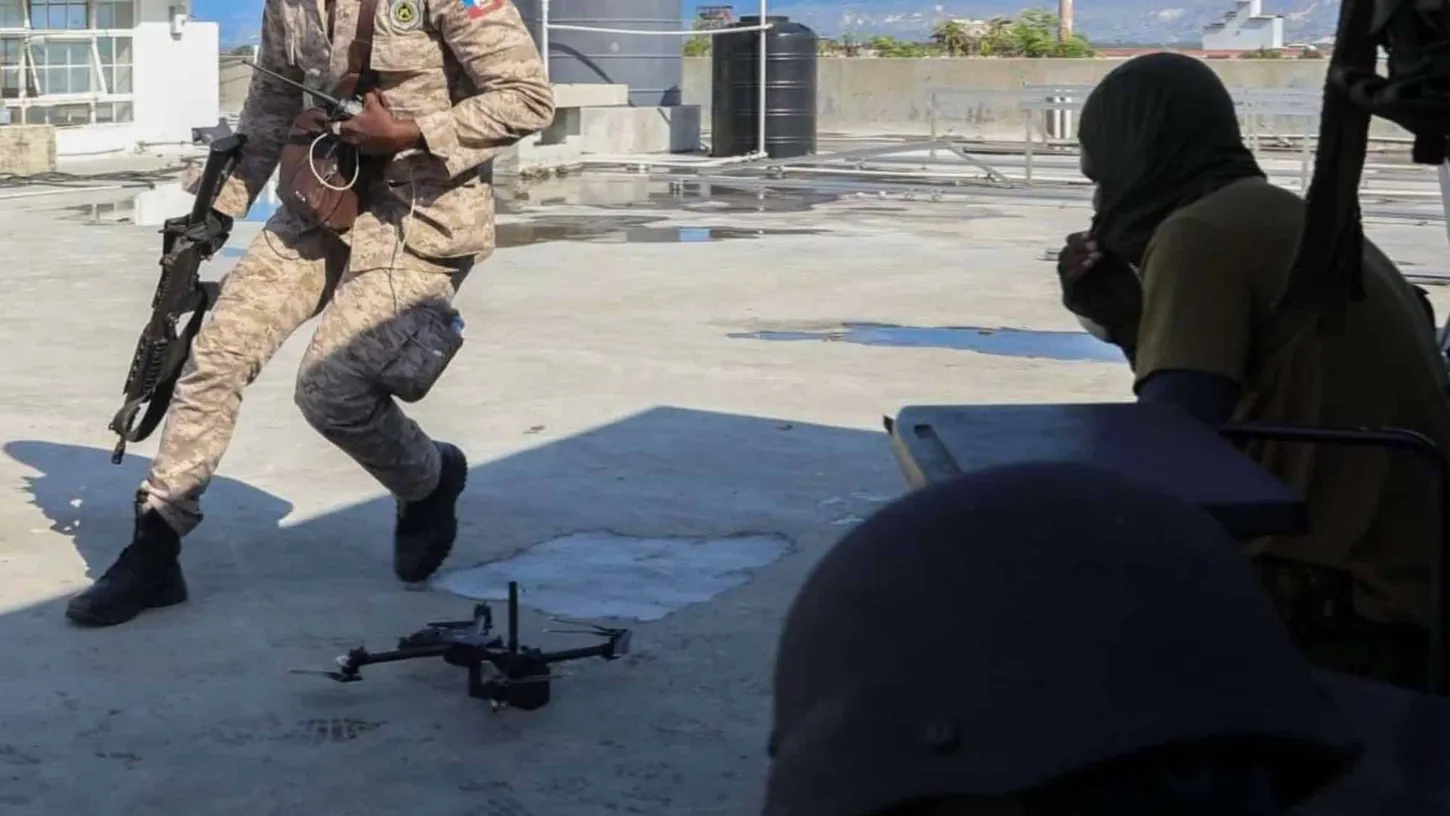
Mathias Saintil, the leader of the Boston gang in Cité Soleil, died Friday, November 6, a day after coordinated police operations swept five communes of Port-au-Prince with at least seven kamikaze drones. Haiti’s prime minister, Alix Didier Fils-Aimé, confirmed the death on X with three words: “One less gang leader.” Saintil’s gang belongs to Viv Ansanm, the coalition the Trump administration designated a Foreign Terrorist Organization in May 2025, and a human rights lawyer told CNN three weeks ago that no major gang leader had been killed in Haiti in years.
The two accounts of how he died do not match. The National Human Rights Defense Network, one of Haiti’s leading rights groups, says a kamikaze drone struck Saintil’s home and his vehicle in the Nan Nélio area between 9 and 10 p.m. Thursday and left him with abdominal wounds he died of the next afternoon. The Haiti National Police, in a statement issued after the prime minister’s post, says he was “struck by multiple gunshots” during a police operation and died later in a hospital in the capital.
Both Accounts Can Be True, and Neither Side Has Reconciled Them
The drones flown Thursday belong to a task force Prime Minister Fils-Aimé set up in March 2025, run from his office with Erik Prince’s Vectus Global in support, Human Rights Watch reports. It operates alongside Haitian police, and the US State Department licensed Vectus to export defense services to Haiti.
The night was not one drone and one target. The rights network counts at least seven kamikaze drones dropped across Tabarre, Croix-des-Missions, Santo, Cité Soleil and La Plaine du Cul-de-Sac, according to the Miami Herald’s Jacqueline Charles. Five of Saintil’s men died at the scene and around 15 were wounded, two of them losing a foot. Saintil was driving to a street party in Pierre-Six, another part of the slum, where a separate strike killed gang members and civilians, the network says.
Gunfire was part of the same action. A pickup truck carrying 15 fighters from the Brooklyn gang of Gabriel Jean-Pierre, known as Ti Gabriel, set out to reinforce Saintil, and task force members intercepted it, shooting five dead and wounding six. A man hit by a drone and then caught in that exchange would fit both statements. Neither the police nor the rights network has said so, and the Herald reports only that the accounts differ.
Saintil was taken to a hospital in Belécourt, then to a facility in Canaan, another gang-held district, where he died around 5:30 p.m. Friday while a third transfer to Carrefour was being arranged. DroneXL reported in August 2025 how far apart the task force and the police can sit when a task force drone that failed to detonate exploded at a police SWAT base in Kenscoff, killing two officers who were trying to disarm it after residents carried it in.
Prince Said Leadership Kills Do Not Win Wars. The Body Count Says What Does.
The campaign has flown more than 2,000 drone strikes since March 2025, CNN reported on October 17, and human rights lawyer Rosy Auguste Ducena told CNN that no major gang leader had been killed in years. Prince’s answer was that leadership kills are not how insurgencies are beaten.
“Wars are won by taking significant numbers of enemy manpower off the battlefield,” Prince told CNN, adding that the United States has an “obsession” with going after leaders.
The manpower count is on the record. Human Rights Watch tallied 141 drone operations between March 1, 2025 and January 21, 2026 that killed at least 1,243 people and injured 738. Among the dead were 17 children and at least 43 adults the group says were not gang members. Human Rights Watch wrote that some of the strikes “appear to be attempts to carry out extrajudicial killings,” and the UN human rights chief, Volker Türk, told the Human Rights Council on October 2, 2025 that most of the drone strikes “are likely unlawful under international human rights law.” A CNN tally of UN reporting counts 85 civilians killed by the drones, a figure rights workers told CNN is probably incomplete because the targeted areas are hard to reach.
The drones themselves are armed quadcopters, the class of aircraft DroneXL described when it first covered the campaign in May 2025 and when the Royal Canadian Mounted Police objected in June 2025 that donated Canadian drones were being used lethally against the terms of the donation.
El Salvador’s 2,500 Troops Gave the Task Force Its Opening
The task force’s tempo rose after four Salvadoran aviation technicians serving with the UN-authorized Gang Suppression Force were ambushed in Croix-des-Bouquets on October 18 and have not been seen since. El Salvador’s president, Nayib Bukele, sent 2,500 troops to Haiti to find them.
Bukele has made the hunt public. On Wednesday he posted aerial footage of Port-au-Prince on X with the caption “Looks like the gangs don’t want to fight us.”
During the search of the Cul-de-Sac plain for the missing men, the task force and Haitian police pushed into territory held by 400 Mawozo and bombed the home of its leader, Wilson Joseph, known as Lanmò San Jou. He survived. The rights network places him in Thor 65 in the commune of Carrefour, reportedly driven there by Ti Bwa gang leader Chrisla Chéry, and he has since appealed to the UN for peace talks. The Gang Suppression Force was not part of Thursday’s drone strikes either, and the Herald reports it has often had to deconflict after learning that another force’s operation was already underway.
DroneXL’s Take
Saintil’s gang terrorized Cité Soleil for years, and nobody in that slum is mourning him. The two death stories still bother me more than the death. I suspect the police version exists because a drone kill belongs to a contractor-backed unit the UN rights chief has called likely unlawful, while a shootout belongs to a police force that can stand behind it, and I can’t prove that. Both accounts may be true. A government that wanted them reconciled would have put out one statement, and it put out two.
I covered the Kenscoff SWAT base explosion last August as a protocol failure. It looks now like a symptom: two chains of command, one set of drones, and nobody willing to own the result when it goes wrong, or now, when it goes right.
Every US police department asking its council for an armed drone will have Haiti cited back at it, and after this week the citation comes with a gang leader’s name and a casualty ledger. The departments that want the capability should be the loudest voices demanding the task force publish who it kills, because the alternative is that Haiti writes the case against them.
Sources: Miami Herald via Yahoo News, CNN, Human Rights Watch, UN Geneva
DroneXL uses automated tools to support research and source retrieval. All reporting and editorial perspectives are by Haye Kesteloo. Read our editorial standards.


