
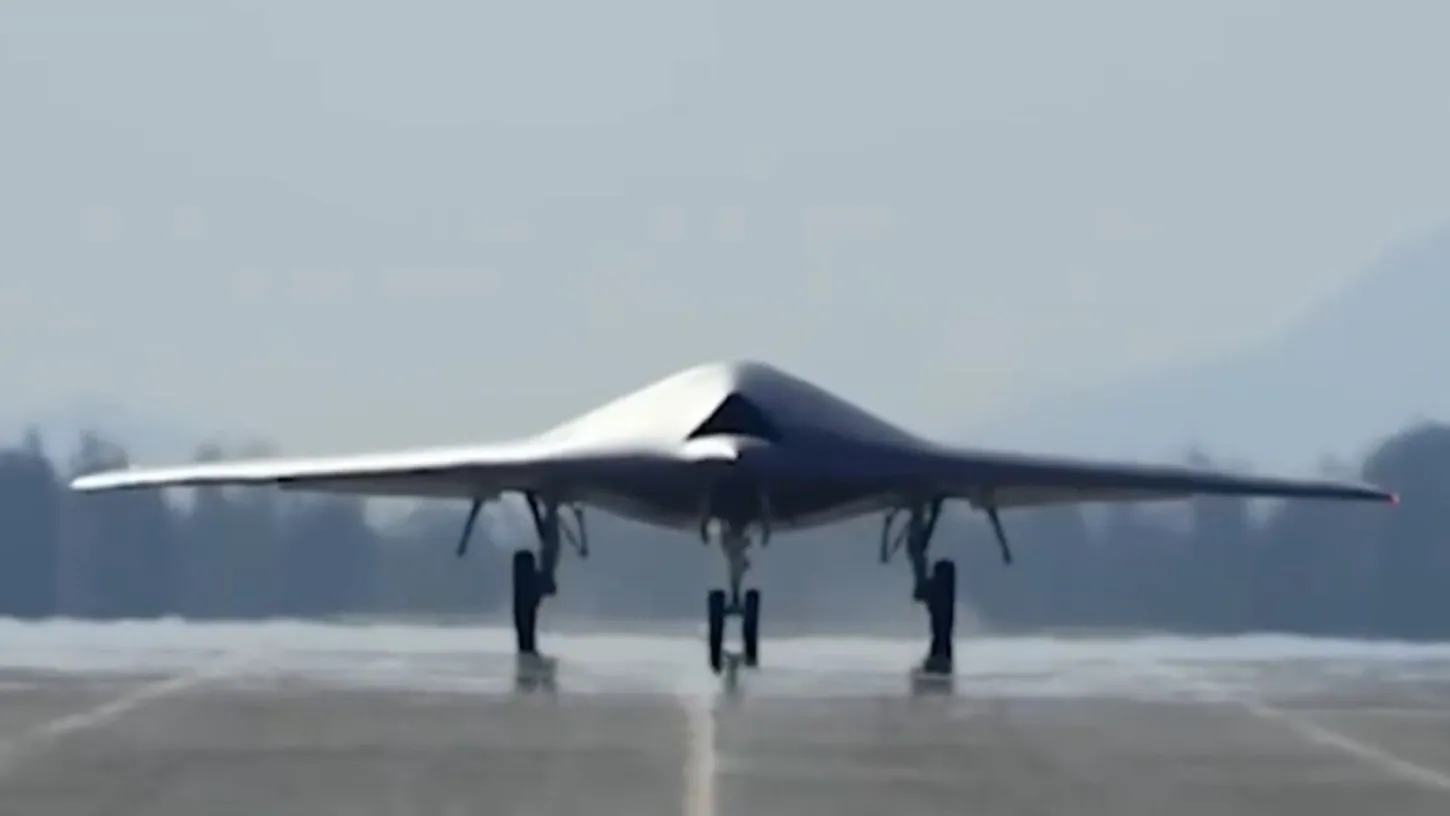
China’s state broadcaster CCTV aired new footage of the GJ-11 stealth combat drone on Monday, including the first close-up look at its internal weapon bays. The report ran as part of CCTV’s countdown to the 77th anniversary of the People’s Liberation Army Air Force (PLAAF) on Wednesday.
CCTV also said the flying-wing drone hit its target in its first live-fire test, after thick cloud nearly kept it from finding that target. The broadcaster did not say when the test took place or which weapon the GJ-11 fired.
GJ-11 Footage Shows Serrated Bay Doors Built for Stealth
Serrated edges run along the doors of the GJ-11’s internal weapon bays, the detail the new footage shows most clearly. The South China Morning Post, which reported the footage on Monday, said the design suggests the drone can carry relatively large missiles without giving up its stealth.
The Aviationist counts two bays on the underside, set between the main landing gear. The clips also show a shielded jet nozzle and a low-visibility coating. A faceted optical window under the nose looks similar, the Post said, to the electro-optical targeting system on China’s J-20 stealth fighter.
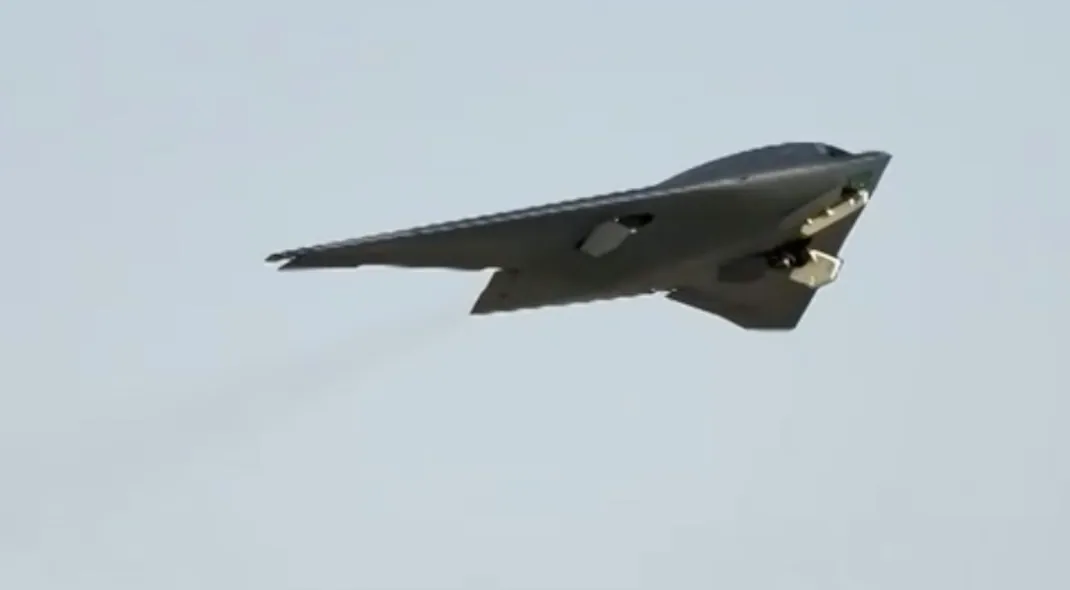
The Aviationist also noted that the landing gear now retracts on camera after takeoff. In the PLAAF’s November 2025 anniversary film, which showed the GJ-11 flying in formation with a J-20 and a J-16D, the gear stayed down.
The GJ-11, short for Gongji-11 or Attack-11, is the air force’s first stealth combat and reconnaissance drone. It is also known as Xuanlong, and Western coverage has long called it Sharp Sword. China unveiled it at the October 2019 parade for the 70th anniversary of the People’s Republic, and the Post says it entered service no later than 2025.
CCTV Says the GJ-11 Scouts and Strikes for Crewed Fighters
According to CCTV, the GJ-11 has operated in coordination with another drone and can also work with crewed aircraft. The broadcaster said the drones can act as “the eyes of crewed fighter jets,” scouting enemy air defenses, drawing fire as decoys, or launching guided munitions on a crewed aircraft’s direction.
The drone’s integrated control station and its operators can be loaded straight onto a military transport aircraft and moved where they are needed, CCTV said.
The GJ-11 is also going to sea. Chinese state media reported on October 30 that the GJ-21, the GJ-11’s carrier-based variant, had taken off from and landed aboard the Sichuan, China’s first Type 076 amphibious assault ship. DroneXL reported in 2024 on GJ-11 mockups spotted beside the Type 076 under construction in Shanghai.
GJ-11 Found Its Target Only After Circling Back
Operator Shi Xiaoran told CCTV that the GJ-11 could not find its target through thick cloud on its first run in that live-fire test. The drone circled back for another pass, located the target, launched its weapon and scored a hit on the second attempt, Shi said.
The report said the GJ-11 went through a series of tests at a desert facility in northwestern China. The Post noted that the air force runs a base at Malan in Xinjiang, where several of China’s new drones are believed to have been developed and tested.
US Air Force Fired Its First Drone Wingman Missile in July
The nearest US milestone came in July. On July 15 the Air Force said Anduril’s YFQ-44A had fired an AIM-120 AMRAAM at a digital target over California’s Mojave Desert, with a human operator ordering the shot. Chief of Staff Gen. Kenneth Wilsbach declined to share more, citing operational security.
Anduril said the drone flew from Edwards Air Force Base and told Breaking Defense the test was an end-to-end, beyond-line-of-sight strike, with its Lattice software feeding the target track to the drone. The YFQ-44A first flew on October 31, 2025. General Atomics said in July that it was on schedule to fire from the internal bay of its YFQ-42A later this year. Both Collaborative Combat Aircraft (CCA) designs got the green light for production in June, and the Air Force says they cost about a third of an F-35A. The Aviationist rates the GJ-11, a large stealth flying wing, closer in class to Lockheed Martin’s Vectis than to either CCA.
DroneXL’s Take
I’d treat the GJ-11 as a weapon the PLA already operates. China has had it in service since at least 2025 and has now taken its navy version to sea on the Sichuan. The cloud story points the same way, because state television had no need to admit that the drone lost its target on the first pass. CCTV gave no date or weapon for the strike, so the hit can’t be checked from outside China, and the Air Force held back further details of its own YFQ-44A shot for operational security as well. American planners should read that fumbled first pass as a sign the GJ-11 is past the demo stage, and plan for it on that basis.
Sources: South China Morning Post, The Aviationist, South China Morning Post on the GJ-21, Breaking Defense, Air & Space Forces Magazine
DroneXL uses automated tools to support research and source retrieval. All reporting and editorial perspectives are by Haye Kesteloo. Read our editorial standards.


