
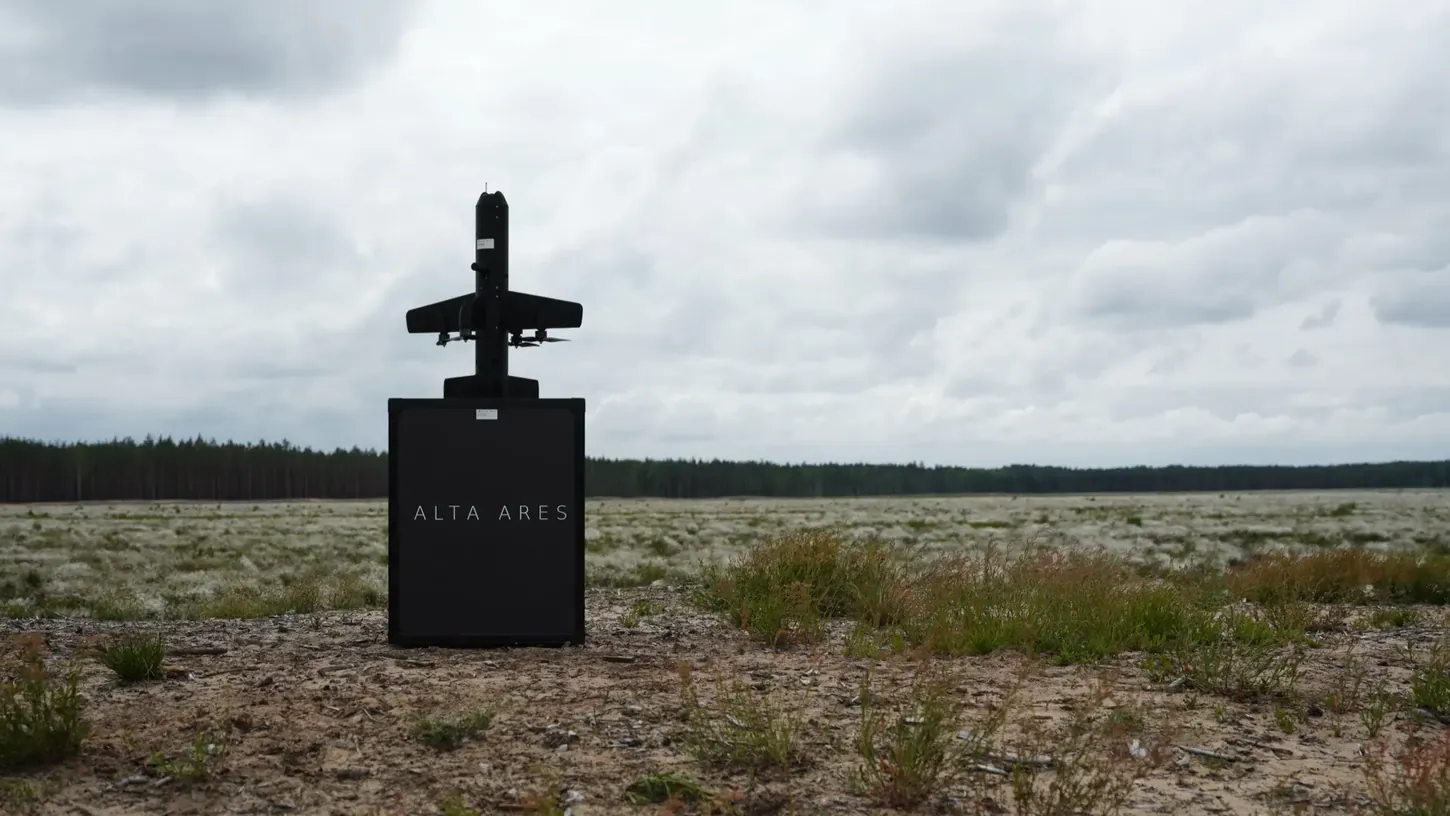
NATO opened its counter-drone marketplace on November 5: a catalog of 16 systems from five companies that Allies can now buy without running a tender of their own. The five are Alta Ares, Axon, Northrop Grumman, OSL UK and Quantum Systems. Alta Ares, a French company founded in 2024, says it won six of the 16 lots, more than any other supplier.
The contracts themselves carry no money. The tender notice behind them says funds are committed only when a country or NATO command places an order, and the one common pot so far is €3.1 million for testing.
NCIA’s Shortlist Came From a Bidder List of 85 Companies
The NATO Communications and Information Agency’s tender notice of 19 December 2025 listed 85 companies as prospective bidders, a list NATO nations could add to, and admitted only systems already deployed with NATO nations or allied forces. Prototypes were barred. Neither NCIA nor NATO has said which companies actually bid.
Four of the five winners appear on that notice: Alta Ares, Northrop Grumman Systems, Operational Solutions Ltd (OSL UK) and Dedrone Defense, the counter-drone business Axon agreed to buy in 2024. Quantum Systems does not, and the notice let NCIA accept nominations after the deadline. Larger names on the list, among them Anduril, Thales, Saab and Fortem, the company Lockheed Martin picked in March for critical infrastructure work, are not in the catalog, and whether they bid is not public. The notice also left man-portable and wearable systems to a separate NATO Support and Procurement Agency contract and required bidders to hold NATO Restricted security clearances.
NCIA’s announcement says every selected system has already been deployed in Allied countries and in Ukraine. Bids were scored against four reference scenarios. Point protection covers a single site such as a command post. Area protection covers a zone up to 1.9 miles (3 kilometers) across, and border protection a 12-mile (20-kilometer) segment. The convoy scenario is a column up to 980 feet (300 meters) long moving at 31 mph (50 km/h).
Alta Ares Says It Holds Every Area Protection Lot
Alta Ares says its six lots cover area defense and border protection, and that it is the only supplier selected for area defense in all three mobility classes: static, transportable and on-the-move. NATO has not published the lot-by-lot split, so that count rests on the company’s word.
The Paris company announced the award the same day, saying NCIA picked five firms from close to 100 applicants. It raised €50 million in June and says its software is trained on battlefield data from Ukraine and from operations in the Gulf, with Shahed-type attack drones and loitering munitions as the target set. “A counter-drone system has to work end-to-end,” CEO and co-founder Hadrien Canter said.
Jamie O’Connor-Delbert, the company’s director of EU, NATO and Eastern Europe engagement, told Interfax-Ukraine the framework puts no cap on the quantity an Ally can buy and that NATO common funding will pay for test batches. Alta Ares and Quantum Systems, two of the five winners, announced at Eurosatory in June that they would explore counter-drone cooperation.
The Catalog Pays Out Only When an Ally Orders
Money reaches these suppliers through task orders. A nation or NATO command sets a requirement, NCIA asks the awardees in that category for quotes, and they get roughly two weeks to answer. Allies can buy, lease or lease-to-own, under the process the December notice lays out.
The detection and engagement radius in the requirements runs from 1.2 to 25 miles (2 to 40 kilometers), wide on purpose because no operational requirement existed yet. The more than $40 billion often attached to the marketplace is a separate pledge. NATO’s announcement describes it as Allies’ commitment under Drone Edge, launched at the Ankara summit’s defense industry forum in July, to spend that sum on counter-drone capabilities over five years. That money sits in national budgets. Bulgaria, for one, took delivery of its first two counter-drone systems, bought from Axon, in August.
The process also ran late. The December notice planned contract award for June 30 and a one-year framework re-competed annually. The awards were announced November 5, and the contracts run 18 months from signature, with an option to extend.
The US Army Plans a Rival Marketplace for the Same Allies
Army Secretary Dan Driscoll signed a statement of intent at Eurosatory on June 16 with NATO Allies including Sweden, Denmark, Norway, France, Poland, the United Kingdom, the Netherlands, Italy and Lithuania, to open the Army’s UAS marketplace to them. Each of those countries can also order from NCIA’s catalog.
Driscoll pitched it as a way to “get our government and other governments’ regulation out of the way,” according to the Army. At home, the Pentagon’s counter-drone marketplace run by Joint Interagency Task Force 401 went live for US bases and agencies in February.
DroneXL’s Take
I like the filter NCIA used. Barring prototypes and requiring systems already fielded with allied forces is the right test for a threat NCIA itself calls rapidly evolving. My read is that it’s why a company founded in 2024 sits in the same catalog as Northrop Grumman.
The catalog still has to prove it’s a buying channel and not a shortlist. An Ally in a hurry can already buy directly, as Bulgaria did, and the US Army is opening its own marketplace to the same countries. NCIA’s route gets used only if its two-week quote process beats both. No task order against these contracts has been announced, and the first one is what I’ll be watching for.
Sources: NCIA, NCIA notice of intent CO-42530191-CUAS, NATO, Alta Ares, Interfax-Ukraine, U.S. Army
DroneXL uses automated tools to support research and source retrieval. All reporting and editorial perspectives are by Haye Kesteloo. Read our editorial standards.


