
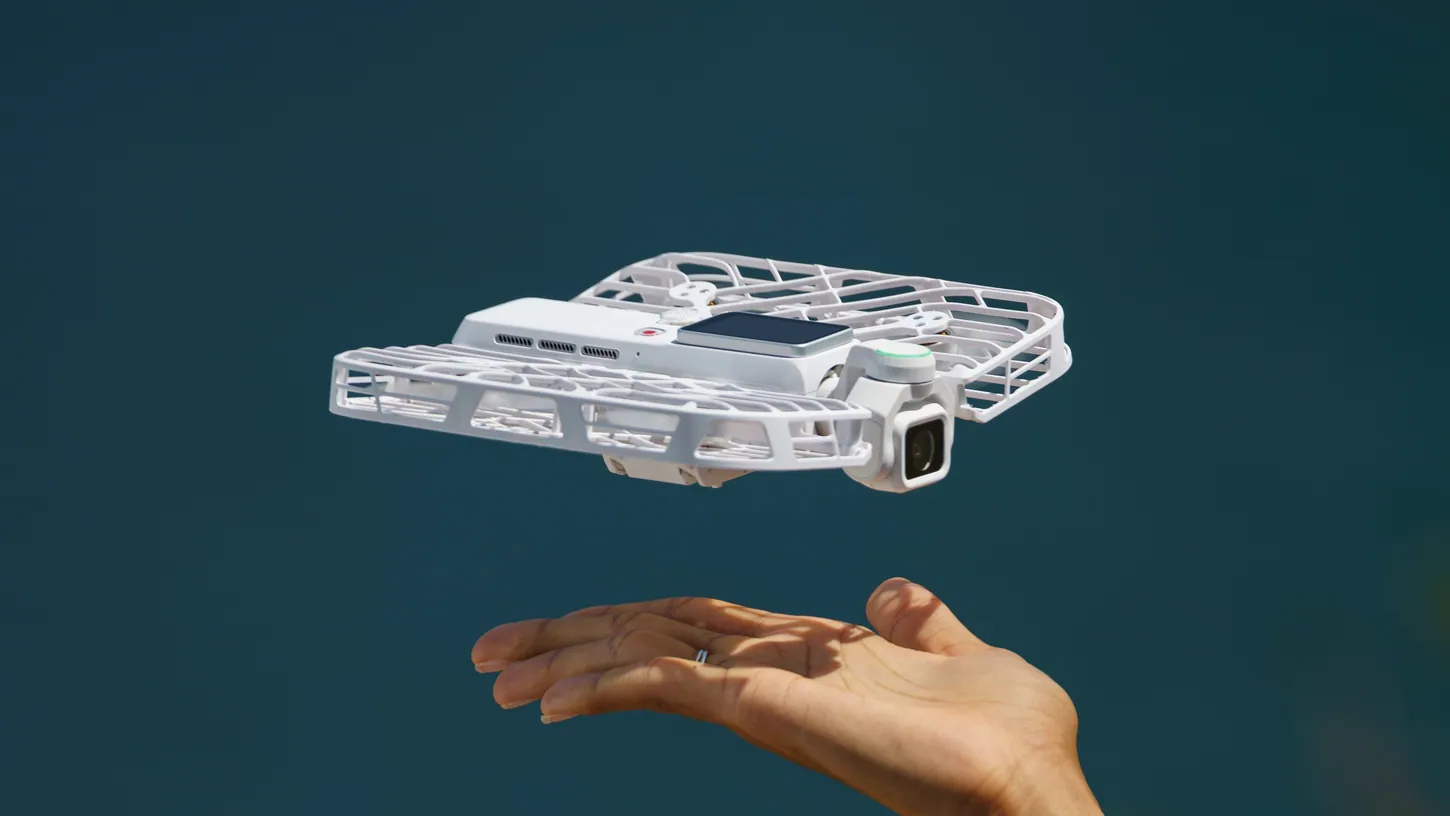
HOVERAir put the VERSA on sale today, November 10, through its own web stores, Amazon and retail partners. The 2-in-1 camera costs €499 (£429) on its own, and the FlySmart bundle that adds the clip-on Flight Kit costs €599 (£519). HOVERAir’s price list also covers Australia and its Canadian store.
The United States is not on that list. A US visitor who clicks Shop on hoverair.com is sent to HOVERAir’s global store, set to Canada, and the company’s own price sheet says “VERSA is currently not available in the US.”
VERSA Packs A Flying Camera Into A 163-Gram Handheld
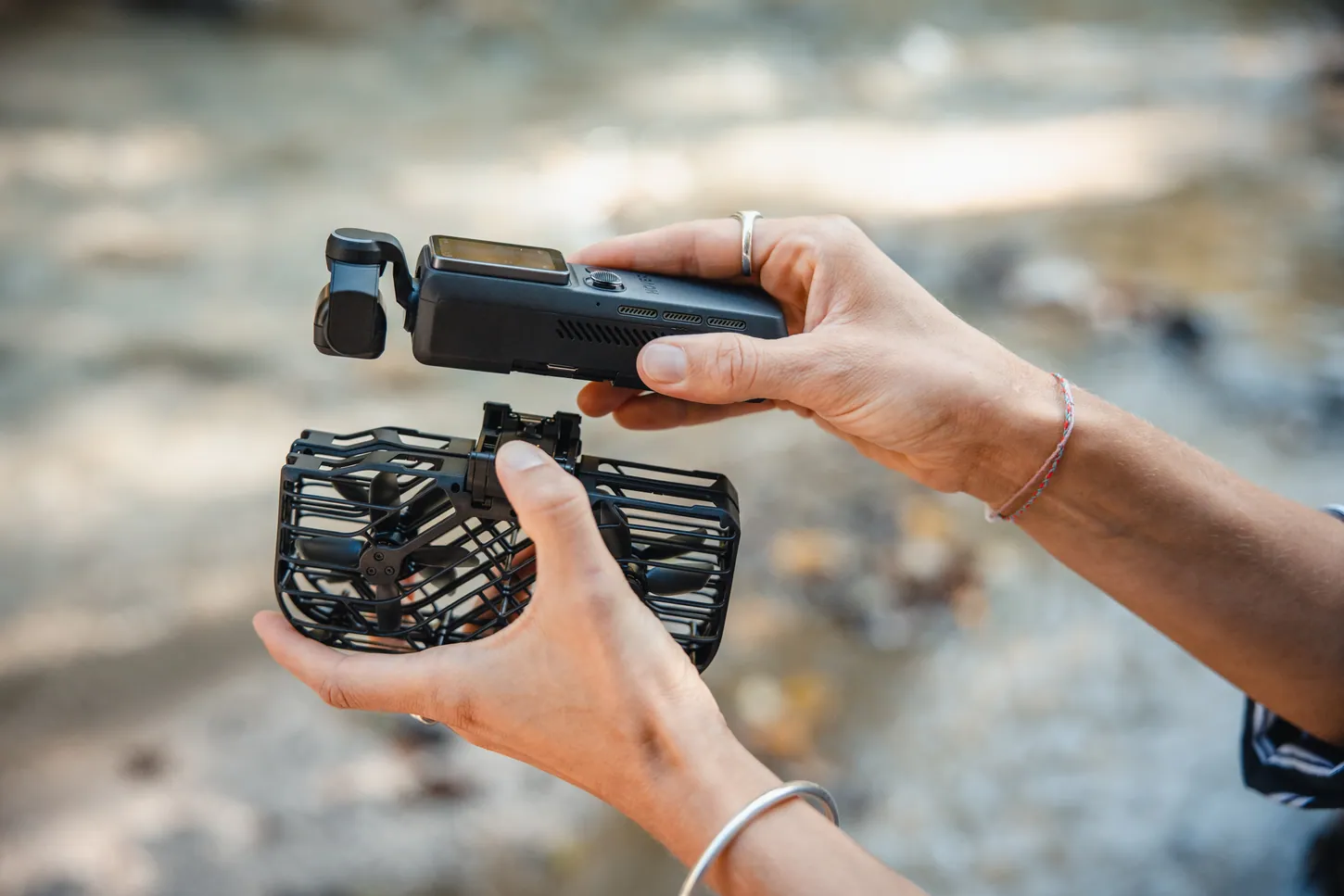
In handheld mode the VERSA weighs 163 grams and shoots 4K at 60 frames per second on a 1/1.3-inch sensor through a 3-axis mechanical gimbal. Snapping on the 67-gram Flight Kit turns it into a 230-gram self-flying camera rated for 14 minutes in the air.
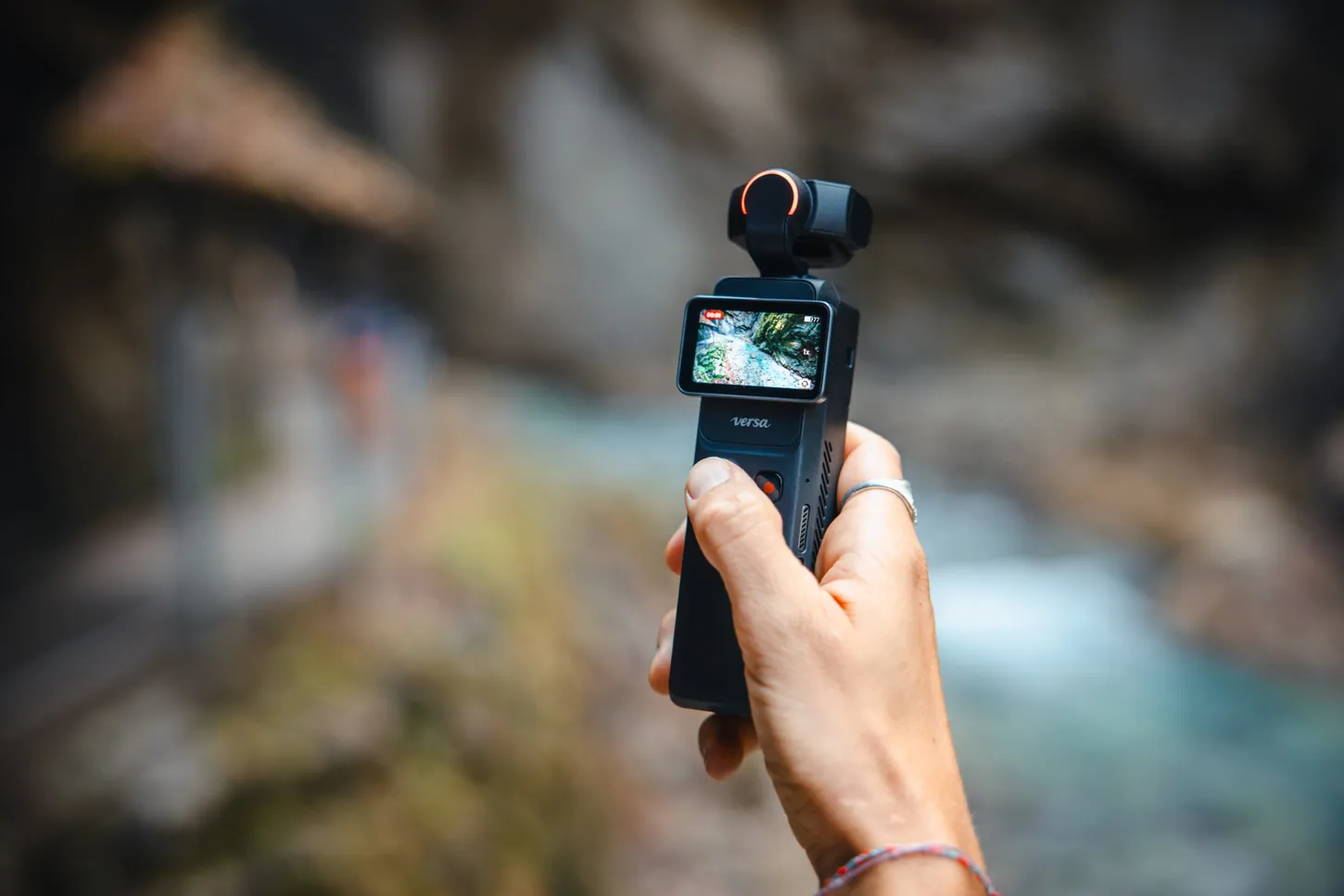
Co-founder MQ Wang, in a background interview HOVERAir sent out with its launch kit, spends much of it on the joint between the two halves. The patent-pending MagLatch mount went through 5,000 attach cycles plus vibration, pull and torsion tests so the propeller cages stay attached at up to 22 mph (36 km/h) and in Level 5 winds. The pogo pins, rated for up to 5 amps, took nearly two years of custom work.
The camera runs on a 4-nanometer chip with no fan. It cools passively in the hand and from propeller airflow in flight, which Wang says keeps fan noise off the built-in microphone. A 2,070 mAh swappable battery covers both modes, good for up to three hours of handheld recording or one 14-minute flight. HOVERAir rates the sensor at up to 17.5 stops of dynamic range, a figure from its own spec sheet, and its 3D Worlds mode flies a 360-degree path to build a scene with Gaussian splatting.
Wang’s case for the product is that most people don’t want to become drone pilots, they want the aerial perspective. The VERSA puts that idea inside a camera people carry whether they plan to fly or not.
The FCC Said In August That Even The Camera Alone Is Covered
HOVERAir’s price sheet does not give a reason. In August, the FCC set aside the VERSA’s equipment authorization days after Indiegogo pre-orders opened. It said the camera alone is a prohibited UAS critical component under its Covered List and the camera with the Flight Kit is a foreign-made drone.
DroneXL initially reported on August 18 that the VERSA had cleared the FCC, based on HOVERAir’s statement and a grant that appeared in the agency’s database. ZeroZero Robotics had sought authorization for the camera alone, with the propeller cages treated as an accessory. The FCC then told DroneXL the grant was issued in error, that selling the device in the US is “a violation of U.S. law,” and that it was weighing further action against HOVERAir for an apparently willful violation. The rule behind it is the FCC’s December 22, 2025 decision to add all foreign-produced drones and their critical components to the Covered List. After the VERSA case, the FCC said it was sending guidance to all Telecommunications Certification Bodies, the private labs that issue grants, to strengthen their screening.
When DroneXL checked the global store from a US connection on November 10, it showed Canadian pricing in US dollars: $539 for the camera and $649 for the FlySmart bundle. Its country selector had no US option, and the price sheet’s footnote says the USD prices apply to the Canadian store only.
The Indiegogo campaign now says shipping is underway and most orders were expected out by the end of October. Backers can request a refund through HOVERAir’s customer support until their order ships. As of November 10, the campaign page does not mention US backers. The VERSA is the second HOVERAir product this year, after the waterproof AQUA in May, to go on retail sale without the US.
DroneXL’s Take
Calling the Flight Kit a drone is the Covered List doing exactly what it says, and in my view HOVERAir earned the August reversal by certifying the camera alone. The camera half is harder to defend. As I read the FCC’s statement, the only thing making a 163-gram handheld gimbal a drone part is the kit it docks into, so an optional accessory keeps it off US shelves. American buyers already watched DJI’s Osmo Pocket 4P launch without them in July because DJI itself is on the Covered List. The FCC’s published test asks whether a part is designed and intended primarily for drone use, and its VERSA statement never explained how a handheld camera meets it. I think the agency owes manufacturers that explanation in writing, because right now nobody building a camera with an optional flight module can be sure it is legal to sell here.
Sources: HOVERAir launch release and 2026 price overview, HOVERAir VERSA specifications, HOVERAir background interview with MQ Wang, HOVERAir, Indiegogo, FCC spokesperson statement provided to DroneXL in August 2026
DroneXL uses automated tools to support research and source retrieval. All reporting and editorial perspectives are by Haye Kesteloo. Read our editorial standards.


