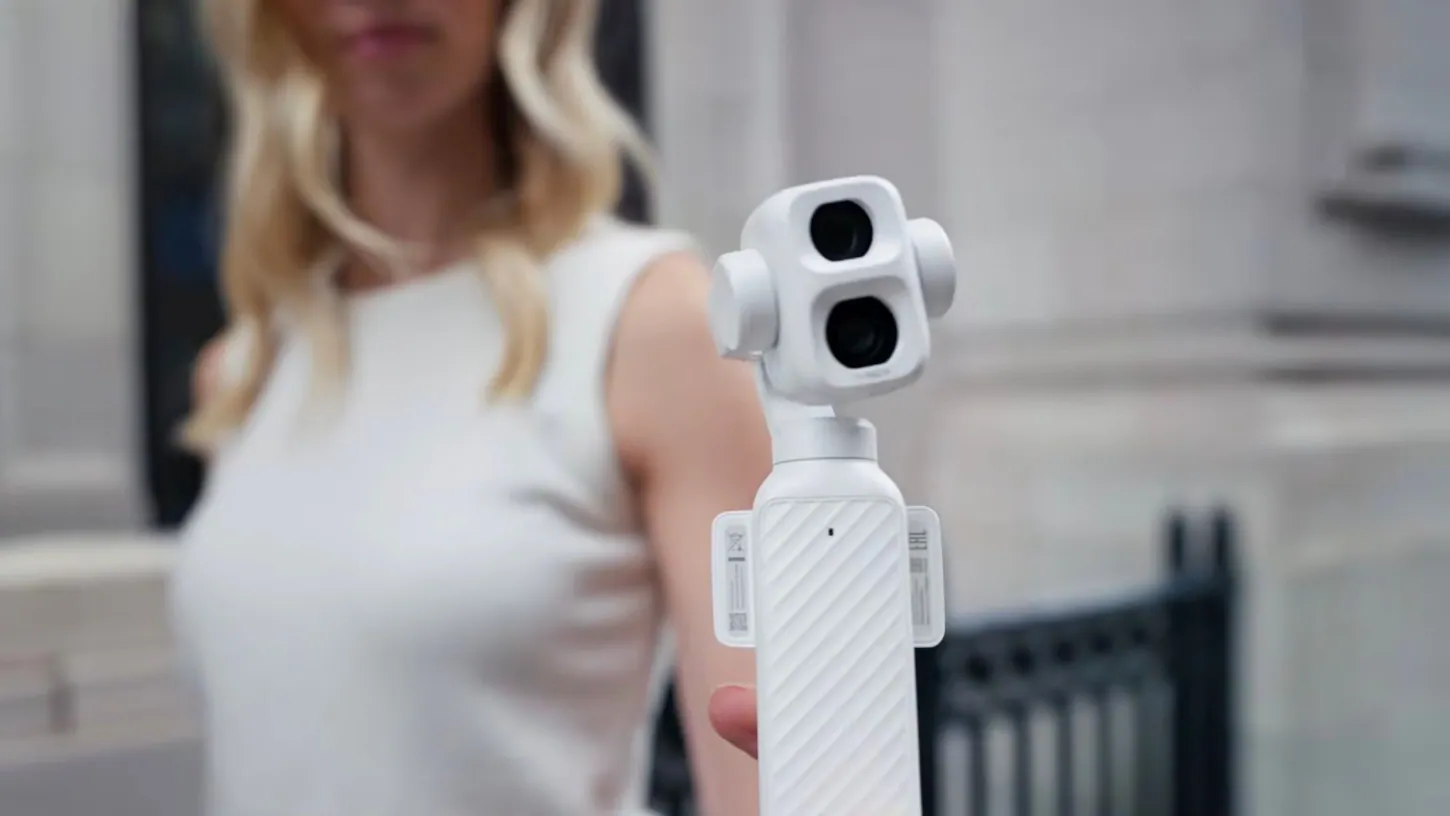
DJI opened worldwide sales of the Osmo Pocket 4P today at 12:00 GMT, putting its first dual-lens pocket gimbal camera on shelves across the UK, Europe, Canada, and Australia. The Standard Combo starts at £529 / €599, about $704 at DJI’s own conversion, and the United States is missing from the availability map for the second Pocket launch this year. The press release announcing the global rollout does not mention the country once.
DroneXL has tracked this camera from the first coordinated teasers in early May through the China debut on June 15, so the exclusion surprised nobody here. What did surprise the industry landed the same morning: an independent lab put DJI’s 17-stop dynamic range claim on a test chart and recorded the best sensor measurement in its history, ahead of the ARRI Alexa 35.
CineD Measured The Best Dynamic Range Result In Its Lab’s History
CineD’s lab test, published today, measured the Pocket 4P’s 1-inch wide camera at 16 stops of dynamic range at a signal-to-noise ratio of 2 and 17.2 stops at SNR 1, the highest figures the outlet has ever recorded, ahead of every cinema camera it has tested.
The sensor uses LOFIC, short for lateral overflow integration capacitor, a design that banks extra highlight charge instead of clipping it. Paired with the new 10-bit D-Log 2 profile at a native ISO of 1600, the wide camera held detail CineD normally sees only from dual-gain cinema sensors. Lab tester Gunther Machu called it “the best result we ever saw since we test cameras.” The outlet noted the Alexa 35 costs roughly 100 times more than the Pocket 4P.
The fine print matters. At the industry-standard SNR 2 threshold, the measured 16 stops sits just under DJI’s 17-stop marketing number, and the 10-bit codec caps real-world exposure latitude at about 10 stops before posterization creeps in. The Alexa 35 still wins latitude at 12 stops with its 13-bit ARRIRAW. The 60mm telephoto’s smaller 1/1.28-inch sensor tested at a conventional 11.6 stops. None of that dents the headline. A pocket camera just posted chart numbers ARRI territory was supposed to own.

DJI’s launch graphic lists the Osmo Pocket 4P’s headline features. Photo credit: DJI
Two Cameras Split The Work Inside A 230-Gram Body
The Osmo Pocket 4P pairs a 1-inch, 20mm-equivalent f/2.0 wide camera with a 60mm-equivalent f/1.8 telephoto on a 1/1.28-inch sensor, delivering 3x optical zoom and 12x total reach from a 3-axis mechanical gimbal inside a 230 g (8.1 oz) body.
The wide camera records 4K/240fps for 8x slow motion, while the telephoto tops out at 4K/200fps. ActiveTrack 8.0 holds subjects locked at full zoom, and the 2-inch, 1,000-nit OLED rotates to power the camera on and start recording in one motion. Today’s press release also confirms 37MP stills, 4K Live Photos that record 1.5-second clips with every shot, 800 MB/s wired transfers over USB 3.1, an 18-minute charge to 80%, and up to 210 minutes of runtime. The 103GB of built-in storage carries over from the China spec sheet DroneXL documented at that launch. It comes in classic black or pearl white, though CineD reports only the black model is available from day one, with pearl white to follow.
The Standard Combo, with camera, fill light, carrying pouch, and a threaded handle, lists at £529 / €599. DJI’s Canadian storefront, which prices in US dollars, shows $619. The Vlog Combo at £605 / €689 adds a Mic Mini 2, Mini Tripod, larger bag, and the FrameTap remote.
The Covered List Blocks A Camera That Does Not Fly
DJI has been on the FCC Covered List since December 22, 2025, which prevents new DJI hardware from receiving the equipment authorization required for legal US sale, and the Pocket 4P’s certification landed on the wrong side of that cutoff.
The standard Osmo Pocket 4 shipped in April with no US price for the same reason, while the older Osmo Pocket 3 stays on American shelves under its pre-listing authorization. Yesterday DroneXL found both blocked cameras listed on Amazon through third-party importers, with the 4P at $980 and an August 17 to 26 delivery window, a $276 premium over DJI’s own conversion. The one dual-lens pocket gimbal Americans can buy through normal retail is the Insta360 Luna Ultra, a matchup DroneXL broke down in June. A rule written for drones now decides which handheld cameras Americans may purchase.
DroneXL’s Take
I have covered every Osmo Pocket since the original launched in 2018, and this is the first one where the lab report matters more than the spec sheet. An independent test bench confirmed that a $704 pocket camera out-measures a cinema camera costing roughly 100 times more on dynamic range, on the same day the country that wrote the Covered List got left off the availability map. Sit with that. This device does not fly. It captures no aerial imagery. The security framework Congress and the FCC sold to the public as a drone measure is functioning as a tariff wall for the camera aisle, and the protected market it created went to Insta360, another Shenzhen company that no longer has to beat this sensor on merit to own the US dual-lens segment.
The protection story falls apart at the register, where American creators pay $980 on the gray market against a £529 official price everyone else pays. The Mini 5 Pro launch ran this exact script in October 2025 and the Pocket 4 ran it again in April. Importers fill the vacuum, prices float above official, DJI says nothing about America. Watch the third-party listings DroneXL flagged yesterday rather than DJI’s US store page. One of those two will show movement first, and it will not be the store page.
Sources: DJI via PR Newswire, CineD, DJI product listings.
DroneXL uses automated tools to support research and source retrieval. All reporting and editorial perspectives are by Haye Kesteloo.