The Federal Communications Commission (FCC) said Friday, November 20, that 71 companies have now been cleared to sell equipment its Covered List would otherwise bar, and 23 of them make drones or drone components. The other conditional approvals went to 24 router companies, 17 robotics companies and seven power inverter makers.
Every approval depends on a plan to move production to the United States. The FCC says the 71 companies have together promised $4.4 billion in investment and 4,700 jobs, and Chairman Brendan Carr said the list has produced “a surge in investment in American manufacturing.” DroneXL has followed the exemption list since the first four drones came off it in March.
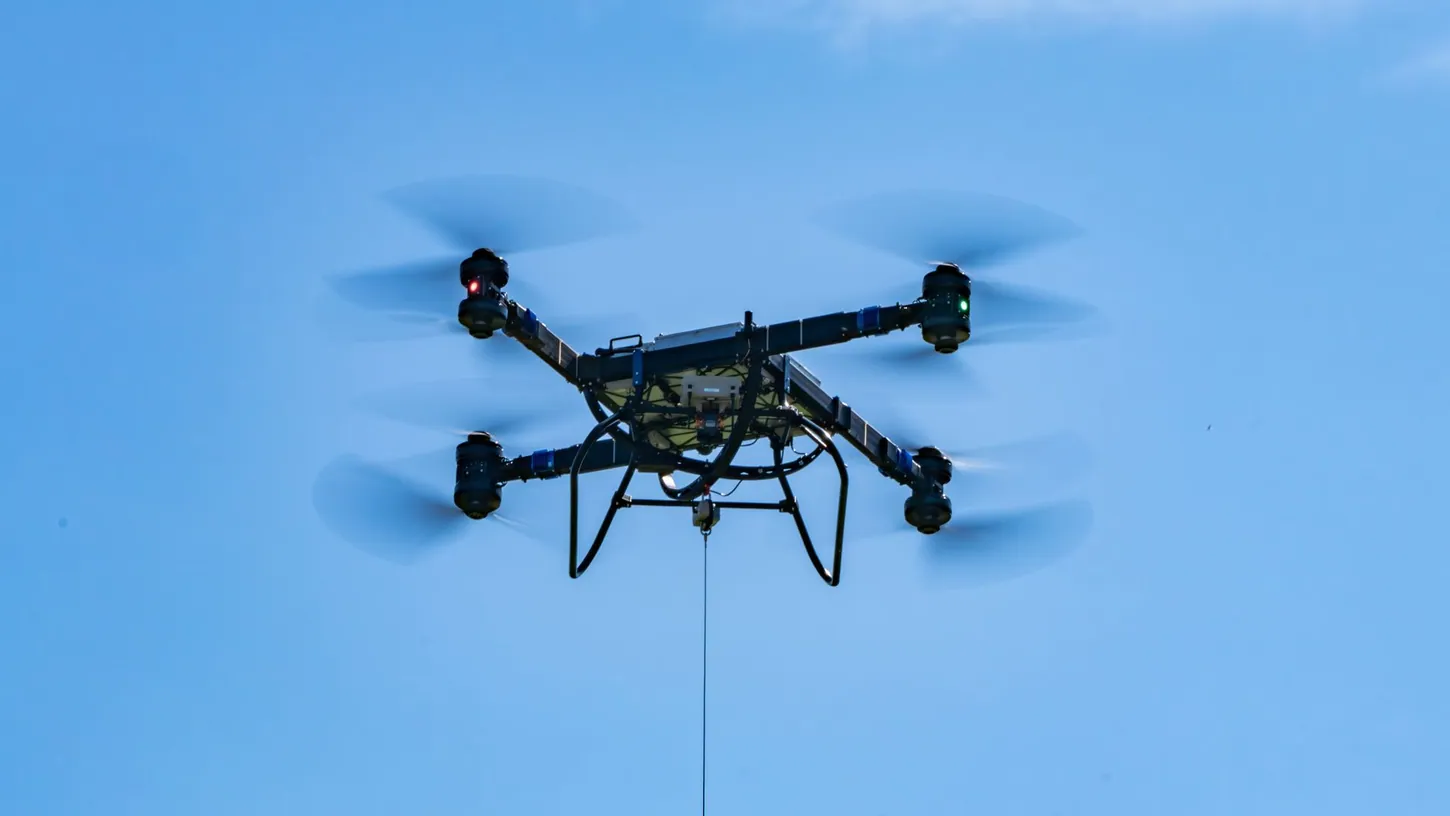
The newest drone on the list is the FB3, a heavy lifter from Italy’s FlyingBasket that carries up to 220 pounds (100 kilograms). It was cleared on November 18. FlyingBasket’s own product page says the FB3 is made in Europe and that U.S. production starts in early 2027.
Drones Account for 23 of the 71 Approvals, and None Is a DJI or Autel
The FCC’s November 18 public notice lists 23 drone and drone-component approvals, the first four dated March 17 and the latest November 18. No DJI or Autel product appears, and both companies sit on the Covered List under a separate entry, Section 1709 of the fiscal 2025 defense bill.
The notice, DA 26-1243, added five approvals this week: the FB3, routers from EnGenius and Zyxel, and robots from Syncrobotic and Bluepath Robotics. The drone table also holds Flock Safety’s Alpha, Manna’s delivery aircraft, Percepto’s Air Max, Exedy’s Ayre CX sprayer, ABZ Innovation’s L50 and the VEX AIR classroom drone.
Applicants send the FCC information on their ownership, their cybersecurity and their onshoring plan, and the Department of War and the Department of Homeland Security review it. The notice treats each approval as a specific determination by the Department of War that the device does not pose a national security risk. The FCC’s release says the average case now takes 24 days, down from 40 three months ago.
Drone approvals carry no end date, while every router approval in the appendix expires within about 18 months. The notice says an approval without a termination date stays in force as long as the company follows its onshoring plan and its products pass updated vetting. A company that misses its plan, or made a false statement in its application, can have its equipment returned to the Covered List.
The FCC’s Drone Investment Figure Reached $6 Billion With No Breakdown
The FCC’s release says $6 billion has been invested in U.S. drone manufacturing since December, with 5,700 jobs. It names no company or project behind it. A July fact sheet put it above $4 billion, and the FCC’s senior national security counsel said $5 billion to $6 billion in October.
That figure came from Adam Chan, who gave it in an interview published October 30 without a breakdown either. The release is more specific about other sectors. It names Amazon’s robotics sites in Texas and Illinois and a 130,000-square-foot Foundry Robotics plant. It counts more than $119 million and more than 2,000 jobs in routers, and about $600 million and more than 1,200 jobs in power inverters.
The release does not split the $4.4 billion in pledges by sector or by company. The FCC says almost all of the 71 companies relied on foreign production before they applied.
Gomez Says the Covered List Has Become an Industrial Policy Tool
Commissioner Anna Gomez, a Democrat, said Thursday that the Covered List was meant to keep insecure equipment from adversary countries out of U.S. networks, Reuters reported. She said the administration now uses it to win concessions unrelated to security, and that it has “instead become an industrial policy tool.”
Congress is looking at the list too. On September 23, House Energy and Commerce Chairman Brett Guthrie and ranking member Frank Pallone introduced the Communications and Technology Transparency Act. Their summary says equipment could be added to the list when Congress or the Commerce Department, working with national security agencies, deems it malicious, and that Congress would get more oversight of additions and removals. Reuters reported that the bill signaled congressional concern about how the FCC uses its authority.
The list is still growing. Reuters has reported that the FCC could use it next to bar new models of Chinese optical transceivers, which data centers depend on.
DroneXL’s Take
The FCC’s release counts dollars and jobs, and it does not describe one security threat that an approval removed. Gomez made that argument a day earlier, and the agency’s own numbers support her.
Each drone approval is a Department of War finding that the aircraft poses no national security risk, and the review covers ownership and cybersecurity. But every approval is also conditional on the onshoring plan, and a company that misses its plan goes back on the list. The FB3 that was cleared on November 18 will be built in Europe until FlyingBasket’s U.S. line starts next year. If the aircraft is safe today, I don’t see what the factory has to do with security. My read is that this is trade policy run through an equipment-authorization office, and DroneXL opposes protectionism dressed up as security.
For pilots, the list shows where this is heading. I can’t find a consumer camera drone among the 23 approvals. They are mostly sprayers, heavy lifters, delivery aircraft and inspection systems sold to businesses, plus a classroom drone and a light-show drone. Eleven months after the FCC barred every new foreign-made drone, no drone cleared by this process replaces a Mini 5 Pro.
Sources: FCC news release, FCC Public Notice DA 26-1243, Reuters, House Energy and Commerce Committee, FlyingBasket
DroneXL uses automated tools to support research and source retrieval. All reporting and editorial perspectives are by Haye Kesteloo. Read our editorial standards.
Advertise with DroneXLYour company hereReach 200,000+ drone readers a month with a sponsored article, a banner on your beat, or a partnership.See the options →