
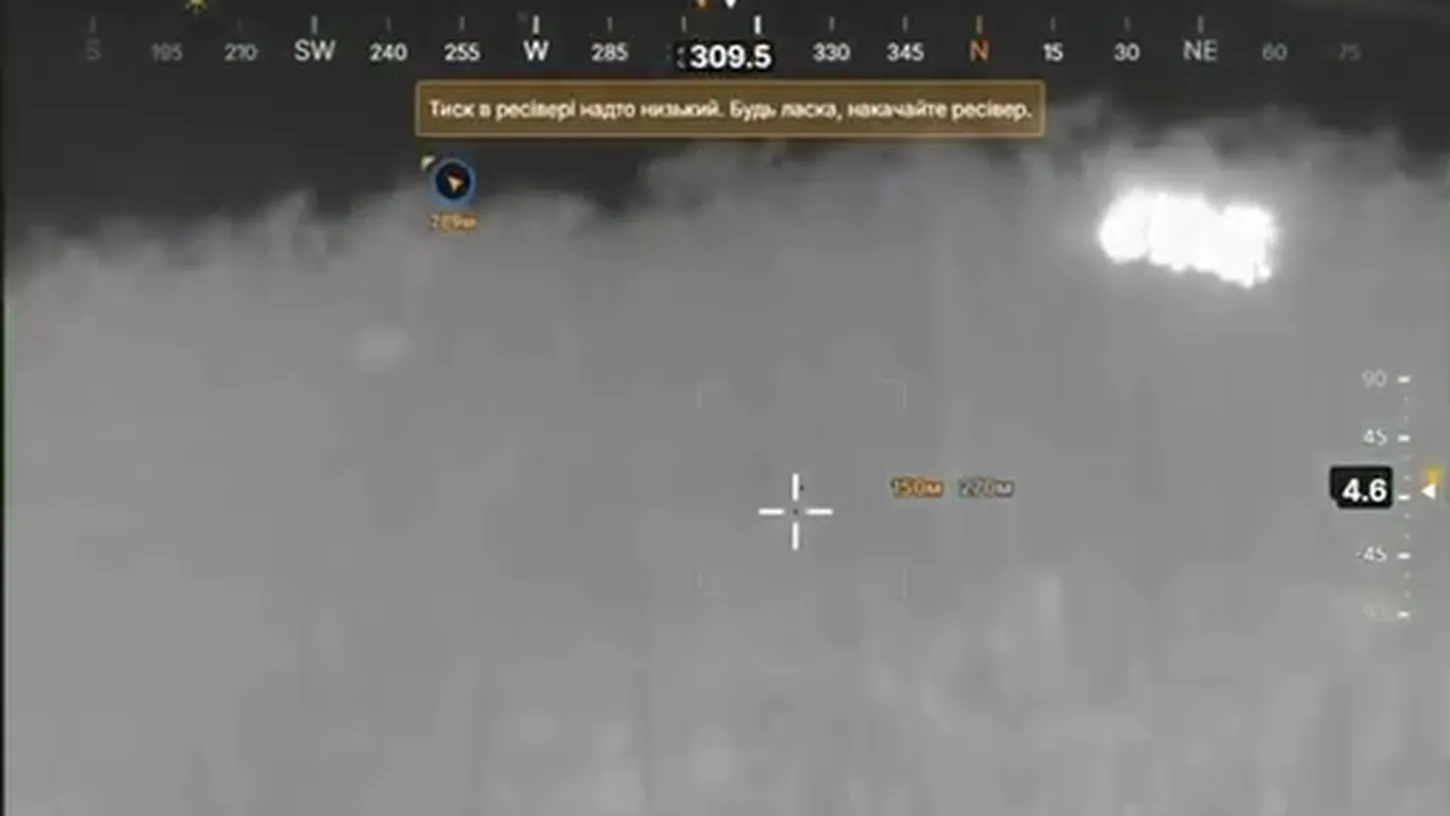
Ukraine’s Blysk laser air defense system shot down a Russian jet-powered Geran drone while guarding a critical infrastructure facility, presidential adviser Serhii “Flash” Beskrestnov said on November 25. He called it the first time any laser had downed a jet Geran, and posted a 21-second video of the engagement.
Blysk is built by the Ukrainian company Carmine Sky and rated at 4 kilowatts by its developers. It went on combat duty in Kyiv in early November. A week ago the company was explaining why it had not hit anything yet: cloud cover and fog over Kyiv had kept it from engaging Russian drones.
Beskrestnov says serial production of the laser is still too early
Beskrestnov, a defense technology adviser to President Zelensky, wrote in a Telegram post that Carmine Sky’s Blysk units are showing first combat results, and that the jet Geran fell “recently.” He named no site, date or variant, and wrote that it is “too early to talk about serial production.”
The post says several Ukrainian companies are developing laser air defense and that the technology is very complex and expensive. The lasers protect infrastructure sites while their trials continue. Blysk is developed under Ukraine’s state Private Air Defense program, which lets businesses field their own air defense crews, with support from the Brave1 defense tech cluster.
The video shows a targeting screen. A crosshair follows a small target past street lamps, then a white fireball fills the upper corner of the frame. Nothing in the footage identifies the drone type. The claim rests on Beskrestnov’s post and video, and the coverage so far relays it.
Jet Gerans fly at up to 500 km/h, while Blysk works inside 1 kilometer
The jet versions are what make the claim interesting. Ukraine’s military intelligence (GUR) says the Geran-4 flies at up to 500 km/h (310 mph) and the Geran-5 K5-K cruises above 450 km/h (280 mph). The propeller Geran-2 tops out around 185 km/h (115 mph).
Carmine Sky’s own figures, reported on November 19 by the Kyiv Independent and LB.ua from an interview with BBC News Ukraine, give Blysk an effective range of up to 1 kilometer (0.6 miles). The company says small FPV drones burn in a fraction of a second, while a Shahed-type airframe needs the beam held for several seconds because of its multilayer hull. A target at 500 km/h covers about 139 meters (456 feet) every second, so it crosses a 1-kilometer bubble in about 7 seconds.
The laser does not slice the drone apart. In a follow-up post Beskrestnov explained that it holds a spot on one point of the airframe until the parts inside overheat and fail, and that power sets both the range and how long the spot has to stay there.
Blysk carries a fraction of the power of Israeli and US lasers
Israel’s Iron Beam is a 100 kW system with a range of up to 10 kilometers (6.2 miles). In September the US Army awarded AeroVironment $464.8 million for the 30 kW LOCUST X3, the first production contract for a laser weapon in US military history.
Military officials credit an Army version of the LOCUST with cutting cartel drone flights over the Rio Grande Valley by about 75%. Those border kills were small quadcopters, not jet-powered attack drones.
Carmine Sky says Blysk has no connection to Tryzub, the laser that former Unmanned Systems Forces commander Vadym Sukharevskyi described in 2024. It is also separate from Sunray, the truck-mounted laser The Atlantic reported in February.
DroneXL’s Take
I’d hold the “world first” label loosely until there’s more than one post and one video behind it, but the direction is right. Ukraine’s newest answers to the jet Geran have been interceptor drones, and two days ago we ran Quantum Systems’ claim that its SPYS interceptor took down a Geran-5. Every one of those interceptors gets used up. A laser that costs electricity per shot changes the math, even with a 1-kilometer reach and a fog problem, because a defender can park it next to the one site it has to protect and never run out of shots. The test I’m watching for is a second confirmed jet kill, with a date and a place attached.
Source: Serhii Beskrestnov on Telegram, Kyiv Independent
DroneXL uses automated tools to support research and source retrieval. All reporting and editorial perspectives are by Haye Kesteloo. Read our editorial standards.
Advertise with DroneXLYour company hereReach 200,000+ drone readers a month with a sponsored article, a banner on your beat, or a partnership.See the options →


