DJI Mini 5 Pro Prop Guards Hands-On: The Firmware Restrictions Nobody Mentioned

Check out the Best Deals on Amazon for DJI Drones today!
I was genuinely excited when these 360° prop guards for the DJI Mini 5 Pro finally became available. After testing them extensively, I can tell you they’re unlike anything DJI has released before – but not entirely in the ways you might expect.
Here’s what you need to know upfront:
- What: DJI’s new quick-release 360° prop guards with integrated propellers
- Price: $39 for four prop guards with built-in props
- Availability: DJI website (currently out of stock in Canada), Amazon
- Why it matters: Firmware-enforced restrictions limit distance to 500m, height to 120m, and trigger early return-to-home
The full details come from my hands-on testing in this video on my Air Photography YouTube channel.
A Completely New Design Approach

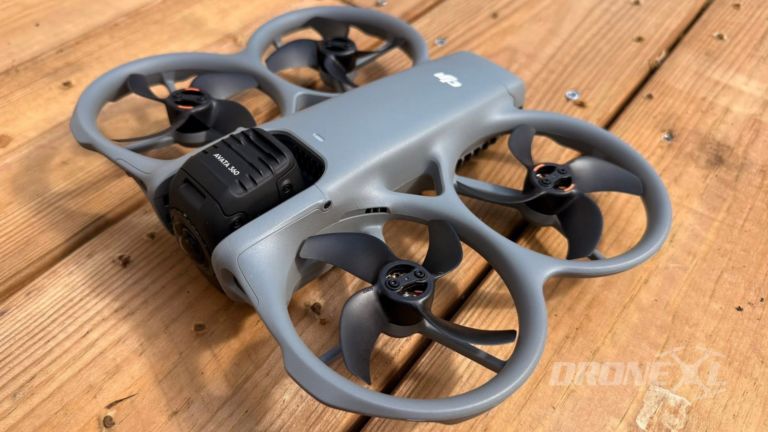
These prop guards are radically different from any DJI has made before. The propeller is built directly into the guard itself – it’s a non-replaceable, all-in-one unit. If you damage the propeller, you’re replacing the entire guard assembly.
The cost math works out like this: a regular prop set runs $11 for two propellers, so $22 for a full set of four. These integrated prop guards cost $39 for four. That’s roughly double the replacement cost if you nick a tree branch or bump a wall hard enough to damage the props.
Weight-wise, I was pleasantly surprised. Each prop guard comes in at about 16 grams, putting you at just over 60 grams total when all four are attached. For full 360° protection, that’s reasonable.
The Quick-Release System Actually Works

Installation couldn’t be simpler. The Mini 5 Pro has small grooves built into the motor arms – the guards clip right into these. Match the colors (orange to orange, gray to gray) just like regular props, press down, and they snap into place.
One critical note: always double-check that each guard is properly seated. I had one that didn’t click in correctly during my first attempt. The good news is the Mini 5 Pro’s firmware will detect improper installation and refuse to take off, displaying a warning message on screen. That’s a smart safety feature.
The magnetic storage feature is a nice touch. Small magnets built into the guards let you stack them together neatly when they’re off the drone. Makes packing them in a camera bag much easier.
You cannot fold the drone with these installed, so removal is mandatory before storage. Given how easily they clip on and off, this isn’t a major inconvenience.

The Firmware Restrictions Are the Real Story
Here’s where things get interesting – and where I think a lot of pilots will be surprised.
When you install these prop guards and take off, the Mini 5 Pro immediately detects them. You’ll see a message with several warnings about limitations. DJI isn’t hiding these restrictions, but the real-world impact is more significant than the specs suggest.
| Limitation | With Prop Guards | Standard Mini 5 Pro |
|---|---|---|
| Maximum Distance | 500 meters (hard cap) | 20 km (FCC) |
| Maximum Height | 120 meters (hard cap) | 500 meters |
| Max Speed (Sport Mode) | ~9 m/s (tested in moderate wind) | 19 m/s |
| Battery RTH Trigger | ~44% remaining (tested) | Standard calculation |
The 120-meter height limit aligns with the legal ceiling in most countries, so that’s not a practical issue for most pilots. But the 500-meter distance cap is firmware-enforced – when I tested it, I got both an audible and visual warning at the top left of the screen stating I could not fly any further.
You can technically adjust the sliders higher in settings, but the firmware overrides you. When I hit 120 meters altitude or 500 meters distance, the drone simply stopped.

The Battery Situation Changes Everything
Here’s the finding that surprised me most. During my test flight, the drone initiated a return-to-home sequence when I was only about 500 meters away with 44% battery remaining.
DJI does warn that battery performance won’t be as good and RTH will trigger sooner than normal. But triggering at 44% when you’re at the maximum allowed distance essentially means you’re getting maybe 10 minutes of useful flight time before the drone decides it’s time to come home.
Combined with the already shorter-than-advertised battery life many pilots are reporting on the Mini 5 Pro, this is a significant consideration.
Additional warnings from DJI include:
- Poor performance in wind – don’t fly on windy days
- Possible effect on transmission signal
- Potential impact on obstacle avoidance
The day I was testing had moderate wind – not overly windy – and my maximum speed in Sport mode was just over 9 meters per second. That’s a significant reduction from the Mini 5 Pro’s standard 19 m/s capability.
Who Should Actually Buy These

Let me be direct: these are not for everybody.
The use cases where these make sense:
- Indoor flying – bumping a wall won’t send your drone crashing
- New pilots learning – extra protection while building confidence
- Tracking through trees or shrubs – a light branch contact might not end your flight
I bought these specifically for tracking scenarios. When I’m using ActiveTrack through areas with trees or shrubs, having that extra layer of protection could prevent a crash if the drone nicks something at lower speeds.
But I want to be realistic: at high speeds, these guards won’t save you. A direct collision at 9+ m/s is still going to result in a crash. These provide protection against glancing contact, not full impacts.
When the prop guards first leaked, there was speculation about using the Mini 5 Pro for indoor real estate work – getting that 1-inch sensor quality in tight interior spaces where the DJI Neo or Flip can’t match image quality. The 500m and 120m restrictions don’t matter indoors, so for that specific use case, these could be exactly what professionals have been waiting for.

Quick Reference
The Bottom Line for Recreational Pilots:
- Firmware restrictions make these impractical for normal outdoor flying beyond 500 meters
- Early RTH trigger at 44% battery significantly reduces effective flight time
- Best suited for indoor use, learning to fly, or tracking through obstacle-heavy environments
- $39 price means double the replacement cost versus standard props if damaged
The concept is interesting – building the propeller directly into the guard is clever engineering and the magnetic storage feature is genuinely useful. But the firmware restrictions are the real consideration here. Know exactly what you’re getting before you order.

Are you planning to pick up these prop guards for your Mini 5 Pro? Let me know in the comments what use case you have in mind.
Discover more from DroneXL.co
Subscribe to get the latest posts sent to your email.
Check out our Classic Line of T-Shirts, Polos, Hoodies and more in our new store today!

MAKE YOUR VOICE HEARD
Proposed legislation threatens your ability to use drones for fun, work, and safety. The Drone Advocacy Alliance is fighting to ensure your voice is heard in these critical policy discussions.Join us and tell your elected officials to protect your right to fly.

Get your Part 107 Certificate
Pass the Part 107 test and take to the skies with the Pilot Institute. We have helped thousands of people become airplane and commercial drone pilots. Our courses are designed by industry experts to help you pass FAA tests and achieve your dreams.

Copyright © DroneXL.co 2026. All rights reserved. The content, images, and intellectual property on this website are protected by copyright law. Reproduction or distribution of any material without prior written permission from DroneXL.co is strictly prohibited. For permissions and inquiries, please contact us first. DroneXL.co is a proud partner of the Drone Advocacy Alliance. Be sure to check out DroneXL's sister site, EVXL.co, for all the latest news on electric vehicles.
FTC: DroneXL.co is an Amazon Associate and uses affiliate links that can generate income from qualifying purchases. We do not sell, share, rent out, or spam your email.