SpaceX implements Starlink speed limit to ground Russian strike drones in Ukraine

Check out the Best Deals on Amazon for DJI Drones today!
Two days after Ukraine’s Defense Minister Mykhailo Fedorov thanked SpaceX for its “quick response” to Russian drones using Starlink connectivity, we’re now seeing the first concrete result: a speed-based kill switch. Starlink terminals are now displaying a “Movement speed is too high” error and cutting connectivity when they detect movement above approximately 75-90 km/h (47-56 mph). That threshold sits just below the cruising speed of the fixed-wing strike drones Russia has been mounting them on.
Here’s what we know so far:
- The Development: SpaceX has deployed an emergency speed limit on Starlink terminals that disconnects service above 75-90 km/h, directly targeting Russian use of satellite-guided strike drones like the Italmas, Molniya, and Shahed.
- The “So What?”: Ukrainian FPV drones, which typically fly below this speed threshold, should remain largely unaffected. Fixed-wing strike drones that Russia relies on for deep rear attacks will lose their Starlink connection mid-flight. Terminals officially registered to Ukrainian brigades can have the limit removed through a whitelist system.
- The Source: Serhiy “Flash” Beskrestnov, advisor on defense technology to the Ministry of Defense of Ukraine, confirmed the measures on Telegram. Multiple Ukrainian OSINT accounts and Russian Telegram channels independently verified the speed restriction.
The speed limit targets the exact drones that hit that Ukrainian train
SpaceX’s new Starlink speed restriction disconnects satellite internet service on any terminal moving faster than approximately 75-90 km/h, an emergency countermeasure implemented at the request of Ukraine’s Ministry of Defense to prevent Russian forces from using commercially obtained Starlink terminals to guide strike drones against Ukrainian cities and military targets. The measure is temporary and will be replaced by a more comprehensive solution, according to Beskrestnov.
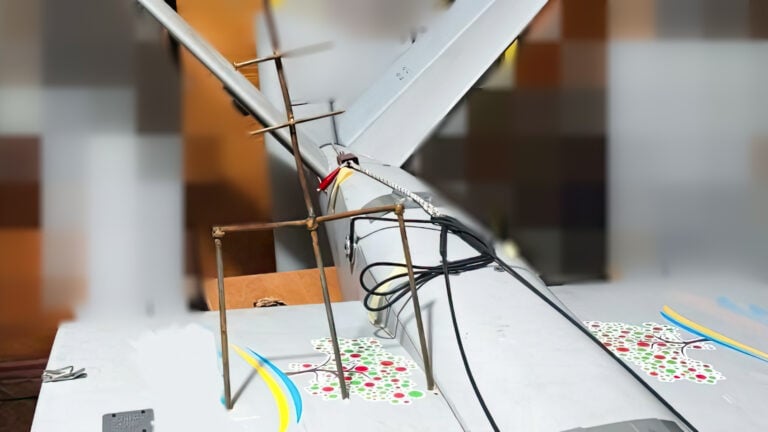
The technical logic is straightforward. Russian fixed-wing strike drones like the BM-35, Molniya, and Starlink-equipped Shaheds fly at speeds well above 90 km/h. The Molniya, a cheap plywood drone that Russian forces have been mounting with Starlink Mini terminals, cruises at speeds that trigger the cutoff. So do the Italmas and the modified Shaheds that struck a Ukrainian passenger train on January 27, killing at least five people.
Ukrainian activist and journalist Serhii Sternenko reported that Russians are already complaining on Telegram that Starlink connections drop at speeds above 90 km/h. He noted this makes it impossible to use the terminals on guided strike UAVs like the Italmas or Molniya. Smaller FPV drones, which operate at lower speeds and shorter ranges, can still function.
The Starlink terminal itself now displays an error screen with a red warning icon and the message “Movement speed is too high. Reduce the speed to restore the connection.” Screenshots of this error, in both English and Ukrainian (Cyrillic), have circulated widely on social media today.

Beskrestnov calls the restrictions “emergency measures” with a whitelist for Ukrainian forces
Serhiy Beskrestnov, known by his call sign “Flash,” is the advisor on defense technology to the Ministry of Defense of Ukraine and the same analyst who identified the Starlink connection to the train attack earlier this week. In a five-part Telegram thread published today, he confirmed that countermeasures are already working in Ukraine and laid out the broader plan.
Beskrestnov stated that he cannot publicly disclose everything that has been done, is being done, or will be done. But he was clear on several points. All actions are aimed at protecting Ukrainian people and infrastructure from enemy strike UAVs. The current restrictions are temporary, or as he put it, “EMERGENCY measures.” They will be replaced by what he described as a comprehensive, well-thought-out global solution that requires more time to implement.
The account @bayraktar_1love (Special Kherson Cat) on X added a detail that matters for Ukrainian forces: the speed limit can be removed if the Starlink terminal is officially registered as part of a brigade’s equipment. This is the whitelist system that CNN first reported Ukraine was pursuing back in 2024. It appears that version of the solution is now partially operational.
The downside is real. Ukrainian drones also use Starlink for beyond-line-of-sight control. As we covered in our Lasar’s Group piece, Ukrainian heavy bomber units have Starlink terminals integrated directly into their airframes for internet-based control at ranges approaching 40 miles. Those systems will need to be registered under the whitelist to keep functioning.
Ukraine’s Starlink data problem is bigger than the speed limit
Beskrestnov’s thread revealed a secondary challenge that is less dramatic but possibly more important for the long-term solution. Ukraine needs to collect complete information on all Starlink terminals in use across the Armed Forces, and soldiers have been reluctant to cooperate.
The problem is straightforward. Many soldiers use volunteer-provided or personally purchased Starlink terminals. These aren’t on any official inventory. Soldiers fear that reporting them to their commanders will result in confiscation, failure to replace them, or other bureaucratic headaches. Beskrestnov was blunt about this, acknowledging that previous attempts to catalog military Starlink use had failed for exactly these reasons.
This matters because any whitelist system only works if you know which terminals belong to friendly forces. Of the estimated 200,000 Starlink terminals operating in Ukraine, fewer than half were procured through official government channels, according to a December 2025 analysis by Militarnyi. The rest exist in a legal gray zone of private purchases, volunteer donations, and foreign sourcing.
Beskrestnov promised to find a way to gather this information that earns soldiers’ trust. He also stressed that SpaceX is directly involved in the process and is actively assisting specialists from the Ministry of Defence.
Russia already beat a 40 km/h speed limit once before
Sternenko’s post included an important historical detail that should temper expectations. Starlink previously had a lower speed threshold of approximately 40 km/h. Russian operators responded by developing proxy boards, hardware modifications that spoofed the terminal’s speed data to bypass the restriction. Starlink now determines speed and coordinates through its own satellite constellation rather than relying on terminal-reported data, making the new limit harder to circumvent.
But Sternenko himself cautioned that a workaround will eventually be found. The question is how long the current measure buys Ukraine before Russian engineers adapt.
The speed limit is a blunt instrument. It works right now because Starlink can independently verify how fast a terminal is moving by tracking its position against the satellite constellation. Previous attempts to restrict Russian use relied on geofencing and account-level blocking, both of which Russia circumvented through third-country purchases and black-market channels. Speed detection is harder to fake, but not impossible.
The 48-hour timeline from complaint to countermeasure
The speed of this response is notable. Here’s the compressed timeline:
On January 26, newly appointed Defense Minister Fedorov said Ukraine needed to respond “very quickly” to Russian Starlink-equipped drones. On January 27, Starlink-guided drones struck the passenger train in Kharkiv region. By January 29, Fedorov publicly thanked SpaceX President Gwynne Shotwell and Elon Musk for their “quick response and the start of work on resolving the situation.” Today, January 31, the first countermeasures are confirmed active in the field.
That is remarkably fast for a measure that affects a constellation serving over 200,000 terminals in a single country. It also shows what Fedorov brings to the defense ministry. As the former Minister of Digital Transformation who personally convinced Musk to provide Starlink within days of the 2022 invasion, he has direct channels to SpaceX leadership that his predecessors lacked.
Ukrainian journalist Illia Ponomarenko credited SpaceX for the response, noting that Russian “Z-fascist channels on Telegram are already whining that Starlink terminals stop working when used at speeds above 90 km/h.” He also pointed to Ukraine’s military statement that this is only a first, temporary solution, with countermeasures against Russia’s use of Starlink to be further refined in cooperation with SpaceX.
DroneXL’s Take
This speed limit is not a permanent solution. It is a tourniquet applied to stop the bleeding while surgeons prep for the real operation.
When we covered the train attack three days ago, I wrote that we’d likely see either a major policy announcement from SpaceX on military use cases, or Starlink terminals would start appearing on sanctions lists. The speed limit is a third option I didn’t predict: a technical countermeasure that doesn’t require policy changes or sanctions enforcement. SpaceX can push it as a software update across the entire constellation.
The real test comes in the next 30-60 days. Russia’s drone engineers are not sitting still. They already beat a 40 km/h limit with proxy boards. The new limit uses satellite-based speed verification, which is harder to spoof, but the cat-and-mouse dynamic never stops. I covered this pattern back in 2024 when the Pentagon announced it had worked with SpaceX to “successfully counter” Russian use of Starlink. Six months later, Russian terminals were back on the battlefield.
What’s different this time is Fedorov. Having the man who built Ukraine’s entire drone infrastructure now running the defense ministry, with personal relationships at SpaceX, creates a feedback loop that didn’t exist before. He can identify the problem on Monday, call Shotwell on Tuesday, and have a software patch deployed by Friday. That speed of response matters more than the specific technical measure.
The whitelist approach is the long-term answer. If SpaceX can reliably distinguish registered Ukrainian military terminals from unregistered Russian ones, the speed limit becomes unnecessary. But building that database requires solving the trust problem Beskrestnov described: soldiers who fear losing their privately purchased terminals won’t voluntarily register them. Expect this to take at least three to six months to fully implement, and expect Russian counter-adaptations well before then.
One more thing worth watching: the Sternenko post noted that strikes on Crimea have also dropped sharply since the countermeasures went live. If that correlation holds, this speed limit may already be saving lives in ways that go beyond the drone-specific threat.
Editorial Note: AI tools were used to assist with research and archive retrieval for this article. All reporting, analysis, and editorial perspectives are by Haye Kesteloo.
Discover more from DroneXL.co
Subscribe to get the latest posts sent to your email.
Check out our Classic Line of T-Shirts, Polos, Hoodies and more in our new store today!

MAKE YOUR VOICE HEARD
Proposed legislation threatens your ability to use drones for fun, work, and safety. The Drone Advocacy Alliance is fighting to ensure your voice is heard in these critical policy discussions.Join us and tell your elected officials to protect your right to fly.

Get your Part 107 Certificate
Pass the Part 107 test and take to the skies with the Pilot Institute. We have helped thousands of people become airplane and commercial drone pilots. Our courses are designed by industry experts to help you pass FAA tests and achieve your dreams.

Copyright © DroneXL.co 2026. All rights reserved. The content, images, and intellectual property on this website are protected by copyright law. Reproduction or distribution of any material without prior written permission from DroneXL.co is strictly prohibited. For permissions and inquiries, please contact us first. DroneXL.co is a proud partner of the Drone Advocacy Alliance. Be sure to check out DroneXL's sister site, EVXL.co, for all the latest news on electric vehicles.
FTC: DroneXL.co is an Amazon Associate and uses affiliate links that can generate income from qualifying purchases. We do not sell, share, rent out, or spam your email.