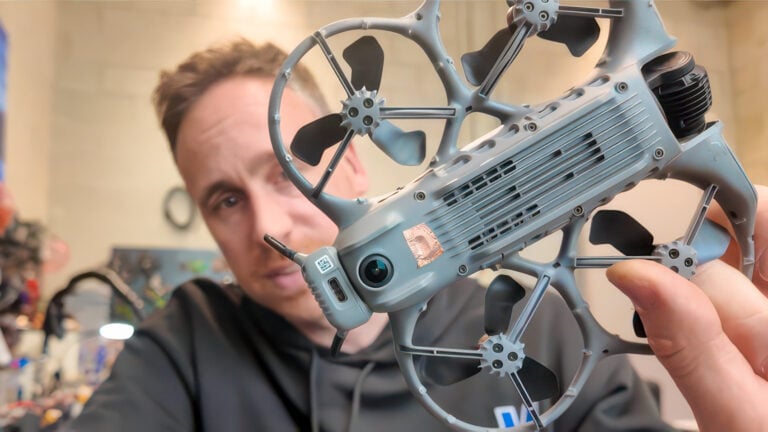
Luke Maximo Bell builds endurance drone, flies for 3 hours 31 minutes on a single charge

Check out the Best Deals on Amazon for DJI Drones today!
The man behind the world’s fastest drone at 408 mph has flipped the script entirely. Luke Maximo Bell, the South African engineer and YouTuber known for his Peregreen speed record quadcopters, just flew a custom-built multirotor for 3 hours, 31 minutes, and 6 seconds on a single battery charge. That beats the previous benchmark set by SiFly’s Q12, which holds the Guinness World Record for small electric multirotor endurance at 3 hours and 11 minutes.
Bell’s result is unofficial for now. There were no Guinness witnesses on site, and he was clear about why: he had never drained these batteries before and did not want to ask people to sit through a four-hour flight attempt with an unknown outcome. A witnessed, official attempt with autonomous forward flight is planned for a future date.

Bell’s endurance drone uses 40-inch propellers and semi-solid state batteries
The core of Bell’s endurance drone is a quadrotor built around T-Motor G40 propellers, each measuring 40 inches in diameter, paired with T-Motor MN105 V2 Antigravity motors rated at 90 KV. The logic is simple: larger propellers generate more thrust at lower RPMs, which is more efficient. Bell chose the smallest, lightest motor that could still spin those massive props at the required speed.
Because no published data existed for this particular motor-propeller combination at the low RPMs Bell needed, he built a bench testing rig to measure exactly how many grams of thrust each watt of power produced. The resulting efficiency curve showed what anyone who builds drones already suspects: as thrust increases, efficiency drops. That meant keeping the total weight as low as possible was critical.
The battery choice is the real story here. Bell used Tattu NMC semi-solid state lipo packs with an energy density of roughly 320 Wh/kg, compared to about 160 Wh/kg for traditional lipos. That is double the capacity for the same weight. The tradeoff is lower instantaneous current delivery, but an endurance drone hovering at low power does not need high burst current. Bell then stripped 180 grams of packaging from each battery, swapped the XT90 connectors for smaller XT60s, and saved 360 grams total across both packs. That weight saving equals the entire carbon fiber frame.
CFD testing, wire thickness optimization, and the 800 mm arm length sweet spot
Bell designed the drone in OnShape and ran CFD simulations through AirShaper to test five different arm lengths. He analyzed propeller wake interactions and individual propeller efficiency across all configurations. The 800 mm arm length produced the best results. Shorter arms caused too much wake interference between propellers. Longer arms added weight without meaningful efficiency gains.
One detail that shows how seriously Bell approached this build: wire thickness optimization. With roughly 11 meters (36 feet) of motor wire running through the arms, the choice of wire gauge matters. Thicker wire loses less power to resistance but weighs more. Thinner wire is lighter but wastes energy as heat. Bell tested voltage drop per meter for multiple wire gauges, plotted both the power loss from resistance and the power cost of carrying the extra wire weight, then added the two curves together. The answer: 18 AWG, the point where combined losses were lowest.
The electronics stack includes a Holybro Nano Drive 4-in-1 ESC and a TBS Lucid H7 flight controller running INAV. Bell used a DJI O4 Air Unit for video transmission after a lighter O4 Air Unit Lite failed to work during testing. The GPS was also swapped from a compact unit to a larger, more reliable Matek module after the original proved unreliable.
The flight: crashes, tuning, and a 3-hour-31-minute hover
Getting there was not straightforward. Early tuning flights produced violent oscillations and at least one crash. The motor mounts, designed intentionally lightweight to save grams, held up. But the carbon fiber arm joints allowed motors to twist off-axis mid-flight. Bell fixed that by drilling through the joints and bolting them in place. The 3D-printed landing legs all broke on the first session and had to be redesigned.
For the record attempt, conditions were decent but gustier than ideal. Bell noted something counterintuitive: the drone was actually more efficient with a light headwind than in dead calm, because the translational airflow over the propellers improved their performance. Hover power consumption sat around 400 watts. When Bell briefly tested slow forward flight at around the 3-hour mark, power dropped to as low as 250 watts.
At 2 hours and 14 minutes, the drone had already exceeded SiFly’s Q12 hover time of 2 hours, with 33% battery remaining. It passed the Q12’s official Guinness endurance record of 3 hours and 12 minutes with power to spare. Bell brought it down at 3 hours, 31 minutes, and 6 seconds, landing at 2.95 volts per cell to avoid damaging the batteries.
DroneXL’s Take
Bell going from the world’s fastest drone to the longest-flying one is not just a fun contrast. It shows genuine engineering range. The Peregreen speed builds are about surviving a few seconds at absurd RPM. This endurance build is about optimizing every gram and every watt over hours. Different problems entirely, and Bell applied the same methodical approach to both: bench test, simulate, build, crash, fix, repeat.
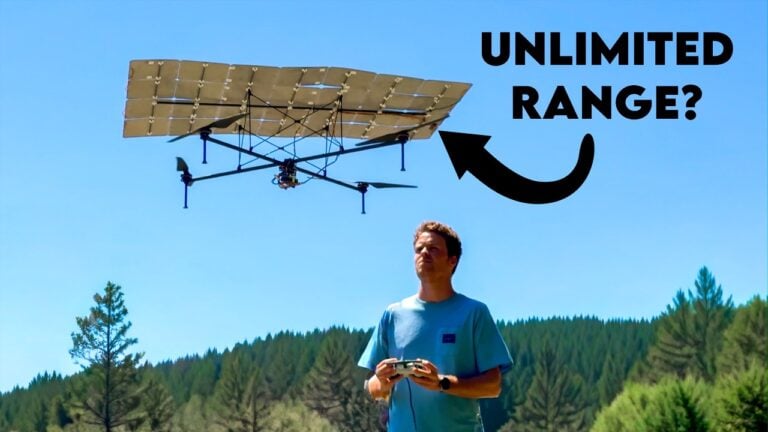
The forward flight numbers are what jumped out to me. Dropping from 400 watts in hover to 250 watts in slow forward flight means the next attempt, with autonomous waypoint navigation, could push well past 4 hours. SiFly said they were targeting 4 hours of flight time with the Q12 within a year of their record. Bell might get there first with a DIY build. If his solar drone project is any indication, the Bells are not done pushing the boundaries of what a home-built multirotor can do.
Editorial Note: AI tools were used to assist with research and archive retrieval for this article. All reporting, analysis, and editorial perspectives are by Haye Kesteloo.
Discover more from DroneXL.co
Subscribe to get the latest posts sent to your email.
Check out our Classic Line of T-Shirts, Polos, Hoodies and more in our new store today!

MAKE YOUR VOICE HEARD
Proposed legislation threatens your ability to use drones for fun, work, and safety. The Drone Advocacy Alliance is fighting to ensure your voice is heard in these critical policy discussions.Join us and tell your elected officials to protect your right to fly.

Get your Part 107 Certificate
Pass the Part 107 test and take to the skies with the Pilot Institute. We have helped thousands of people become airplane and commercial drone pilots. Our courses are designed by industry experts to help you pass FAA tests and achieve your dreams.

Copyright © DroneXL.co 2026. All rights reserved. The content, images, and intellectual property on this website are protected by copyright law. Reproduction or distribution of any material without prior written permission from DroneXL.co is strictly prohibited. For permissions and inquiries, please contact us first. DroneXL.co is a proud partner of the Drone Advocacy Alliance. Be sure to check out DroneXL's sister site, EVXL.co, for all the latest news on electric vehicles.
FTC: DroneXL.co is an Amazon Associate and uses affiliate links that can generate income from qualifying purchases. We do not sell, share, rent out, or spam your email.






![Review And Rewrite This Article For Publication. Do All Of The Following: 1. Fact-Check: Verify Dates, Locations, Quotes, Agency Names, And Acronyms. Mark Anything Uncertain With [Verify]. Did The Article Reference And Link To The Original Source? Flag If Missing. 2. Devil'S Advocate: In 3–4 Sentences, Assess Whether The Article Is Factually Sound, Well-Written, And Reads As Human. Be Blunt. 3. Humanize: Fix All Ai Patterns — Break Parallel Sentence Pairs, Remove Em-Dashes Used As Dramatic Pauses, Cut Redundant Consecutive Sentences, Remove Rhetorical Counting Devices. Strip These Words: Crucial, Vital, Key, Significant, Notably, Importantly, Essentially, Arguably, Landscape, Ecosystem, Trajectory, Transformative, Game-Changer, Groundbreaking, Unprecedented, Cutting-Edge, Robust, Seamless, Leverage (Verb), Utilize, Going Forward, In Conclusion, In Summary. Vary Sentence Length. Make The Take Section One Editor'S Sharp Opinion, Not A Summary. 4. Seo: Give 5 Alternative Title Ideas, A Permalink Slug, And A Meta Description (Under 155 Characters). Output Order: Devil'S Advocate Assessment → Revised Article With [Verify] Flags → Seo Block.](https://dronexl.co/wp-content/uploads/2025/02/DJI-Dock-3-and-Matrice-4D-and-4TD-Usher-in-Versatile-Drone-in-a-Box-Solution-for-Remote-Operations-0022.jpg.webp)