FT’s ‘kill zone’ report confirms what Ukraine’s frontline has become: a drone-dominated no-man’s-land

Check out the Best Deals on Amazon for DJI Drones today!
The Financial Times sent reporters into eastern Ukraine and came back with a term that every military planner should memorize: the “kill zone.” It is the strip of land closest to the front lines where anything that moves, on wheels, on foot, or on treads, gets targeted and destroyed by first-person-view drones. We have been covering this transformation for years, but the FT’s ground-level reporting adds something that satellite imagery and Telegram channels cannot: the sound of rotors overhead that never stops, the fiber-optic cables criss-crossing cratered fields, and the pick-up trucks encased in spiked metal cages that look like they rolled off a Mad Max set.
Here is what you need to know:
- The development: The Financial Times reports that the area within roughly 15 km of Ukraine’s front lines has become a “kill zone” where FPV drones hunt everything that moves, forcing a near-total retreat of conventional vehicle transport.
- The impact: Soldiers now crawl for days under anti-thermal cloaks, supplies arrive by drone, the wounded leave by robot, and vehicle movement is largely confined to bad weather.
- The source: Financial Times investigation by Christopher Miller, Chris Campbell, Peter Andringa, and Sam Joiner.
Conventional transport has been pushed out of the forward combat area
The kill zone is a concept named by Taras Chmut, a Ukrainian marine veteran and founder of Come Back Alive, one of the largest charities arming Ukraine’s military. It describes the strip of territory where FPV drones loiter over supply lines, hunt vehicles, and strike with precision that makes movement suicidal without countermeasures.
“Almost no transport is used in the kill-zone closer to the frontline,” said Iryna Rybakova, press officer for the 93rd Kholodnyi Yar Separate Mechanized Brigade.
That is not an exaggeration. The FT describes movement by road confined to rain, snow, or high winds, when visibility drops and drone optics degrade. Thousands of kilometers of nets now form tunnels over main highways to stop suicide FPV drones from diving at vehicles. Even under netting, driving forward is a gamble. The vehicles that do venture in are reinforced with armor, anti-drone cages, and spikes to lessen explosion impact.
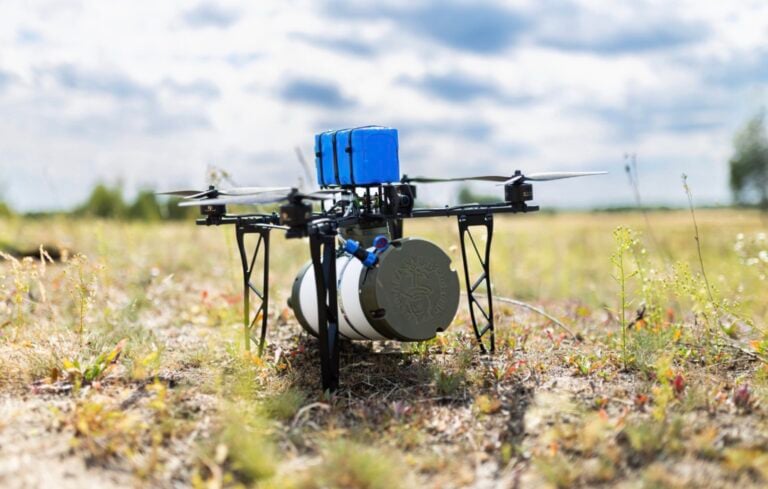
Troops live underground or in heavily camouflaged positions. We reported in December on how ground drones now handle 90% of frontline logistics for some units. The FT’s reporting confirms this at scale: supplies arrive by air drone, bulkier loads move by unmanned ground vehicles, and in some cases a UGV is the only viable way to evacuate a wounded soldier.

Fiber-optic drones bypass the electronic warfare stalemate
Electronic warfare saturates Ukraine’s front lines. Jammers force drone operators into a constant contest of adaptation, frequency-hopping against signal suppression. But the FT highlights a workaround that Russia has increasingly favored: drones tethered to fiber-optic cables reaching up to 40 km in some cases.
These fiber-optic FPV drones are immune to radio interference. Some lie in wait beside roads, then launch and strike passing vehicles. Mike Dewhirst, founder of drone maker Evolve Dynamics and consultancy AirQit, described it as a new, dynamic form of mining.
We covered fiber-optic drone development in detail last April. At that point, these drones cost roughly $800, double the price of standard FPV models, and required extensive pilot retraining due to the cable’s weight altering flight dynamics. The FT’s report on 40-km cable lengths shows how fast this technology is scaling. When we last reported, the typical range was 10-20 km. That gap has closed fast.
Ukraine is also scaling production. President Zelenskyy announced earlier this year that more than 20 new certified fiber-optic drone models had emerged, with 11 Ukrainian enterprises producing them. Just days ago, we reported on Ukraine’s Ratel H ground vehicle being upgraded with a fiber-optic drone launcher, combining ground and aerial unmanned systems into a single mobile platform.
165 days without rotation: the human cost of the kill zone
The FT includes a detail that puts the kill zone’s reality into sharp focus. Two Ukrainian infantry soldiers, Alexander Alikseenko and Alexander Tishayev, held their position near Orikhiv for 165 days without rotation. Thirty attempts were made to relieve them. Their salvation came from a period of thick fog.
Five and a half months. No rotation. Thirty failed relief attempts. That is what total drone dominance of a combat zone looks like for the people inside it.
The soldiers trapped at the front endure freezing cold in winter, dry heat in summer, and months without bathing. On top of drone strikes, firefights, and mortar blasts, they deal with mice and mosquitoes. Self-propelled artillery, mobile by definition, now operates from fixed, camouflaged, partially buried positions. Every artillery unit and tank crew includes a dedicated anti-drone mobile fire group. Countering small UAVs is now a core function of nearly every formation.
Kherson’s “drone dome” intercepts 95% of incoming attacks
Kherson, the southern Ukrainian city battered by relentless Russian shelling and drone strikes, has become a testing ground for urban drone defense. Oleksandr Prokudin, governor of the Kherson region, told the FT that the city is building a “drone dome.”
Layers of netting are suspended above roads, hospitals, and critical infrastructure. In some districts, the sky is barely visible through the mesh. Combined with electronic warfare systems, sensors, and civilian response teams trained with shotguns, Prokudin says about 95% of incoming drones are now intercepted.
We have tracked Kherson’s drone war extensively. In December 2024, we reported on over 9,500 Russian drone attacks on Kherson civilians, with the city’s population dropping from 250,000 to just 60,000. By May 2025, Prokudin told us that radio-electronic systems were neutralizing about 80% of attacks. The jump to 95% interception, if accurate, is a significant improvement and suggests layered defense is working.
The netting approach has spread. French and Swedish fishing nets are being repurposed as anti-drone barriers on Ukraine’s front lines. The Pentagon recently issued guidance recommending nets, barriers, and camouflage as low-cost physical defenses against small drones, citing lessons from exactly this type of warfare.
DroneXL’s Take
The FT’s “kill zone” reporting puts institutional credibility behind what we’ve been documenting piece by piece for three years. The battlefield transformation is complete. This is no longer an emerging trend. It’s the reality of ground warfare in 2026.
What strikes me most is the 40-km fiber-optic cable figure. When we reported on these systems in April 2025, the range was 10-20 km. Doubling that in under a year means the electronic warfare stalemate isn’t static. It’s accelerating. Russia’s material advantage in fiber-optic cabling, which we’ve tracked since their Saransk factory was targeted by Ukrainian strikes, gives Moscow an edge here that Ukraine is working hard to close.
The Kherson drone dome is equally telling. A jump from 80% to 95% interception suggests that layered defense, netting plus electronic warfare plus armed civilians, actually works at scale. Taiwan took notice, too. Their T-Dome program borrows directly from Ukraine’s experience.
Expect NATO procurement to shift hard toward counter-drone passive defenses by mid-2026. The Pentagon’s recent guidance on netting and barriers for the FIFA World Cup was no accident. These are Ukraine’s lessons, applied domestically. Every military that isn’t studying the kill zone concept right now is going to learn it the hard way.
Editorial Note: AI tools were used to assist with research and archive retrieval for this article. All reporting, analysis, and editorial perspectives are by Haye Kesteloo.
Discover more from DroneXL.co
Subscribe to get the latest posts sent to your email.
Check out our Classic Line of T-Shirts, Polos, Hoodies and more in our new store today!

MAKE YOUR VOICE HEARD
Proposed legislation threatens your ability to use drones for fun, work, and safety. The Drone Advocacy Alliance is fighting to ensure your voice is heard in these critical policy discussions.Join us and tell your elected officials to protect your right to fly.

Get your Part 107 Certificate
Pass the Part 107 test and take to the skies with the Pilot Institute. We have helped thousands of people become airplane and commercial drone pilots. Our courses are designed by industry experts to help you pass FAA tests and achieve your dreams.

Copyright © DroneXL.co 2026. All rights reserved. The content, images, and intellectual property on this website are protected by copyright law. Reproduction or distribution of any material without prior written permission from DroneXL.co is strictly prohibited. For permissions and inquiries, please contact us first. DroneXL.co is a proud partner of the Drone Advocacy Alliance. Be sure to check out DroneXL's sister site, EVXL.co, for all the latest news on electric vehicles.
FTC: DroneXL.co is an Amazon Associate and uses affiliate links that can generate income from qualifying purchases. We do not sell, share, rent out, or spam your email.