Drones Will Hunt Toxic Algae Across Florida’s Lake Okeechobee

Check out the Best Deals on Amazon for DJI Drones today!
Every summer, a thick green menace takes over Florida’s largest lake. Embry-Riddle researchers are about to send drones after it.
Florida’s Biggest Lake Has a Toxic Summer Tenant
Lake Okeechobee is 730 square miles of freshwater sitting at the heart of South Florida’s ecosystem. It supplies water for agriculture, feeds the Everglades, and supports some of the best bass fishing in the country, as reported by Embry-Riddle.
Every summer, it turns toxic.
Blue-green algae, technically a primitive bacteria called cyanobacteria, feasts on phosphorus and nitrogen from agricultural runoff and accumulates in the warm, still water. At peak bloom, mats have covered as much as 90% of the lake’s surface.

In June 2023, NASA satellite imagery showed algae blanketing over half the lake at once. That is not a local nuisance. That is an ecological emergency.

The blooms produce toxins that irritate the throat and lungs when airborne. They kill fish. They devastate wildlife. They shut down marinas, trigger public health alerts, and cost regional economies hundreds of millions of dollars in lost tourism and fishing revenue when they spread into connecting waterways. People living near the lake know the annual arrival by smell alone.
Right now, the South Florida Water Management District monitors the lake through 32 fixed sampling stations, collecting data twice a month during peak bloom season from May through October. For a 730-square-mile body of water, that is like checking a patient’s temperature twice a month and hoping nothing goes wrong in between.
Embry-Riddle Aeronautical University thinks drones can do significantly better.
What the Drones Will Actually Do
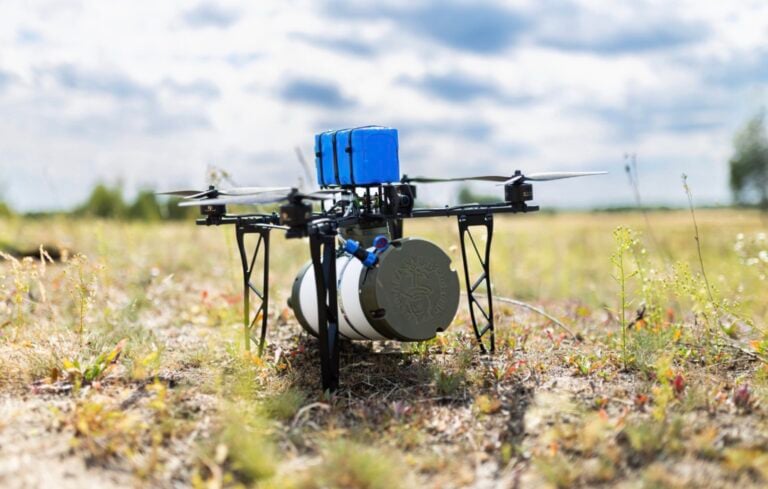
The research team at Embry-Riddle, backed by a $500,000 EPA grant and partnering with the University of South Florida and the Sanibel-Captiva Conservation Foundation, is building a system where a single drone can collect multiple water and air samples across a broad region in a single flight.
That sounds simple. The engineering is not.
Water is heavy. Carrying liquid samples reduces battery life and limits flight range, forcing the team to optimize every gram. Their current prototype uses a dual-syringe system controlled by small motors, which simultaneously collects samples from the lake surface and from a depth of about 1.6 feet.

That two-depth sampling matters because cyanobacteria behave differently at the surface versus below it, migrating up toward sunlight in the morning and redistributing deeper at night.
For atmospheric sampling above the algae, the team is developing an impinging system: a narrow suction tube containing liquid that captures airborne microorganisms at multiple altitudes and locations in discrete samples.
Existing impinging devices are commercially available, but the Embry-Riddle version goes further by collecting multiple separate samples at different heights in a single pass. That has not been done before.
The drones will also carry thermal infrared, multispectral, and hyperspectral cameras capable of detecting hundreds of spectral bands, far beyond what human eyes or standard cameras can see.
Those sensors can assess cyanobacteria concentrations and monitor the health of aquatic vegetation across the lake continuously, not just at fixed points twice a month. That data will then be fused with existing NASA and European Space Agency satellite imagery to produce a combined picture with dramatically higher resolution and frequency than either system can deliver alone.
First deployments over Lake Okeechobee are planned for this summer and fall.
The Students Building It
What makes this story quietly remarkable is who is doing the work.
Justin Fratto is a junior in Mechanical Engineering. He is designing the water sampler, iterating through prototypes, working within the physical constraints of the airframe while meeting the scientists’ data requirements.
He described the experience as being given a problem, brainstorming a solution, and then actually building it. That is the kind of education that does not come from a textbook.
Kayla Taylor is a Ph.D. candidate in Electrical Engineering and Computer Science. She grew up in Sarasota, Florida, and watched red tide destroy coastlines near her home. She was not drawn to this project because it was available.
She was drawn to it because it is personal. She wants to lead research that matters to the community she came from.
Dr. Kevin Adkins, who directs Embry-Riddle’s Uncrewed Vehicle and Atmospheric Investigation Lab, framed the mission simply: a single aircraft collecting multiple samples across a broader region than any fixed station can cover. With enough data and enough sampling, patterns emerge. And with patterns, predictions become possible.
DroneXL’s Take
I love this story for a reason that has nothing to do with the technology.
Most drone coverage at DroneXL focuses on military applications, public safety, or commercial logistics. This one is about a group of researchers and students trying to protect a lake. That is a different kind of mission, and it deserves the same level of attention.
Here is what strikes me as genuinely significant. The current monitoring system for a 730-square-mile lake is 32 fixed stations sampling twice a month. That is not monitoring. That is a snapshot. A bloom can form, peak, and begin dispersing in the time between two readings. By the time the data shows the problem, the problem has already moved.
Drones fix that. Not by replacing the scientists but by putting sensors where scientists cannot physically go, at the frequency the ecosystem actually demands. Fusing drone imagery with satellite data creates something neither system can do alone: continuous, high-resolution, ground-truth-verified monitoring of a dynamic biological system.
What gets me as a pilot is the sampling challenge at low altitude over water. Surface-level flight over a large open lake means dealing with wind, spray, GPS drift, and the added weight of liquid samples. These students are solving real flight engineering problems, not just data collection problems.
By the time these drones deploy this summer, Lake Okeechobee will probably already be showing early signs of bloom activity. The timing is not academic. It is urgent.
Photo credit: Embry‑Riddle/Krystel Knowles
Discover more from DroneXL.co
Subscribe to get the latest posts sent to your email.
Check out our Classic Line of T-Shirts, Polos, Hoodies and more in our new store today!

MAKE YOUR VOICE HEARD
Proposed legislation threatens your ability to use drones for fun, work, and safety. The Drone Advocacy Alliance is fighting to ensure your voice is heard in these critical policy discussions.Join us and tell your elected officials to protect your right to fly.

Get your Part 107 Certificate
Pass the Part 107 test and take to the skies with the Pilot Institute. We have helped thousands of people become airplane and commercial drone pilots. Our courses are designed by industry experts to help you pass FAA tests and achieve your dreams.

Copyright © DroneXL.co 2026. All rights reserved. The content, images, and intellectual property on this website are protected by copyright law. Reproduction or distribution of any material without prior written permission from DroneXL.co is strictly prohibited. For permissions and inquiries, please contact us first. DroneXL.co is a proud partner of the Drone Advocacy Alliance. Be sure to check out DroneXL's sister site, EVXL.co, for all the latest news on electric vehicles.
FTC: DroneXL.co is an Amazon Associate and uses affiliate links that can generate income from qualifying purchases. We do not sell, share, rent out, or spam your email.