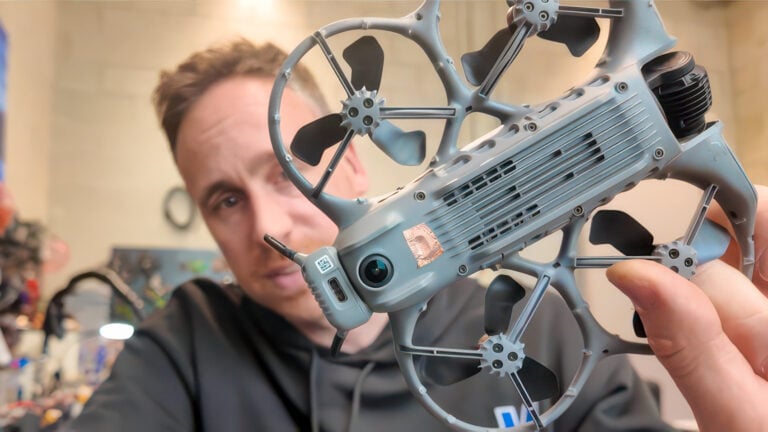
Shahed Drones Are Hitting The Gulf And The $2,500 Answer Is Still Being Ignored

Check out the Best Deals on Amazon for DJI Drones today!
Two days ago, The National published a detailed breakdown of how to counter Iran’s Shahed-136 drone threat now hitting Gulf states. Fighters, heavy machine guns, Skyranger 35 systems, Gepard tanks, jamming guns — the full conventional toolkit. It’s a solid piece. But it has a notable gap. The word “interceptor” does not appear once.
That’s not a minor omission. It’s the most important development in counter-Shahed warfare over the past 18 months.
As we covered earlier this week, Ukraine’s experience absorbing more than 57,000 Shahed-type strikes has produced a doctrine the Gulf is now scrambling to absorb. The UK is sending Ukrainian specialists to help. President Zelensky called that expertise “largely irreplaceable.” None of that changes what’s missing from the broader conversation: the economics of the fight.
The Math That Conventional Analysis Ignores
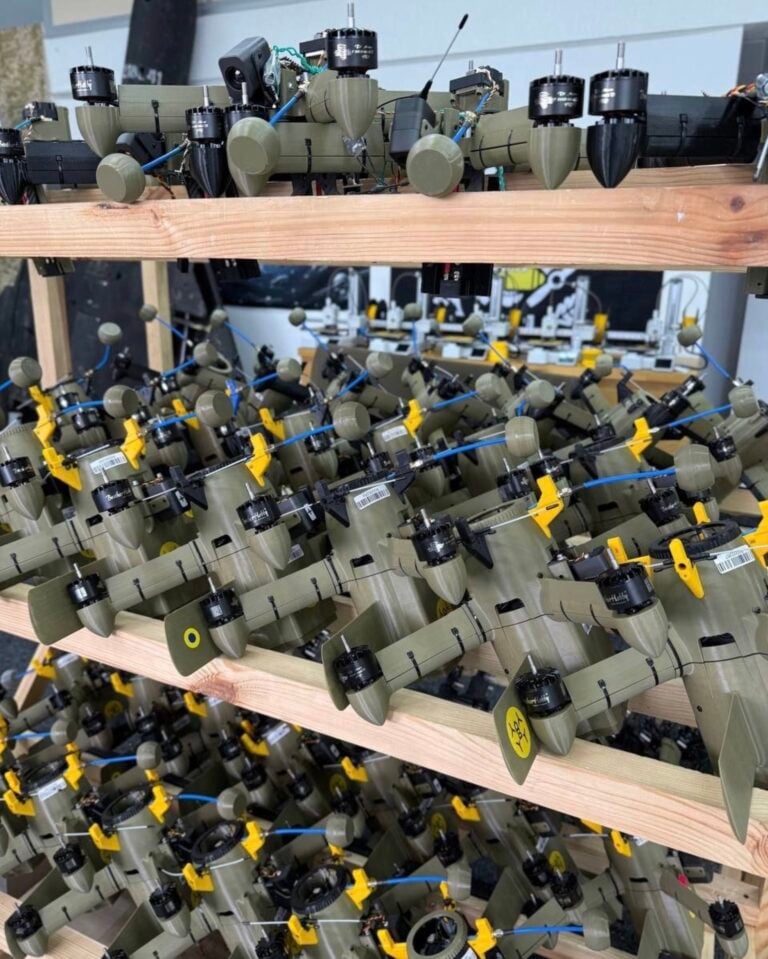
The Shahed-136 costs Iran somewhere between $20,000 and $50,000 per unit. A Thaad interceptor missile runs $12 million per shot. A Patriot missile costs $1 million. The National correctly notes that preserving expensive missile stocks is a priority — but the solution it describes (Skyranger guns, Gepard AAA, Hydra rockets) still doesn’t get at the cheapest proven answer. Ukraine’s Octopus and Sting interceptor drones cost roughly $2,500 each. They destroy Shaheds at a confirmed 80–90% hit rate. In January 2026 alone, Ukrainian forces shot down a record 1,704 Shaheds — with 70% of those kills credited to interceptor drones, not guns or missiles.
That ratio matters more than any hardware list.

Why Interceptor Drones Work Where AAA Struggles
Anti-aircraft artillery creates two problems when used in urban environments: debris and deconfliction. Fragments from rounds fired at low-altitude drones fall somewhere. The friendly fire incident in Kuwait — where three US fighters were mistakenly shot down — is exactly the coordination failure that massed AAA in a dense air picture produces.
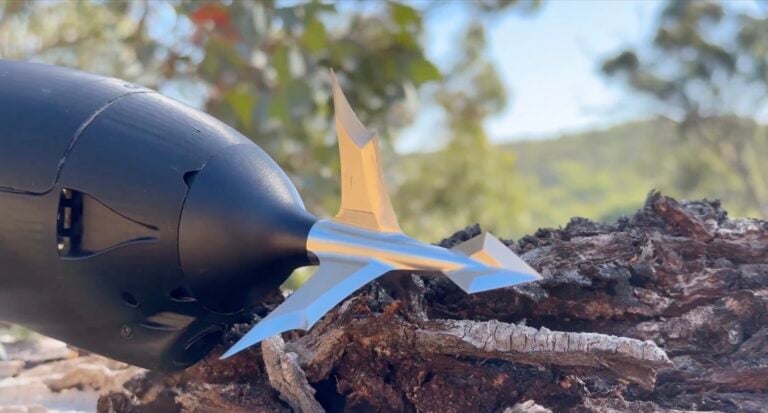
Interceptor drones sidestep both problems. They operate in designated flight corridors, they’re expendable, and they carry only enough payload to destroy the drone they’re chasing. The Sting from Wild Hornets uses thermal imaging to track Shaheds at altitudes up to 10,000 feet and screams toward targets at nearly 195 mph — fast enough to catch a Shahed cruising at 115 mph with significant closing speed to spare.
As we reported in detail after Ukraine began mass producing the Octopus system in November 2025, the economic logic is straightforward: deploy $2,500 interceptors against $35,000 Shaheds, preserve $1 million missiles for cruise missiles and ballistics. Gulf states now under Shahed attack are facing this exact equation in real time.
The Speed Problem Looming On The Horizon
There’s a harder problem the Gulf will eventually face, and Ukraine is already wrestling with it. Russia has deployed the Geran-3, a jet-powered Shahed variant flying at 400–500 kph. Current interceptor drones top out around 350 kph. That speed gap is a real vulnerability, and there’s no near-term fix. As we reported March 1, this is Ukraine’s next unsolved problem — and it will become the Gulf’s problem too if Iran upgrades its Shahed fleet.
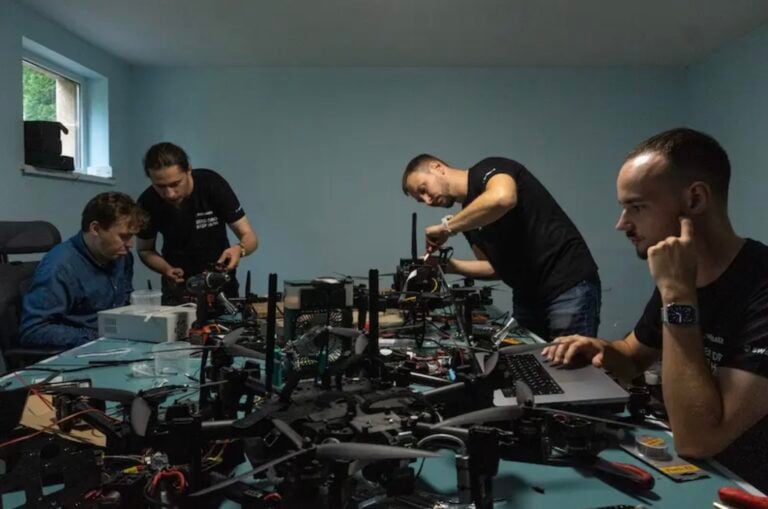
Iran’s production capacity already makes the Shahed threat self-sustaining. The National‘s source confirmed a single engineer can assemble 12 Shaheds in a 10-hour shift. The economics of that production advantage don’t disappear with more Patriot batteries.

DroneXL’s Take
The UK sending Ukrainian counter-drone specialists to Gulf partners is the right move. But the question is whether those specialists are bringing the full playbook — including interceptor drone deployment — or just advising on how to use existing Western hardware more effectively.
The conventional analysis misses what three years of live combat proved: you can’t missile-defense your way out of mass drone warfare. The numbers break. Kuwait proved it. The Gulf states are learning in weeks what Ukraine figured out under fire over years.
I covered Ukraine’s interceptor program from the earliest Wild Hornets prototypes through the Octopus mass production announcement last November. The technology works. The doctrine works. What’s missing is the political will to transfer it rapidly enough to matter. My prediction: within 60 days, at least two Gulf states sign formal counter-drone technology transfer agreements with Ukraine modeled on the UK’s Project Octopus. The Shahed is now a Gulf problem. The only country with a proven, scalable, cost-effective answer is Ukraine. That answer starts with a $2,500 drone, not a $12 million missile.
Editorial Note: AI tools were used to assist with research and archive retrieval for this article. All reporting, analysis, and editorial perspectives are by Haye Kesteloo.
Discover more from DroneXL.co
Subscribe to get the latest posts sent to your email.
Check out our Classic Line of T-Shirts, Polos, Hoodies and more in our new store today!

MAKE YOUR VOICE HEARD
Proposed legislation threatens your ability to use drones for fun, work, and safety. The Drone Advocacy Alliance is fighting to ensure your voice is heard in these critical policy discussions.Join us and tell your elected officials to protect your right to fly.

Get your Part 107 Certificate
Pass the Part 107 test and take to the skies with the Pilot Institute. We have helped thousands of people become airplane and commercial drone pilots. Our courses are designed by industry experts to help you pass FAA tests and achieve your dreams.

Copyright © DroneXL.co 2026. All rights reserved. The content, images, and intellectual property on this website are protected by copyright law. Reproduction or distribution of any material without prior written permission from DroneXL.co is strictly prohibited. For permissions and inquiries, please contact us first. DroneXL.co is a proud partner of the Drone Advocacy Alliance. Be sure to check out DroneXL's sister site, EVXL.co, for all the latest news on electric vehicles.
FTC: DroneXL.co is an Amazon Associate and uses affiliate links that can generate income from qualifying purchases. We do not sell, share, rent out, or spam your email.








![Review And Rewrite This Article For Publication. Do All Of The Following: 1. Fact-Check: Verify Dates, Locations, Quotes, Agency Names, And Acronyms. Mark Anything Uncertain With [Verify]. Did The Article Reference And Link To The Original Source? Flag If Missing. 2. Devil'S Advocate: In 3–4 Sentences, Assess Whether The Article Is Factually Sound, Well-Written, And Reads As Human. Be Blunt. 3. Humanize: Fix All Ai Patterns — Break Parallel Sentence Pairs, Remove Em-Dashes Used As Dramatic Pauses, Cut Redundant Consecutive Sentences, Remove Rhetorical Counting Devices. Strip These Words: Crucial, Vital, Key, Significant, Notably, Importantly, Essentially, Arguably, Landscape, Ecosystem, Trajectory, Transformative, Game-Changer, Groundbreaking, Unprecedented, Cutting-Edge, Robust, Seamless, Leverage (Verb), Utilize, Going Forward, In Conclusion, In Summary. Vary Sentence Length. Make The Take Section One Editor'S Sharp Opinion, Not A Summary. 4. Seo: Give 5 Alternative Title Ideas, A Permalink Slug, And A Meta Description (Under 155 Characters). Output Order: Devil'S Advocate Assessment → Revised Article With [Verify] Flags → Seo Block.](https://dronexl.co/wp-content/uploads/2025/02/DJI-Dock-3-and-Matrice-4D-and-4TD-Usher-in-Versatile-Drone-in-a-Box-Solution-for-Remote-Operations-0022.jpg.webp)