NASA’s Dragonfly Enters Full Assembly Phase as $3.35B Budget and Schedule Risks Loom Over 2028 Launch
Check out the Best Deals on Amazon for DJI Drones today!
Full rotorcraft integration on NASA’s Dragonfly octocopter began in early 2026 at the Johns Hopkins Applied Physics Laboratory (APL) in Laurel, Maryland — the same facility where engineers spent the past three years validating rotor performance in simulated Titan conditions. The timing matters because this is the phase where problems get expensive fast. And according to NASA’s Office of Inspector General (OIG), there are already reasons to watch this mission closely.
Here’s what’s happening with the Dragonfly mission right now:
- The Development: NASA’s Dragonfly octocopter has entered full integration and testing in 2026, targeting a July 2028 launch aboard a SpaceX Falcon Heavy and arrival at Saturn’s moon Titan in 2034.
- The Budget Problem: Lifecycle costs have ballooned to $3.35 billion — roughly four times the original $850 million cost cap — with the NASA OIG flagging inadequate cost reserves and questionable financial tracking.
- The Science Goal: Dragonfly will fly up to 70 miles across Titan over a 3.3-year mission, sampling organic surface materials to study the prebiotic chemistry that may have preceded life on Earth.
- The Sources: NASA Science, NASA’s integration announcement, Johns Hopkins APL, and the NASA OIG report (September 2025).
Dragonfly’s Integration Phase Begins With Three Years of Rotor Data Behind It
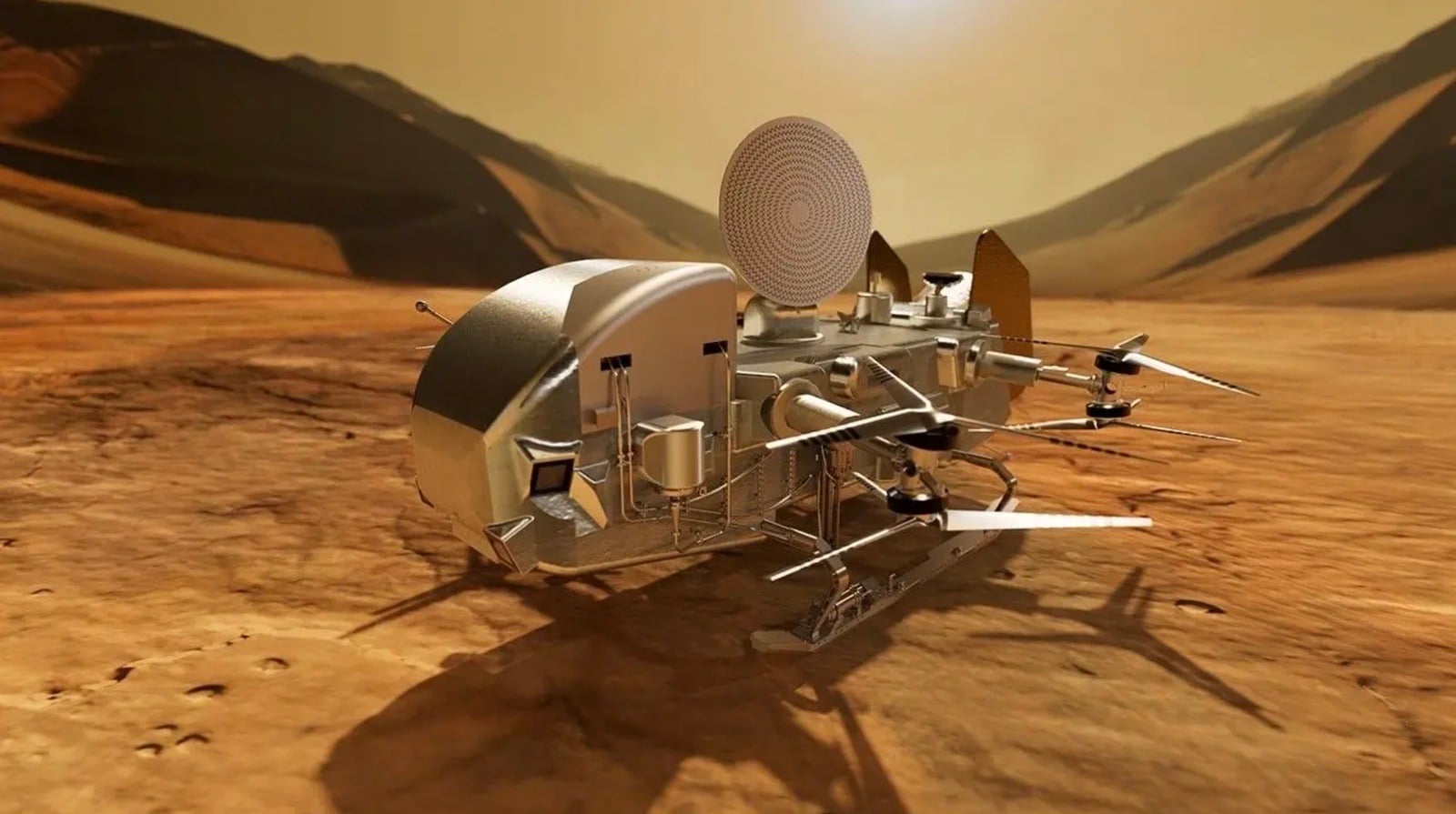
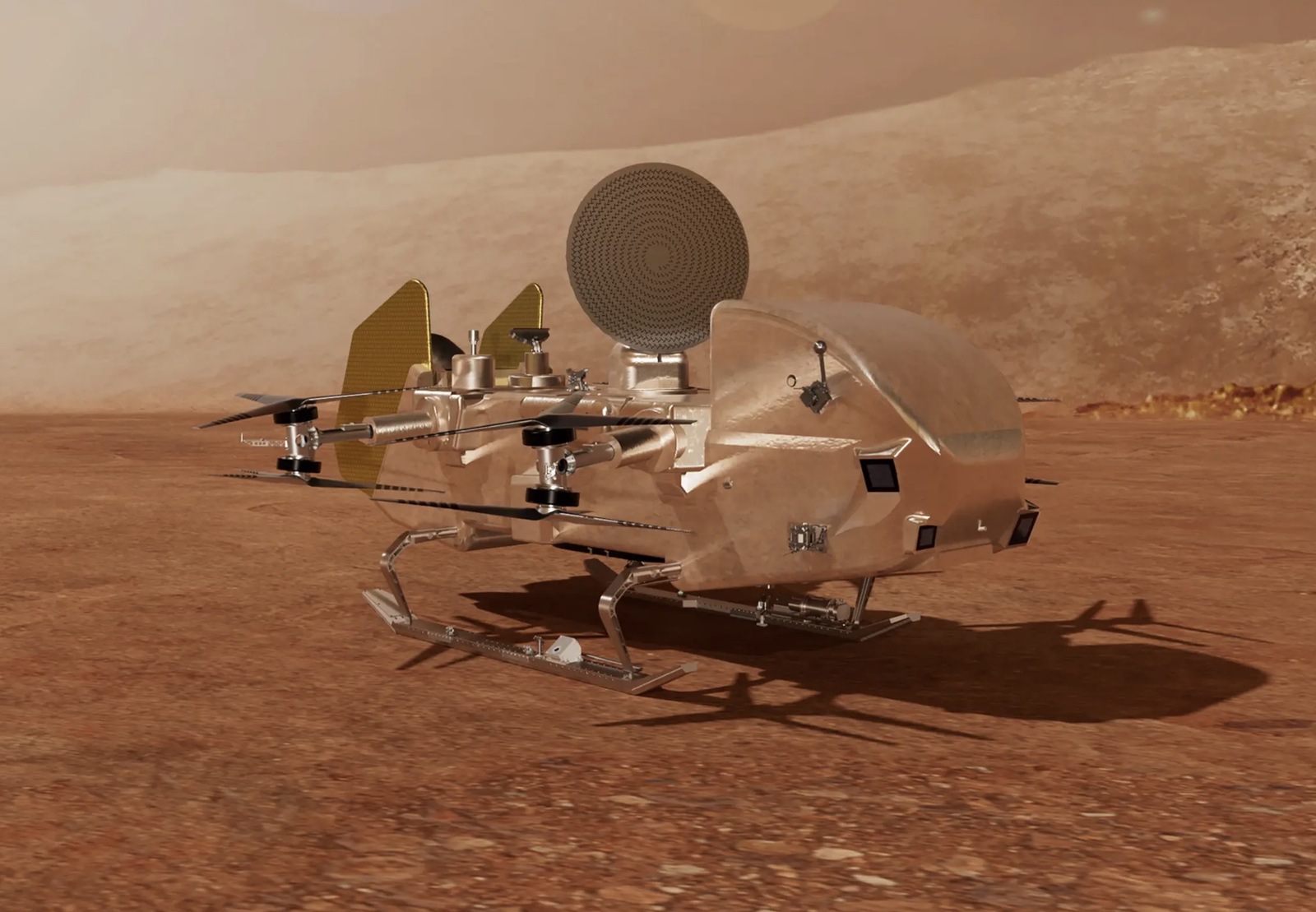
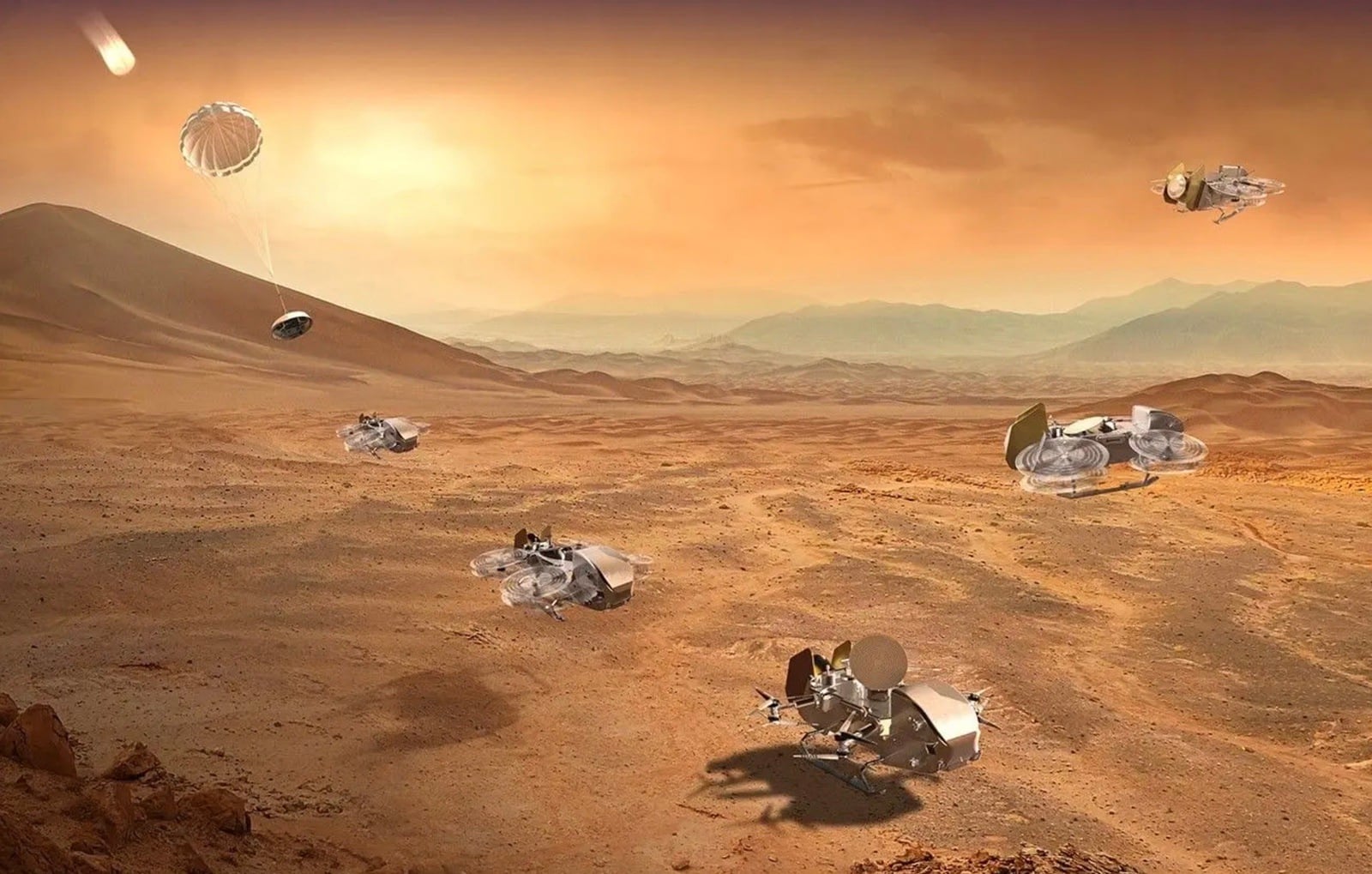
NASA’s Dragonfly is an octocopter designed for a world no drone has ever touched. It is a car-sized, nuclear-powered rotorcraft with eight rotors arranged in four counter-rotating pairs, built to fly autonomously through Titan’s nitrogen-rich atmosphere — which is denser than Earth’s — at temperatures around -290 degrees Fahrenheit. Full assembly at APL began in February 2026, drawing on rotor aeromechanics data gathered over three years of wind tunnel testing.
The most recent rotor testing happened at NASA Langley Research Center’s Transonic Dynamics Tunnel (TDT) in Hampton, Virginia. Engineers bathed a full-scale half-width model of Dragonfly in heavy gas that replicates Titan’s thick atmosphere, measuring stress on rotor arms, vibration effects on rotor blades, and aeromechanical performance factors that will feed directly into Dragonfly’s flight plans and navigation software.
“When Dragonfly enters the atmosphere at Titan and parachutes deploy after the heat shield does its job, the rotors are going to have to work perfectly the first time,” said Dave Piatak, branch chief for aeroelasticity at NASA Langley. “There’s no room for error, so any concerns with vehicle structural dynamics or aerodynamics need to be known now and tested on the ground.”
The rotors passed. APL’s lead rotor engineer Felipe Ruiz noted the challenge of designing for a flight environment engineers are “still learning about,” making wind tunnel validation one of the mission’s most important steps. The data now informs high-fidelity models predicting how Dragonfly will actually perform above Titan’s surface.
Lockheed Martin completed the heat shield and backshell structures that will protect Dragonfly during atmospheric entry. NASA’s Goddard Space Flight Center finished the Ion Trap Mass Spectrometer — the core of the Dragonfly Mass Spectrometer (DraMS) instrument — which cleared its acceptance review and is preparing for space-environment testing. APL also verified the 3-inch-thick Solimide-based foam insulation that keeps the lander’s interior at operational temperatures despite Titan’s extreme cold.
Titan Is the Target Because It Looks Like Early Earth
Titan is the only moon in the solar system with a dense atmosphere. It has a nitrogen-methane atmosphere thicker than Earth’s, rivers and lakes of liquid methane, complex organic compounds raining down from the sky, and a water-ice crust with a liquid water ocean beneath the surface. At sites where that crust melted in the past, liquid water and complex carbon-rich molecules may have mixed for extended periods — the same chemical conditions that existed on Earth before biology began.
Dragonfly isn’t looking for life. It’s looking for what came before life. Principal investigator Elizabeth “Zibi” Turtle of APL frames the mission as investigating the chemistry that preceded biology — the organic synthesis pathways that may be universal rather than unique to Earth. As we’ve covered previously at DroneXL, Dragonfly will target Selk Crater, a 50-mile-wide impact site where liquid water likely pooled with organics for thousands of years.
The mission flies one sortie every one to two Titan days — called a Tsol, lasting about 16 Earth days — and will cover up to 70 miles across the surface over its 3.3-year primary mission. The landing site sits in Titan’s equatorial region, selected in part to maintain direct line-of-sight to Earth for communications.
The OIG Report Reveals the Real Story: Cost Overruns, Thin Reserves, and Questionable Financial Tracking
The NASA OIG’s September 2025 audit of the Dragonfly project is worth reading in full. The findings show a mission that has experienced repeated replanning, budget growth from an $850 million cost cap to $3.35 billion in total lifecycle costs, and schedule delays of more than two years from the original April 2026 launch target — all before a single component has left Earth.
The cost cap at selection was $850 million for Principal Investigator-Managed Mission Costs. By April 2024, those same costs had grown to $2.6 billion. Justifications included COVID-19, supply chain disruptions, inflation, and the decision to switch to a heavy-lift launch vehicle to compensate for the delayed timeline. NASA directed four separate replans between June 2019 and July 2023 — effectively rebuilding the mission’s budget and schedule from scratch, repeatedly.
The OIG found the project entered its current assembly phase with lower-than-optimal cost reserves, known as Unallocated Future Expenses. To manage the shortfall, APL plans to re-phase work and delay payments to some contractors. The OIG warned that delaying development and testing activities — exactly what is happening — leads to later risk identification and more expensive mitigations. The OIG also found that Dragonfly’s project plan, dated February 2023, had not been updated to reflect the April 2024 cost and schedule baseline as of July 2025.
Perhaps most concerning: NASA’s Office of the Chief Financial Officer identified potential issues with the accuracy of APL’s Earned Value Management system — the project management tool used to track cost and schedule performance — and brought in the Defense Contract Management Agency for an independent assessment. That’s an unusual step. It means the numbers being used to track Dragonfly’s financial health may not be reliable.
The broader consequence is structural. As we reported in April 2024 when NASA confirmed the mission, previous New Frontiers missions cost roughly $1 billion each and launched on a five-year cadence. Dragonfly’s costs and delays have pushed the next New Frontiers Announcement of Opportunity back by years, creating at least a 12-year gap in the program’s mission launch cadence. One mission is crowding out an entire generation of planetary science.
DroneXL’s Take
Dragonfly is genuinely one of the most ambitious rotorcraft programs ever conceived. Flying an autonomous octocopter on another world, at -290 degrees Fahrenheit, with no ability to intervene or repair, is an extraordinary engineering challenge. The rotor testing data coming out of NASA Langley is real progress, and the science case for Titan is strong.
But the OIG report tells a different story underneath the mission milestones. A project that started with an $850 million cost cap is now at $3.35 billion — nearly four times over — with thin reserves, a financial tracking system under independent audit, and a project plan that wasn’t updated for over two years after a major rebaseline. That’s not a one-time pandemic disruption. That’s a pattern of management decisions that NASA’s own Inspector General called out directly.
The next 18 months are critical. Dragonfly is now in the assembly and test phase — the period when cost overruns are hardest to control and schedule delays are most expensive. If the reserves are as thin as the OIG report suggests, any significant technical surprise between now and the July 2028 launch could trigger another replan. Watch for NASA’s FY2027 budget request. If Dragonfly’s allocation grows again, it’s a signal the mission is running behind its current baseline — and other planetary science programs will pay the price.
Editorial Note: AI tools were used to assist with research and archive retrieval for this article. All reporting, analysis, and editorial perspectives are by Haye Kesteloo.
Discover more from DroneXL.co
Subscribe to get the latest posts sent to your email.
Check out our Classic Line of T-Shirts, Polos, Hoodies and more in our new store today!

MAKE YOUR VOICE HEARD
Proposed legislation threatens your ability to use drones for fun, work, and safety. The Drone Advocacy Alliance is fighting to ensure your voice is heard in these critical policy discussions.Join us and tell your elected officials to protect your right to fly.

Get your Part 107 Certificate
Pass the Part 107 test and take to the skies with the Pilot Institute. We have helped thousands of people become airplane and commercial drone pilots. Our courses are designed by industry experts to help you pass FAA tests and achieve your dreams.

Copyright © DroneXL.co 2026. All rights reserved. The content, images, and intellectual property on this website are protected by copyright law. Reproduction or distribution of any material without prior written permission from DroneXL.co is strictly prohibited. For permissions and inquiries, please contact us first. DroneXL.co is a proud partner of the Drone Advocacy Alliance. Be sure to check out DroneXL's sister site, EVXL.co, for all the latest news on electric vehicles.
FTC: DroneXL.co is an Amazon Associate and uses affiliate links that can generate income from qualifying purchases. We do not sell, share, rent out, or spam your email.