Pentagon And Gulf States Eye Ukrainian Interceptor Drones As Patriot Missile Stocks Run Low
Check out the Best Deals on Amazon for DJI Drones today!
The economics finally broke. Gulf states spent the last week firing Patriot interceptors worth over $13.5 million each at Iranian Shaheds that cost $30,000 to build. Now, according to reporting by the Financial Times, the Pentagon and at least one Gulf government are in active talks to buy Ukrainian drone interceptors that do the same job for roughly $2,500 apiece.
The key details:
- The Development: The Pentagon and at least one Gulf government are negotiating purchases of Ukrainian-made interceptor drones to counter waves of Iranian Shahed-136 attacks following U.S. and Israeli strikes on Iran.
- The Math: A single PAC-3 missile for the Patriot system costs over $13.5 million. A Ukrainian Sting interceptor costs approximately $2,500 and destroys the same target.
- The Constraint: Ukrainian President Volodymyr Zelensky has stated that any such cooperation must not reduce Ukraine’s own air defense capabilities — and that all sales, even those manufactured outside Ukraine, require Kyiv’s approval.
- The Source: Financial Times, citing Ukrainian defense industry figures and a Ukrainian government official who described the Pentagon talks as “sensitive.”
Ukraine’s Interceptor Advantage Is Three Years Of Combat-Proven Doctrine
Ukraine’s low-cost interceptor drone program is the most battle-tested counter-Shahed capability in the world. Since Russia began launching Shahed-type drones against Ukrainian cities in 2022, Kyiv has absorbed more than 57,000 such attacks and developed a layered response that no NATO military had previously built from scratch. The core of that response is cheap, fast, purpose-built quadcopters that chase down Shaheds mid-flight and destroy them kinetically — at a fraction of the cost of any missile system.
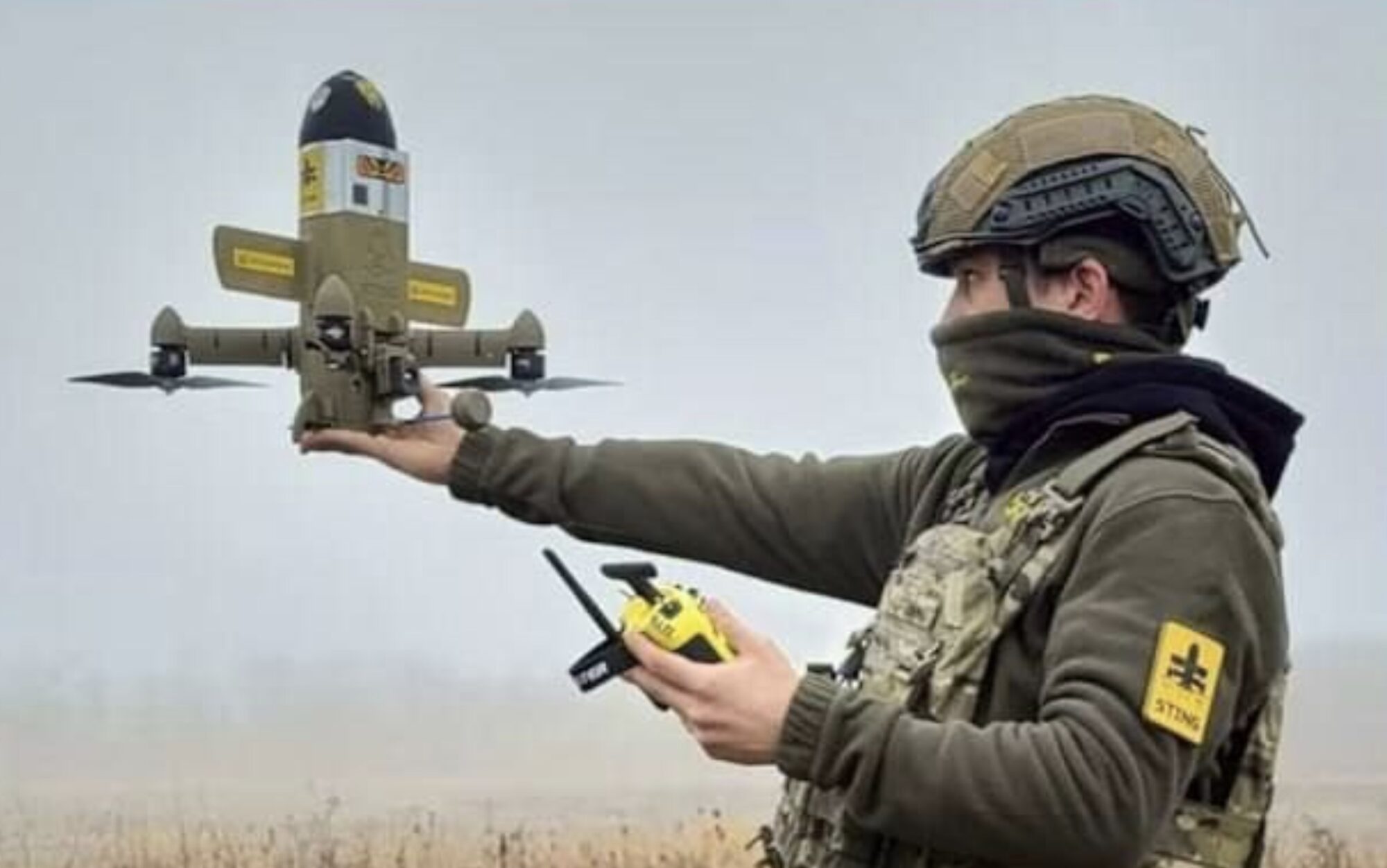
The most prominent Ukrainian interceptor in active deployment is the Sting, built by Wild Hornets, a volunteer-founded Ukrainian nonprofit-turned-miltech company. The Sting is a 3D-printed, bullet-shaped quadcopter that reaches speeds of up to 315 km/h — nearly double the Shahed’s cruising speed of 185 km/h. It uses Kurbas thermal imaging cameras from Odd Systems for targeting, has an engagement range of up to 25 kilometers, and can be deployed in under 15 minutes from any flat surface without a catapult. As of late 2025, Wild Hornets reported the Sting had destroyed over 1,500 targets, with the company citing effectiveness rates of 60–90% depending on crew experience and radar setup.
The Merops (also called the Surveyor), a fixed-wing interceptor developed by Project Eagle — a venture led by former Google CEO Eric Schmidt — takes a different approach. Once a pilot guides it into visual range, it engages autonomously. As we reported on March 1, the Merops has recorded hit rates as high as 95% in Ukrainian operations, according to Ukraine’s First Deputy Prime Minister Mykhailo Fedorov. Its unit cost runs roughly $15,000 — higher than the Sting but still a fraction of any missile-based alternative. Ukrainian company General Cherry also manufactures a fast dedicated “Shahed hunting” interceptor, and at least a dozen Ukrainian companies now produce kinetic interceptors in the $2,000–$5,000 price range.
In January 2026 alone, Ukrainian forces shot down a record 1,704 Shaheds, with 70% of those kills credited to interceptor drones rather than guns or missiles. That ratio is the real data point Gulf states need to absorb.
Iran’s Gulf Tactics Mirror Russia’s Odesa Playbook
The tactical situation in the Gulf closely mirrors what Ukraine has been dealing with along the coast of Odesa. Iranian Shaheds skim low over water on approach to avoid radar and confuse missile interceptors — the same technique Russian-operated Shaheds use to approach Odesa from the Black Sea. Ukrainian experts who have been fighting this exact problem say that offshore drone deployment gives interceptors their best engagement window, and that the water-skimming approach is specifically designed to defeat traditional air defense radar coverage.
That context matters when you look at what’s already happened. On Saturday, February 28, Iranian Shaheds struck satellite communications terminals at the U.S. Navy’s Fifth Fleet headquarters in Manama, Bahrain — a strike one former Fifth Fleet officer called “astounding” given it hit the ops center for the entire Middle East, in broad daylight. Iran has since fired hundreds of drones at Gulf targets, and experts cited by the FT estimate Iran may have stockpiled tens of thousands of Shaheds. U.S. officials confirmed Iran had launched over 2,000 drones in the conflict as of this week, according to CNBC.
Patriot systems were never designed to absorb this volume. As we covered yesterday, a single Patriot PAC-3 intercept that was meant for ballistic missiles is being expended on $30,000 drones. Do that math at scale and the defender loses economically even when winning tactically. Lockheed Martin produced only 620 PAC-3 MSE missiles last year and has a seven-year timeline to reach 2,000 per year. That production gap is why Gulf states are now looking at Ukrainian interceptors — not as a replacement for Patriot, but as the lower-cost layer that handles Shaheds while Patriot reserves are saved for ballistic threats.
The Zelensky Calculation: Interceptors For PAC-3s
Ukraine’s interest here isn’t purely commercial. Zelensky has explicitly framed this as a swap. In interviews this week, he told Gulf leaders that Ukraine would supply interceptor drone specialists and systems in exchange for PAC-3 missiles — the exact munitions Ukraine needs to defend against Russian cruise and ballistic missile attacks that cheap interceptors can’t handle. The logic is straightforward: if Gulf states use Ukrainian $2,500 interceptors instead of PAC-3s against Shaheds, the global PAC-3 stockpile stays larger, and more of it becomes available to Ukraine.
“Ukraine’s expertise in countering ‘Shahed’ drones is currently the most advanced in the world,” Zelensky said. He added that any cooperation must proceed without reducing Ukraine’s own defense capabilities — a condition that will shape how any export deal gets structured.
Zelensky has also been in direct contact with the Emir of Qatar and the President of the UAE about Ukrainian anti-drone technology. He separately told Bloomberg that Ukraine would send specialists to the Gulf if Middle Eastern countries used their influence with Russia to secure a ceasefire in Ukraine.
The UK is already moving. As we reported on March 2, Britain announced it would bring Ukrainian counter-drone specialists to help Gulf partners — an extension of the UK’s Project Octopus program, which aims to produce 2,000 interceptor drones per month in partnership with Ukrainian manufacturers.
The Speed Problem Ukraine Still Hasn’t Solved
There is one honest caveat that any Gulf procurement deal needs to account for. Ukrainian interceptors handle propeller-driven Shaheds well. Russia’s newer jet-powered Geran-3 drones, which fly at over 550 km/h, are a different problem. Current Ukrainian interceptors top out around 315–350 km/h. That speed gap means the Geran-3 can outrun every quadcopter-based interceptor currently in service. Ukraine is working on fixed-wing interceptor designs capable of exceeding 400 km/h, but none has been publicly deployed yet.
For the Gulf right now, this limitation is manageable. Iran’s current Shahed-136 fleet is propeller-driven, and the Sting and similar Ukrainian interceptors are built for exactly that threat. But Iran and Russia share drone technology. The jet-powered variants may not stay exclusive to the Russia-Ukraine theater indefinitely.
DroneXL’s Take
I’ve been tracking this story since Wild Hornets first went public with the Sting in October 2024. Back then the thermal footage of an interceptor chasing down a Shahed over Ukrainian farmland at night felt like a proof-of-concept novelty. Watching that same weapon system become the subject of Pentagon procurement talks 16 months later is not a surprise — but the speed of it is. The Gulf crisis collapsed a two-year adoption timeline into weeks.
We covered the Sting’s first public appearance in October 2024, then its rapid NATO adoption in October 2025, and then the broader production scale-up pressure from Russia’s surge in January. The FT’s reporting today connects those dots in a way that mainstream coverage hasn’t.
What the FT confirms is the cost argument that’s been obvious since 2022. The U.S. military and Gulf states spent years watching Ukraine develop $2,500 interceptors and treated it as an interesting experiment. It took a Shahed hitting the Fifth Fleet’s ops center in broad daylight to make this urgent. The drone warfare community has been saying this for years: you cannot missile-defense your way out of mass drone attacks. The economics break. Ukraine proved that over thousands of nights. The Gulf is learning it now in real time.
What I’ll be watching: whether the Pentagon’s interest translates into actual procurement, or whether this stalls in the typical multi-year acquisition process. If a deal closes within 90 days, it will be the fastest major U.S. defense procurement from a foreign nation-state supplier in modern memory. Expect the first Ukrainian interceptor drones to arrive at a Gulf partner within 60 days if negotiations proceed — likely under a Kyiv-coordinated framework that keeps Ukrainian operators embedded for training. That’s not just a defense sale. It’s the formalization of Ukraine as a defense exporter, with long-term implications for the drone industry well beyond this conflict.
Editorial Note: AI tools were used to assist with research and archive retrieval for this article. All reporting, analysis, and editorial perspectives are by Haye Kesteloo.
Discover more from DroneXL.co
Subscribe to get the latest posts sent to your email.
Check out our Classic Line of T-Shirts, Polos, Hoodies and more in our new store today!

MAKE YOUR VOICE HEARD
Proposed legislation threatens your ability to use drones for fun, work, and safety. The Drone Advocacy Alliance is fighting to ensure your voice is heard in these critical policy discussions.Join us and tell your elected officials to protect your right to fly.

Get your Part 107 Certificate
Pass the Part 107 test and take to the skies with the Pilot Institute. We have helped thousands of people become airplane and commercial drone pilots. Our courses are designed by industry experts to help you pass FAA tests and achieve your dreams.

Copyright © DroneXL.co 2026. All rights reserved. The content, images, and intellectual property on this website are protected by copyright law. Reproduction or distribution of any material without prior written permission from DroneXL.co is strictly prohibited. For permissions and inquiries, please contact us first. DroneXL.co is a proud partner of the Drone Advocacy Alliance. Be sure to check out DroneXL's sister site, EVXL.co, for all the latest news on electric vehicles.
FTC: DroneXL.co is an Amazon Associate and uses affiliate links that can generate income from qualifying purchases. We do not sell, share, rent out, or spam your email.