Army’s AMP-HEL Laser Passes FAA Safety Test At White Sands — A Stray Airliner Made The Case
Check out the Best Deals on Amazon for DJI Drones today!
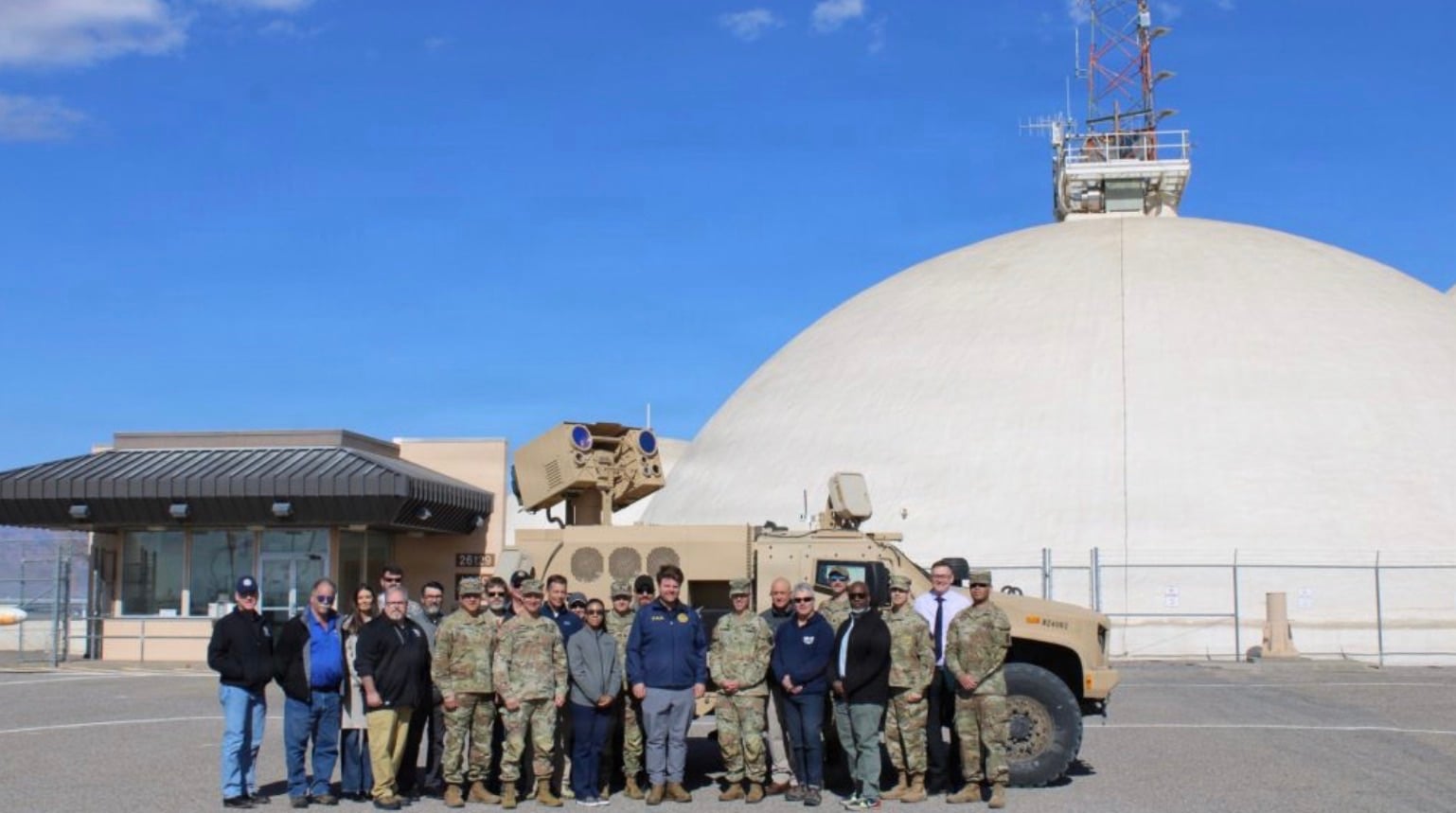
The Pentagon’s counter-drone laser program just got its most convincing argument yet — and the FAA didn’t plan it. On March 7, during a live evaluation at White Sands Missile Range in New Mexico, the Army Multi-Purpose High Energy Laser (AMP-HEL) automatically shut itself off when a commercial aircraft flying toward Albuquerque drifted into the same one-degree tracking angle the system was holding on a simulated threat. The laser wasn’t firing. It couldn’t have reached the plane. But the safety inhibit kicked in anyway, and that unscripted moment did more to reassure the FAA than any prepared demonstration could have. Full account from DefenseScoop.
That’s the story coming out of the March 7-8 joint evaluation at White Sands — a test fast-tracked after two back-to-back laser incidents in Texas last month created an interagency crisis and drew bipartisan anger on Capitol Hill.
- The development: JIATF 401, the FAA, and roughly half a dozen other agencies conducted a “first of its kind” evaluation of the AMP-HEL system March 7-8 at White Sands Missile Range, New Mexico, as reported by DefenseScoop.
- The so what: The test was specifically designed to address FAA concerns about laser safety near civilian airspace — concerns that became impossible to ignore after the El Paso airspace shutdown and the Fort Hancock friendly-fire incident last month.
- The source: DefenseScoop reported the full account on March 16, including on-record comments from Col. Scott McLellan, deputy director of JIATF 401.
The White Sands Test Addressed Two Specific FAA Concerns
The March 7-8 AMP-HEL evaluation at White Sands Missile Range targeted two explicit FAA objectives: demonstrating the system’s effect — or lack thereof — on aircraft materials when fired at full power, and proving its automated inhibit function works reliably when friendly aircraft appear in the laser’s tracking cone. Both objectives, according to JIATF 401, were met.
For the materials test, testers wheeled an actual Boeing 767 fuselage onto the range and fired the AMP-HEL at maximum effective range for up to eight seconds. No structural damage. Col. McLellan described the goal as disproving myths about what high-energy lasers actually do at distance — laser energy dissipates over space in ways that don’t match the Hollywood version.
For the inhibit test, crews flew multiple aircraft — including a threat aircraft, a friendly, and an unknown — behind simulated targets at various ranges. The system shut itself down in every scenario where it shouldn’t fire. The AMP-HEL reads ADS-B signals from commercial planes and cuts the operator out of the loop when a civil aircraft enters the tracking angle. McLellan’s description: “You almost have to force it to fire, and there has to be multiple things that line up.”
Then the unplanned aircraft happened on day one. A commercial flight approaching Albuquerque drifted into the one-degree cone the laser was holding on the test target. The system shut off before testers understood why. Once they identified the cause, McLellan called it a “tipping point” for the evaluation — an unscripted proof of concept no prepared demo could replicate.
Texas Created The Urgency That Made This Test Happen
The White Sands evaluation didn’t come from a routine testing schedule. It came from two bad weeks in February.
On February 10, U.S. Customs and Border Protection used a Pentagon laser — later identified by Reuters as AeroVironment‘s LOCUST system — to shoot down an object near El Paso that was later reported to be Mylar balloons. The FAA responded by issuing a 10-day airspace closure around El Paso International Airport without notifying the White House, the Pentagon, or local authorities. Fourteen commercial flights were canceled. Medical aircraft diverted 45 miles.
Two weeks later, near Fort Hancock, the military used a directed-energy weapon to destroy what turned out to be a CBP drone that CBP had not told anyone was flying. The coordination failure ran in both directions. Bipartisan congressional criticism followed immediately, with Sen. Ted Cruz and Sen. Maria Cantwell pushing for agency accountability and tighter protocols.
White Sands was the answer — not to the policy mess, but to the specific technical question the FAA had been asking: can this system fire at a cartel drone without threatening a Southwest Airlines flight in the same airspace? The March 7-8 test was the first time anyone tried to answer that question formally, with the FAA in the room.
The Cost Math Still Drives The Push For Lasers
AeroVironment CEO Wahid Nawabi appeared on 60 Minutes and put the cost argument plainly in reference to his company’s LOCUST system: a Patriot missile battery runs about $1 billion to procure, and each Patriot missile costs around $4 million per shot. AeroVironment’s laser fires at roughly $3 per engagement. The AMP-HEL tested at White Sands operates on the same directed-energy economics — high upfront, near-zero per shot — though JIATF 401 has not released specific cost figures for that system.
That math is driving the whole program. Cartel organizations are flying hundreds of drones per day across the southern border, according to DHS officials. A DHS counter-drone official told Congress that hostile organizations flew roughly 27,000 drones within 500 meters of the border in the first half of 2024 alone. You can’t intercept that volume with $4 million missiles. You can’t intercept it with nets, either — though JIATF 401’s Replicator 2 purchase of the Fortem DroneHunter F700 suggests nets are part of the layered answer for different threat profiles.
McLellan was direct about the limits of any single system: “Lasers aren’t the panacea.” RF detection, air domain awareness, kinetic interceptors, physical barriers — the counter-drone answer is a layered stack, not a single weapon. That’s the same conclusion the Bumblebee V2 kinetic interceptor fielding pointed to last month, and it’s what the JIATF 401 counter-UAS marketplace was built to support — multiple validated systems, fast procurement, no single point of failure.
DroneXL’s Take
The most telling detail in the entire White Sands account is what Col. McLellan chose to highlight: an accident. A plane that had nothing to do with the test stumbled into the tracking cone, the safety system cut the operator out, and he called it a “tipping point.” That’s not a test result. That’s a story for a congressional briefing. JIATF 401 knew exactly what audience they were playing to.
The Texas incidents exposed something that’s been true for a while: the military’s urgency and the FAA’s caution are operating on different timelines, with different risk tolerances, over the same airspace. White Sands was a forced reconciliation — get in a room, fire the laser at a real fuselage, fly real planes, and produce data the FAA can hold. The fact that it took two disasters and bipartisan Senate anger to get there is worth noting.
Expect a third incident before the end of summer. Not because the technology isn’t ready, but because the coordination architecture still isn’t. The ADS-B inhibit works. The automated safety shutoff works. What doesn’t work yet is the interagency communication layer — who notifies whom, in what order, before a trigger is pulled. That’s a policy problem, not an engineering one, and policy moves slower than lasers. Watch for DHS and DoD to announce a formal coordination protocol before the 2026 FIFA World Cup security window opens in June. If they don’t, the next incident won’t happen over a desert range. It’ll happen somewhere with cameras.
Editorial Note: AI tools were used to assist with research and archive retrieval for this article. All reporting, analysis, and editorial perspectives are by Haye Kesteloo.
Discover more from DroneXL.co
Subscribe to get the latest posts sent to your email.
Check out our Classic Line of T-Shirts, Polos, Hoodies and more in our new store today!

MAKE YOUR VOICE HEARD
Proposed legislation threatens your ability to use drones for fun, work, and safety. The Drone Advocacy Alliance is fighting to ensure your voice is heard in these critical policy discussions.Join us and tell your elected officials to protect your right to fly.

Get your Part 107 Certificate
Pass the Part 107 test and take to the skies with the Pilot Institute. We have helped thousands of people become airplane and commercial drone pilots. Our courses are designed by industry experts to help you pass FAA tests and achieve your dreams.

Copyright © DroneXL.co 2026. All rights reserved. The content, images, and intellectual property on this website are protected by copyright law. Reproduction or distribution of any material without prior written permission from DroneXL.co is strictly prohibited. For permissions and inquiries, please contact us first. DroneXL.co is a proud partner of the Drone Advocacy Alliance. Be sure to check out DroneXL's sister site, EVXL.co, for all the latest news on electric vehicles.
FTC: DroneXL.co is an Amazon Associate and uses affiliate links that can generate income from qualifying purchases. We do not sell, share, rent out, or spam your email.