Ukrainian FPV Drone Takes Down $16M Russian Ka-52 Near Pokrovsk, Killing Both Pilots
Check out the Best Deals on Amazon for DJI Drones today!
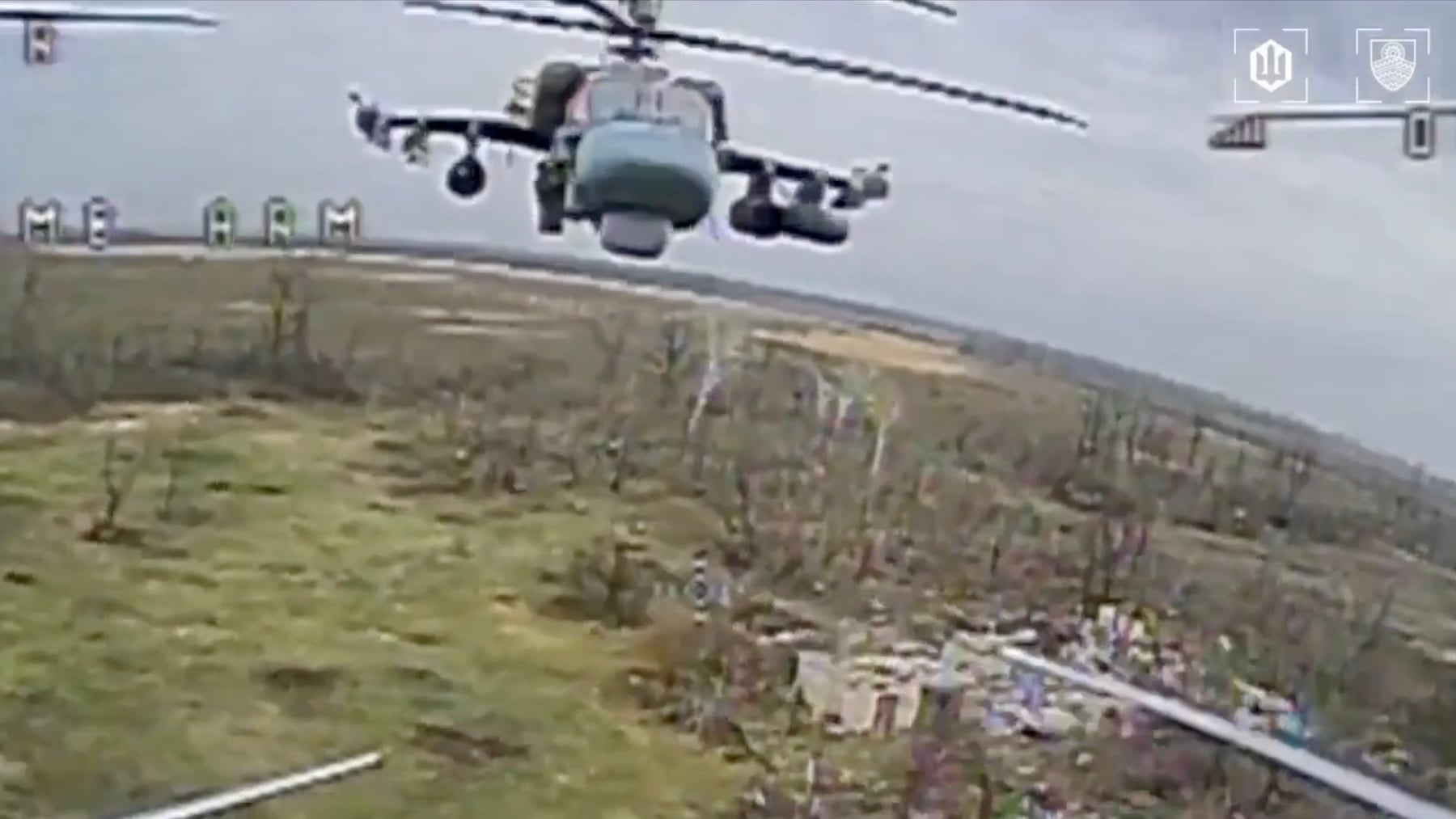
A Ukrainian FPV drone shot down a Russian Ka-52 “Alligator” attack helicopter in the Pokrovsk sector on March 20, 2026, according to Ukrainian civil society activist Serhii Sternenko, who posted documentation and video to his Telegram channel. The strike was carried out by operators from the “Khyzhaky Vysot” drone unit, part of Ukraine’s 59th Separate Assault Brigade of Unmanned Systems. The incident has not been independently confirmed by Ukraine’s General Staff or Air Force Command — standard caution applies to Telegram-sourced battlefield claims — but video of the hit shows the FPV drone flying directly into the weapons pylons mounted on the helicopter’s wing, likely triggering a detonation. The Ka-52, valued at roughly $16 million per unit, is one of Russia’s most capable attack helicopters. Both pilots ejected and initially survived, taking cover in a trench near burned-out armor, but a follow-up drone reconnaissance flight confirmed they were dead. The full sourced report with video is available at the link.
The loss is not just hardware. The Ka-52 carries the GOES-451 electro-optical targeting system, connects to Russia’s battlefield management networks in real time, and can launch LMUR (“Izdelie 305”) precision-guided missiles from up to 15 kilometers out, well beyond the reach of most shoulder-fired air defenses. Taking one down with an FPV platform costing roughly $400–$700 is the kind of cost asymmetry that defense analysts have been writing about in theory. Ukraine is making it routine.
What the Ka-52 Brings to the Battlefield
The Ka-52, developed by Russia’s Kamov Design Bureau, is a two-seat combat helicopter built for reconnaissance, target coordination, and strikes against both ground and aerial threats. Its coaxial rotor design is distinctive: no tail rotor, more compact, and agile at low altitudes where FPV drones operate. Twin VK-2500 gas-turbine engines push it to a top speed of 300 km/h (186 mph), with a cruise speed around 260 km/h and an operational range of approximately 500 kilometers. Maximum takeoff weight reaches 10,800 kilograms, with up to 2,800 kilograms of weapons across six hardpoints.
Its weapons package includes a 30mm 2A42 autocannon, unguided S-8 and S-13 rockets, and anti-tank guided missiles including the 9M120 “Ataka” and 9A4172K “Vikhr-1.” The Ataka has a range of about 6 kilometers but requires the helicopter to maintain continuous guidance while the missile is in flight, which means hovering in a fixed position. That hovering behavior has made Ka-52s predictably vulnerable to both ground air defenses and, increasingly, FPV drones. According to analysis from Militarnyi, combat experience has exposed real limitations in the helicopter’s sensor suite, limiting how effectively crews can detect low-altitude, fast-moving threats like FPV drones before it’s too late.
The FPV Strike on Video
Footage from the “Khyzhaky Vysot” unit shows the FPV drone approaching the Ka-52 at low altitude, then striking the weapons mount on the wing. The angle and point of impact suggest the operator targeted the ordnance hardpoints rather than the fuselage or rotors. If the drone detonated munitions already on the pylon, the secondary explosion would explain the rapid destruction visible in follow-up footage showing the helicopter burning on the ground. A second video, posted by Sternenko, shows the wreckage fully engulfed.
This is consistent with a targeting tactic that experienced FPV operators in Ukraine have described in open-source footage: aim for fuel tanks or weapons loads rather than the airframe, since FPV warheads are small and structural damage alone may not be enough to bring down a helicopter. I’ve watched dozens of these strike clips over the past year, and the ones that reliably destroy rotary-wing targets almost always show operators going for the wings or pylons rather than the cockpit.
Russia Knows This Is a Problem
This shootdown did not happen in isolation. Russia’s own helicopter manufacturer, “Russian Helicopters,” has already acknowledged publicly that FPV drones have damaged and destroyed its rotorcraft, and announced ongoing efforts to develop protective upgrades. What those upgrades look like in practice has not been disclosed, but the admission itself is telling: a state-controlled defense manufacturer conceding that a low-cost adversary weapon is destroying its products.
The pressure is mounting from multiple directions. As we reported in February, the Financial Times documented how the frontline has become a drone-dominated no-man’s-land where any movement at low altitude invites a strike. Our coverage from yesterday on U.S. and Chinese drone production strategies showed just how wide the gap has grown between the cost of a platform and the cost of the weapon used to destroy it. An MQ-9 Reaper costs $28–34 million per the Congressional Research Service. A Ka-52 costs $16 million. An FPV drone costs $400–$700.
Ukraine has been methodically building this capability. The 59th Separate Assault Brigade of Unmanned Systems, the unit responsible for this strike, is part of a deliberate Ukrainian strategy to organize dedicated drone formations rather than distribute FPV operators as an afterthought across conventional units. As we covered earlier this month, Ukraine is also pushing AI-assisted targeting into its FPV pipeline, which could make intercepts like this one faster and more repeatable. Ukraine has separately been scaling interceptor drone production at the same time, fighting the air war from both ends simultaneously.
The broader pattern is spreading fast. Iranian-backed militias in Iraq have already adopted the same FPV strike model against U.S. bases, and as we noted after NATO’s Hedgehog exercise, Ukrainian drone operators effectively neutralized two conventional military battalions in a single day during simulation, using FPV-led tactics that share the same doctrinal logic behind this Ka-52 kill.
DroneXL’s Take
I’ve been covering drone warfare since long before most defense publications treated it as anything other than a novelty. What’s happening in Pokrovsk right now isn’t a novelty. It’s a structural shift in how air power works at low altitudes, and this Ka-52 shootdown is one of the cleaner illustrations I’ve seen of where that shift is heading.
The Ka-52 is not an old, outdated platform. It is Russia’s primary attack helicopter for precision ground strikes, and it costs $16 million per unit. The FPV drone that killed it cost somewhere between $400 and $700. Russia’s helicopter manufacturer has admitted the problem publicly. That admission tells you the losses are frequent enough to be impossible to hide.
What strikes me most watching the video is the targeting precision. The operator flew straight for the weapons pylon rather than the airframe, and the secondary explosion confirms it worked. That level of operator skill, inside a dedicated unmanned systems brigade, is not accidental. Ukraine has been training for exactly this.
Russia will develop FPV countermeasures for its helicopters. Electronic jamming, physical screening, and changes to operational altitude and flight profiles are all possible. But by the time those upgrades reach the fleet in meaningful numbers, Ukraine’s FPV operators will have moved to the next generation of targeting methods. The gap between attacker and defender on this specific problem will stay wide for at least another 18 months, and Russia will lose more Ka-52s before it closes.
DroneXL uses automated tools to support research and source retrieval. All reporting and editorial perspectives are by Haye Kesteloo.
Discover more from DroneXL.co
Subscribe to get the latest posts sent to your email.
Check out our Classic Line of T-Shirts, Polos, Hoodies and more in our new store today!

MAKE YOUR VOICE HEARD
Proposed legislation threatens your ability to use drones for fun, work, and safety. The Drone Advocacy Alliance is fighting to ensure your voice is heard in these critical policy discussions.Join us and tell your elected officials to protect your right to fly.

Get your Part 107 Certificate
Pass the Part 107 test and take to the skies with the Pilot Institute. We have helped thousands of people become airplane and commercial drone pilots. Our courses are designed by industry experts to help you pass FAA tests and achieve your dreams.

Copyright © DroneXL.co 2026. All rights reserved. The content, images, and intellectual property on this website are protected by copyright law. Reproduction or distribution of any material without prior written permission from DroneXL.co is strictly prohibited. For permissions and inquiries, please contact us first. DroneXL.co is a proud partner of the Drone Advocacy Alliance. Be sure to check out DroneXL's sister site, EVXL.co, for all the latest news on electric vehicles.
FTC: DroneXL.co is an Amazon Associate and uses affiliate links that can generate income from qualifying purchases. We do not sell, share, rent out, or spam your email.






![Review And Rewrite This Article For Publication. Do All Of The Following: 1. Fact-Check: Verify Dates, Locations, Quotes, Agency Names, And Acronyms. Mark Anything Uncertain With [Verify]. Did The Article Reference And Link To The Original Source? Flag If Missing. 2. Devil'S Advocate: In 3–4 Sentences, Assess Whether The Article Is Factually Sound, Well-Written, And Reads As Human. Be Blunt. 3. Humanize: Fix All Ai Patterns — Break Parallel Sentence Pairs, Remove Em-Dashes Used As Dramatic Pauses, Cut Redundant Consecutive Sentences, Remove Rhetorical Counting Devices. Strip These Words: Crucial, Vital, Key, Significant, Notably, Importantly, Essentially, Arguably, Landscape, Ecosystem, Trajectory, Transformative, Game-Changer, Groundbreaking, Unprecedented, Cutting-Edge, Robust, Seamless, Leverage (Verb), Utilize, Going Forward, In Conclusion, In Summary. Vary Sentence Length. Make The Take Section One Editor'S Sharp Opinion, Not A Summary. 4. Seo: Give 5 Alternative Title Ideas, A Permalink Slug, And A Meta Description (Under 155 Characters). Output Order: Devil'S Advocate Assessment → Revised Article With [Verify] Flags → Seo Block.](https://dronexl.co/wp-content/uploads/2025/02/DJI-Dock-3-and-Matrice-4D-and-4TD-Usher-in-Versatile-Drone-in-a-Box-Solution-for-Remote-Operations-0022.jpg.webp)