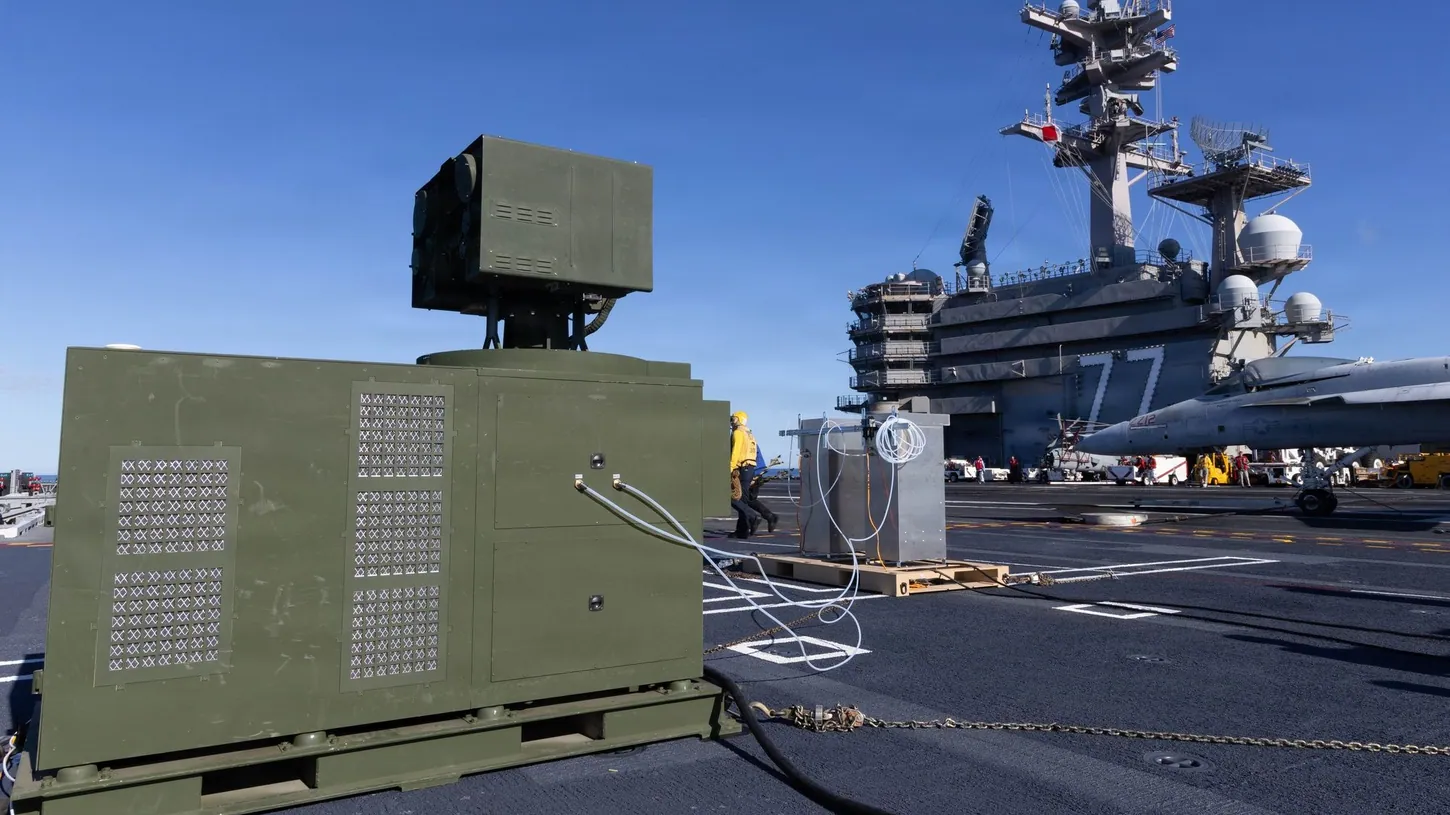
The US Navy just put a laser weapon on an aircraft carrier for the first time. On October 5, 2025, a palletized AeroVironment LOCUST system detected, tracked, and destroyed multiple drones in a live-fire test aboard the USS George H.W. Bush, as reported by News Nation Now.
The Navy sat on the news for 197 days before releasing it on April 20, 2026, timed to coincide with the Sea-Air-Space 2026 exposition. This marks a real shift in how supercarriers will defend themselves against cheap drones.
How the palletized LOCUST works
The LOCUST Laser Weapon System is built by AeroVironment and currently rates around 20 kilowatts of power. That’s modest compared to ship-mounted lasers like the HELIOS on the destroyer USS Preble, but it’s enough to cook the optics or fuel lines on small drones at close range.
The central element is a turret that houses the laser along with electro-optical and infrared cameras for target tracking. Secondary radars and radio frequency detectors can also cue the system. AeroVironment upgraded LOCUST in March 2026 with AI-assisted targeting and a scalable power output that can climb past 35 kilowatts.
For the carrier test, the team used the palletized P-HEL version. Crews literally rolled the container onto the flight deck, lashed it down, and plugged it into ship power.
No modifications to the carrier. No drydock time. The Army has already deployed this same system on JLTVs and Infantry Squad Vehicles and along the southern US border.
The cost math driving this
Here’s why the Navy cares. A single SM-2 surface-to-air missile runs about 2.1 million dollars. An SM-6 costs 4.3 million. A Houthi Shahed drone? Around 20,000 dollars on the high end. Some of the cheaper one-way attack drones fired at Navy ships cost as little as 2,000 dollars to build.
From October 2023 to early 2025, Navy destroyers in the Red Sea fired 120 SM-2s, 80 SM-6s, and another 20 Evolved Sea Sparrows and SM-3s. Total munitions spend approached a billion dollars. The ratio of interceptor cost to target cost in some engagements ran 200 to 1, sometimes worse.
A laser shot, by contrast, costs roughly the price of the electricity it takes to fire. No magazine to reload. No logistics tail. No inventory crisis when a carrier strike group sits on station for months. That math is the entire reason directed energy has moved from a research curiosity to an operational priority.
Why this matters for US carriers now
The USS George H.W. Bush isn’t sitting in a test range. The carrier deployed in late March 2026 and was last seen operating off the coast of Namibia on its way to join a growing naval force in the Arabian Sea. The Bush is heading into exactly the kind of environment where Iranian and Houthi drone swarms have been harassing American warships for over two years.
Before this test, no US aircraft carrier had ever hosted a laser weapon. The USS Preble carries HELIOS. The USS Dewey and USS Stockdale carry the lower-power ODIN dazzler. But the crown jewels of the fleet, the 11 Nimitz-class and Ford-class supercarriers, had to rely on their escort ships, fighter jets firing AIM-120 AMRAAMs and Sidewinders, and point-defense missiles like the RIM-116.
That gap is closing. Chief of Naval Operations Adm. Daryl Caudle told reporters in January that his goal is for directed energy to be the first solution whenever a threat is within line of sight of a ship. Adm. Caudle wrote his Naval Postgraduate School thesis on directed energy and nuclear weapons. He’s a true believer, and he runs the Navy.
DroneXL’s Take
Here’s what I find genuinely significant. The test itself wasn’t the hard part. Cooking a quadcopter at short range with 20 kilowatts is something the Army has done for years on JLTVs and at the border. The real story is that the Navy proved it can bolt a laser onto a flight deck, plug it into ship power, and get it operational without cutting a single hole in the hull.
That’s the scalable model. If the Navy wanted to equip every carrier and amphibious assault ship in the fleet with LOCUST next week, the limiting factor wouldn’t be ship integration. It would be production volume at AeroVironment.
The flip side is equally honest: 20 kilowatts is still toy-grade power. LOCUST works against quadcopters and small fixed-wing drones at close range. It will not stop a Shahed-136 at distance, and it certainly won’t stop a cruise missile. Real carrier defense against the full drone and missile threat spectrum needs megawatt-class lasers, which are still years away from the fleet. The planned Trump-class battleships are where those will likely debut.
For now, treat this test as a proof of concept that matters more for production and logistics than for lethality. The Navy finally has a path to equip its most valuable ships with counter-drone lasers at sustainable cost. That alone changes the economics of carrier operations in contested waters.
Photo credit: U.S. Navy