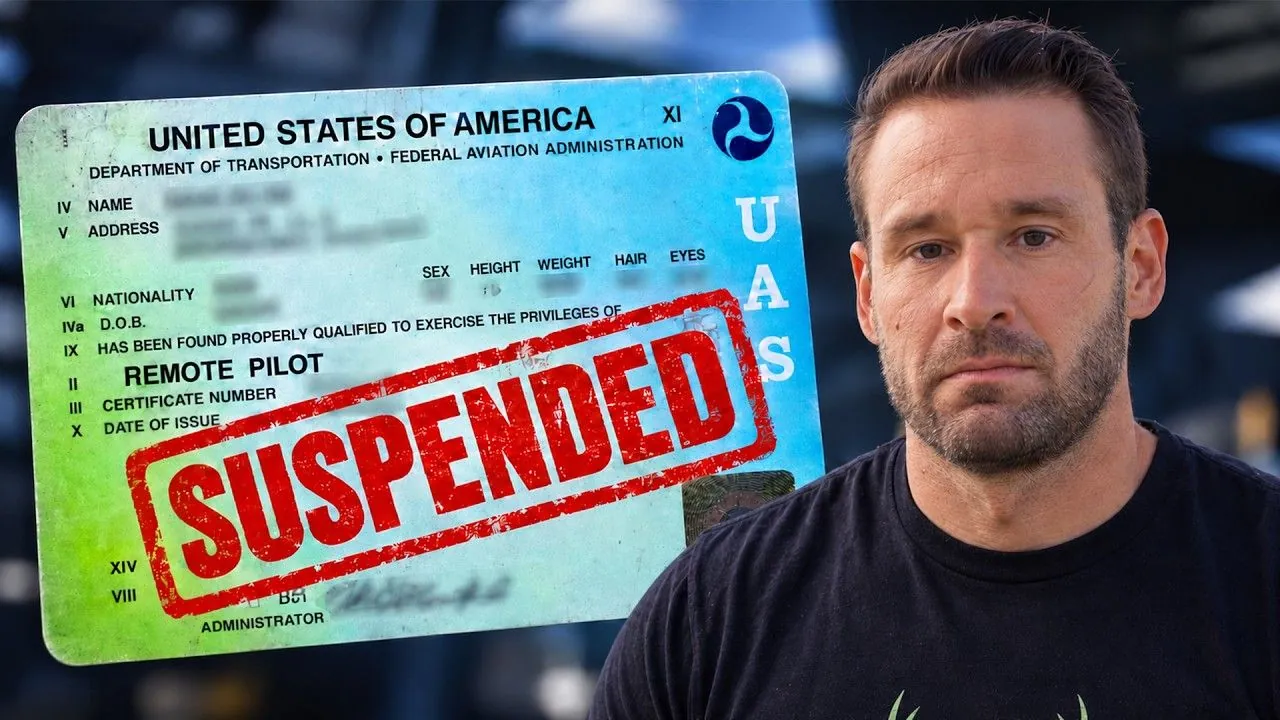
I’m not Greg — it’s Ben. But Greg is here with me and we’re putting him to the test. We searched for the hottest topics and the burning questions drone pilots are asking right now, and we’re forcing Greg to answer them all in real time with no prep. It’s time to learn something, folks. This is Grilling Greg.
What Happens to Your FAA Registration When You Sell a Drone?
Our first question: if you dispose of one of your registered drones and someone else attempts to register it, would the FAA detect that two people own the same unit? And what is the process when you sell a drone?
Greg’s answer: the FAA doesn’t have anything in place to check for double registrations in the system — and it shouldn’t, because you never know if the previous owner has deregistered the drone. So technically you could have a drone double-registered, which is fine. Whatever registration you have, as long as it’s valid and you present it to the FAA, and as long as you have that registration number on your drone, you’re good.
When you sell a drone, you should go to the FAA DroneZone. If you’re flying recreationally, you should remove the drone from your inventory — that effectively deregisters it — and then remove the sticker from the drone. If you’re operating under Part 107, you need to cancel or terminate the registration. Under Part 107 there’s no inventory system; each drone just has its own separate registration number. Either way, remove the sticker before you hand the drone over.
Why does the sticker matter so much? Think of it like a car. If you sell a car but leave your license plate and registration on it and someone then goes and robs a bank with it, the authorities are going to knock on your door. Same thing with a drone — if somebody does something dumb with it and it still has your sticker on it, the FAA is going to pick up that drone and come looking for you. So yes, you definitely want to get rid of that.
One more thing: we offer free stickers at pilotinstitute.com/free — we’ve sent out close to 60,000 of them now.
Can HOAs and Private Property Owners Restrict Where You Fly?
A lot of questions come in about local restrictions and signage from HOAs, universities, and private landowners. Let’s clear this up: nobody can restrict you from flying over their property unless it’s the federal government that has put something in place. HOAs and private landowners cannot put restrictions on what you do in the airspace above their land.
With that said, they can restrict operations to and from property that they own and control. If an HOA owns the roads in a neighborhood, for example, they could prevent you from taking off and landing from those roads. And if an HOA has bylaws saying you can’t take off from your own property within the community, you could be fined — though how that actually works in practice I’m not entirely sure.
Universities are unfortunately infamous for this — trying to prevent people from flying over their campuses, which is not something they have the authority to do. If organizations want to understand how to approach this properly, the FAA has a document with guidelines and contact information specifically designed to help prevent overreaching by local municipalities, HOAs, and others trying to control airspace. We’ll put a link in the description so people can share it.
Is It Legal to Take Off from a Public Road to Film Private Property?
Here’s a scenario that comes up a lot: taking off from a public country road to film a windmill, a watering pond, and other things on private property — maybe even in an HOA area. Is that legal?
Yes, it’s totally legal. Taking off from a public road is fine. Where I’d urge caution is flying over someone’s property with the intent of filming it without their approval. If I see a cool estate in the distance and I want to get a shot from a distance, that’s fine. But if you’re getting close enough to identify people in the image or see inside the house, you shouldn’t do that — there are laws against filming people inside their property. If someone is in their backyard, technically you could photograph them because there’s no legal expectation of privacy outdoors, but should you? Probably not.
We all have a role in being good stewards of this industry. People are already wary of drones because of privacy concerns. Every time we fly over someone’s yard and take pictures without their knowledge — even if it’s technically legal — it damages the reputation of everyone who flies drones responsibly and gives people more ammunition to push for bans that none of us want to see.
If you’re doing real estate photography and flying over neighboring yards to photograph a listed property, always try to avoid capturing other people on their property. And if a neighbor comes out and confronts you, deescalate. Tell them you’ve been hired by their neighbor who’s selling their house, that you’re doing real estate photography, and that they won’t be in any of the pictures. If they’re receptive, offer to show them exactly what you’re capturing on your screen so they can see you’re focused entirely on the listed property.
Flying Over People: What Actually Qualifies Someone as Part of the Operation?
A common question: if I’m flying under Part 107 in a parking lot with a group of friends, what does it take for them to count as part of the mission so I can fly over them with a non-categorized drone?
To be part of the operation, you have to actually have a part in the safety of the flight. For a while, people were asking whether telling two people at a wedding to watch the drone as it flew directly over them would count — it doesn’t. We’ve seen people try signing waivers as well. The FAA doesn’t allow that either when it comes to transitioning over people or moving vehicles.
The bottom line: to fly over people, you need either a categorized drone or a FAA waiver. It doesn’t matter if you’re flying over someone for half a second or 60 seconds — you’re still flying over people. The same applies to roads: if cars are moving, you cannot transition over those roads. If there are no cars, you can. The road itself isn’t the issue — it’s the people and people in moving vehicles.
There is one exception worth knowing: if traffic is stopped at a red light, you can fly over — because those occupants are inside a stationary object that provides them protection. The moment those cars start moving again, they’re back to being people in moving vehicles.
Category 1 is the easiest threshold to reach for flying over people: sub-250 grams, with prop guards and Remote ID. Hit those three criteria and you’re essentially good to fly over people. Categories 2 and 3 have additional restrictions, and category 4 requires FAA approval of your design. But at the base level: categorized drone or waiver — period.
Do You Need a Part 107 to Post Drone Videos on a Monetized YouTube Channel?
This one comes up constantly, and there’s real confusion around it. YouTube used to only place ads on videos from monetized channels, so it was clear when money was involved. A couple of years ago that changed — now YouTube places ads on virtually any video, even from non-monetized creators, but the creator doesn’t see that revenue. It all goes to YouTube.
That shift created confusion: if there are ads on my video, does that mean I need a Part 107? The answer is no — what matters is the intent of the flight. If you went to the park to fly recreationally, filmed your kids, and then uploaded the video, that’s a recreational flight. You don’t need Part 107 just because YouTube happens to run an ad against it.
I use this example in our course: you’re in the middle of a park filming your kids recreationally, and suddenly in the distance there’s an avalanche and you capture the whole thing. Can you sell that footage to a news outlet? Yes — because at the time you recorded it, this was a recreational flight. You just happened to be there.
Now flip it: you just bought a new iPhone and you’re going to make a video for your monetized channel, and you want to use your drone to get aerial footage of the iPhone for that video. That’s not recreational. The intent of the flight was to capture footage for commercial content. That’s a Part 107 flight.
The FAA created the recreational exemption for the model aircraft flyer at an AMA field — for the mom and kid going to the park, for pure recreational enjoyment. As soon as you step outside that intent, you’re in Part 107 territory.
What Industries Can You Enter With a Part 107?
A lot of people who are getting into Part 107 want to know what paid work actually looks like. The answer is: a ton of options, and more are emerging every day.
The drone is a tool — a tool for capturing data. Whether that’s thermal data, RGB data, multispectral data, or photogrammetry for mapping, you’re creating a digital product. That product might be used for mine mapping, roof inspections, power line inspection, solar panel inspection, or wind turbine inspections. It might be real estate photography, wedding videography, or aerial cinematography for Netflix or local productions. The applications are genuinely limitless.
Agriculture is a growing space too — you can spray chemicals on crops with a drone, or map plant health across an entire field. Just this week I saw a success story in our Pilot Institute community: a student who just landed a $10,000 gig for next year mapping and inspecting golf courses. Using multispectral data, you can detect grass health problems before they’re visible to the naked eye, giving the groundskeeper a head start before anything goes brown. That’s a real, repeatable business.
For the investment involved — a course plus the test runs around $300 — and then you have that certificate permanently, unless you do something that gets it revoked. One paid gig covers that cost and then some.
What Is the Pilot Institute Premium Community?
After getting the Part 107 certificate — which I like to call the license to be dangerous — a lot of people wonder: now what? How do I get clients? How do I run the business? How do I advertise?
That’s exactly what we built the Pilot Institute premium community for. It’s a platform with high-quality interviews with working professionals in the drone industry, updated continuously with new content. Think of it as a living course — it’s always growing. On top of the content, it’s community-based, so you can talk to other pilots and professionals. We have private communication with premium members where you get more direct access to me and to Jillian.
The premium community is for pilots who want to take their business to the next level. And practically speaking, a single paid gig you land through what you learn there will more than cover the membership cost. If you want to check it out, there’s a link in the description.
This article is based on a video by Pilot Institute YouTube channel. You can also find Greg on DroneXL.