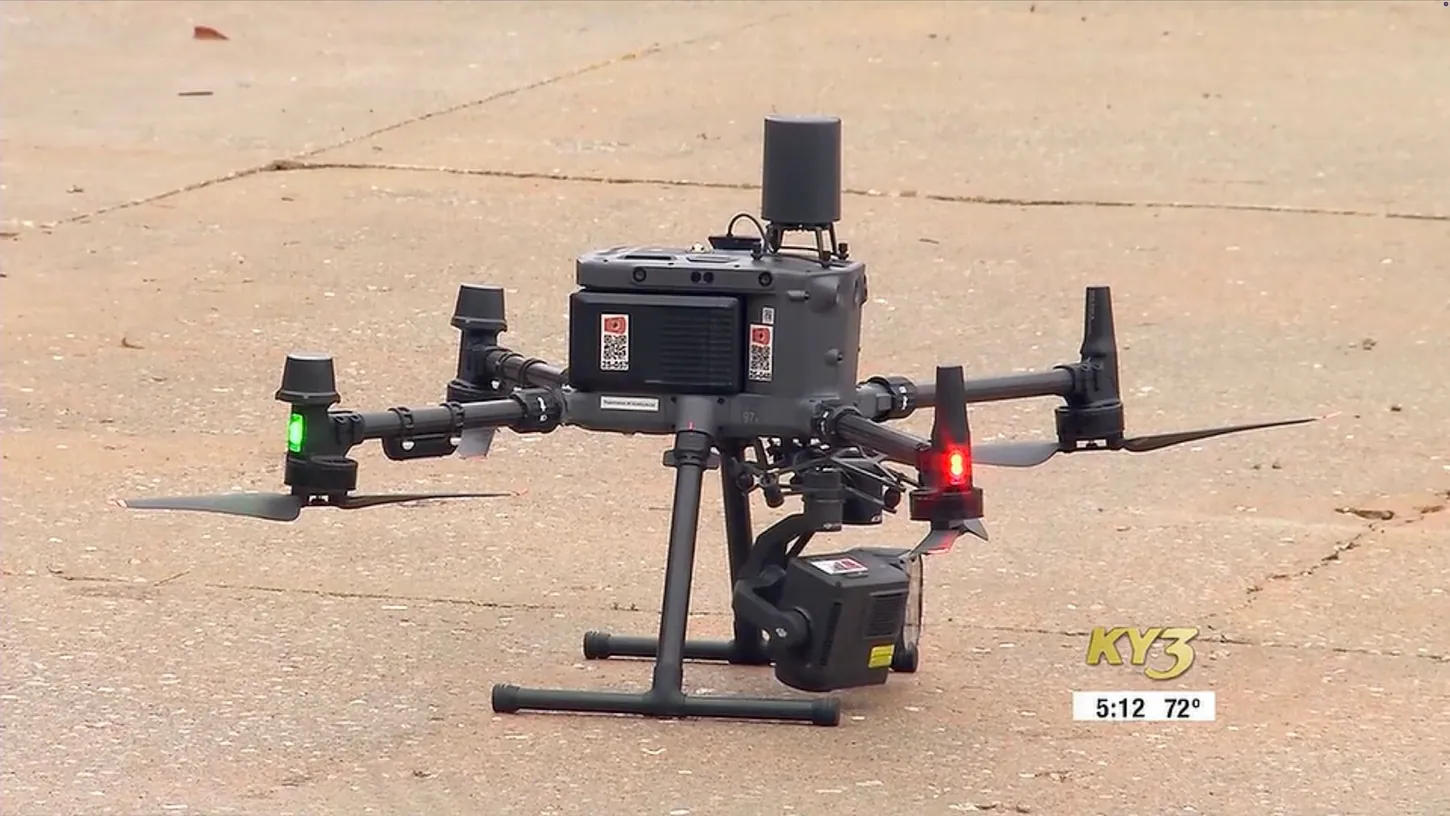
The Alaska Division of Forestry and Fire Protection (DFFP) used its Unmanned Aerial Systems Module to identify hot spots and spot fires across the Gerstle River during the Sawmill Creek Fire, helping ground crews achieve 100 percent containment four days after ignition. The fire was held to 14.8 acres on state land east of Delta Junction.
The blaze started Monday, May 18, 2026, when high winds reignited embers from an old burn at the northern end of the Delta Agricultural Project, about 25 miles southeast of town. By Friday, May 22, the fire was fully contained — a notably fast suppression timeline for an escaped agricultural burn that jumped into trees.
What The Drone Actually Did
The operational value here was thermal acquisition of dispersed heat across difficult terrain. After the initial escape into timber, storm winds carried embers across the Gerstle River and scattered spot fires through the surrounding area. Without aerial infrared, ground crews would have had to walk the perimeter visually, slow and prone to missing buried heat.
DFFP’s UAS Module flew the area with an infrared camera, identified each hot spot, and guided ground forces directly to the locations. The drone repeated overflights as needed to confirm no heat remained. That sequence — fly, locate, direct, reflight to verify — is the standard playbook DFFP has been refining since at least 2025.
Neither DFFP nor the agency’s public reporting specifies the drone manufacturer or model used on the Sawmill Creek operation.
Part Of A Now-Established Alaska Pattern
DFFP’s UAS Module has appeared in fire reporting repeatedly through 2025 and into 2026. The unit assisted on the Goldrun Complex in July 2025 and helped firefighters discover hidden heat on the Nenana Ridge Complex the same month. Both cases used the same infrared-and-guide playbook now visible on Sawmill Creek.
That pattern matters because Alaska’s interior wildfire season is increasingly defined by lightning starts and agricultural burn escapes hitting fuel beds desiccated by warming spring conditions. Ground-only crews can suppress the obvious flame front; what kills containment timelines is the buried heat that smolders for days and re-emerges as wind shifts. Infrared aerial recon collapses that detection problem.
DFFP also has a separate state-level UAS context: an unmanned aircraft set a record in 2025 as the furthest-north UAS deployment for wildfire management by a federal land management agency, on the Onion Fire (#433). Alaska is functionally a proving ground for cold-weather, long-range wildfire UAS work.
Why The Cause Matters
As AK FIRE INFO reported, Sawmill Creek is the second escaped agricultural burn DFFP responded to in the Delta Junction area within a 48-hour window. The agency had already published a notification about an escaped ag burn on May 18 before the Sawmill Creek incident absorbed crew attention.
For DFFP, ag burn escapes are a recurring operational headache, not an outlier. Spring conditions, residual fuel from previous burns, and winds that pick up faster than burn permits anticipate combine into a predictable pattern. Drones do not solve the cause, but they shorten the response when the cause inevitably produces a fire.

The Sawmill Creek run held the fire to 14.8 acres and brought it to full containment in four days. Forty-four personnel were assigned, supported by two water tenders, two local dozers, the DFFP White Mountain T2IA crew, and a Tanana Chiefs Small Module crew.
DroneXL’s Take
The part that doesn’t make the headline is exactly what this kind of fire teaches.
A 14.8-acre fire contained in four days does not generate national coverage. It is not a megafire, it is not a community evacuation, it is not a federal disaster declaration. It is a state ag burn that escaped, scattered into trees, threw spot fires across a river, and got caught fast because the UAS Module flew the perimeter with thermal and pointed crews at the heat one location at a time.
That is the actual day job of a wildfire UAS program. Not the spectacular footage. The unglamorous repetition of fly, locate, direct, verify, repeat — applied to fires the public never hears about because the program worked.
Alaska’s DFFP has been running that playbook for at least two seasons now, and Sawmill Creek is what it looks like when the playbook is working as designed. The headline is the megafire that didn’t happen.
Photo credit: UAS MOD/DFFP