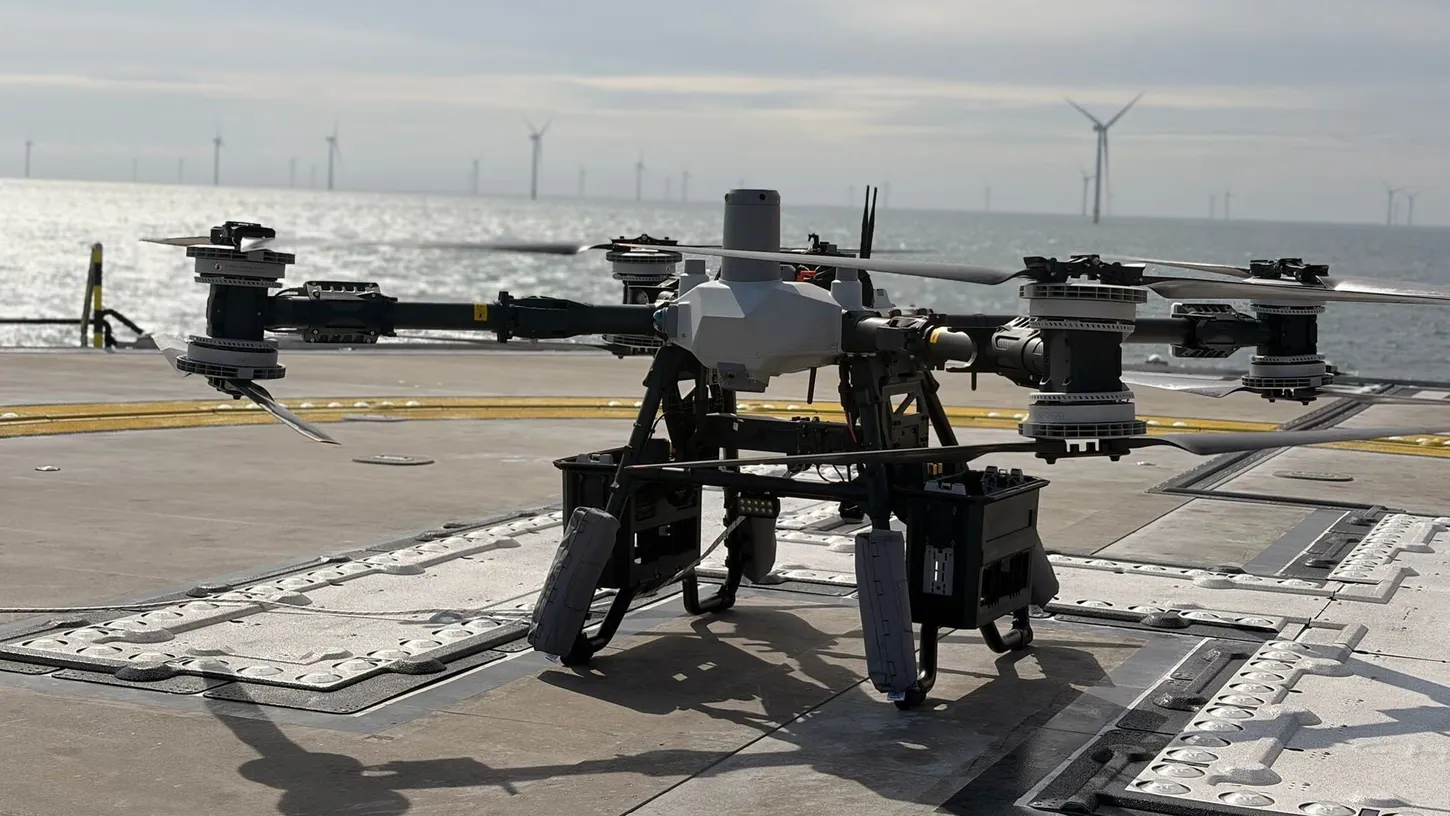
A DJI FlyCart 100 spent this spring hauling other people’s garbage off the highest mountain on Earth. Working with the Nepali operator Airlift, the heavy-lift drone moved 22,207 lbs (10,073 kg) between Everest Base Camp and Camp 1 this season: 15,906 lbs (7,215 kg) of oxygen, rope and ladders carried up, and 6,300 lbs (2,858 kg) of trash carried back down. This is one of the most honorable jobs a drone has ever been handed, and it exists because we are the ones who fouled the mountain in the first place.
Eight Minutes Instead Of An Eight-Hour Death Trap
The number that matters most on Everest is not the payload, it is the eight minutes, because that is how long the drone spends crossing terrain that costs a human being six to eight hours and sometimes a life.
The route between Base Camp and Camp 1 runs through the Khumbu Icefall, a shifting river of ice that has killed dozens of climbers and porters over the decades. Sherpas cross it hauling loads on their backs, again and again, every season. The FlyCart 100 flies over it in eight minutes with a load no human should carry through that maze at all.
Move the trash and the oxygen by air, and you delete the most dangerous commute in mountaineering. The Sherpa who used to make that crossing twenty times a season to stock the camps now makes it far less. That is the part of this story worth leading with: before the mountain gets cleaner, the people who clean it stop dying.
A Machine Built To Work Where Bodies Fail
The reason this works is that DJI built the FlyCart 100 for exactly the place that breaks everything else, and the specs read like a challenge to physics rather than a product sheet.
At sea level the aircraft lifts 220 lbs (100 kg). Above 20,670 feet (6,300 m), in the thin, brutal air of the high camps, it still moves 104 lbs (47 kg) in temperatures that swing from 5 to 41 F (-15 to 5 C), with a maximum takeoff weight of 375 lbs (170 kg) and a top speed of 45 mph (20 m/s).
DJI also just debuted its EV50 eVTOL on the same mountain, a story DroneXL covered earlier this month. The EV50 grabs the altitude record and the headlines. The FlyCart 100 is the workhorse actually clearing the trash, flight after unglamorous flight.
The World’s Highest Garbage Dump Has A Human Author
Everest earned its ugliest nickname the hard way, and no drone can fix the reason it exists, because the reason is us.
The mountain is called the world’s highest garbage dump because the average climber leaves 17.6 lbs (8 kg) of trash behind: spent oxygen bottles, torn tents, food packaging, human waste, gear too heavy to carry down once the summit is behind them. Multiply that by the hundreds who attempt the peak each season, across decades, and the roof of the world becomes a landfill with a view. The FlyCart 100 is set to pull roughly 22,000 lbs (10,000 kg) per season from higher camps that no cleanup crew could ever safely reach on foot before.
That is a heroic patch on a wound we keep reopening. A drone can carry the garbage down. It cannot make people stop dropping it. The machine solves the logistics. It does nothing about the ethics, and the ethics are the actual problem.
DroneXL’s Take
Here’s what I actually think, and I am not going to dress it up. A person who climbs Everest and leaves their trash on the way up leaves a piece of themselves on that mountain, and it is not the noble piece.
So here is a proposal that costs the honest climber nothing. Weigh every expedition on the way in. Log the oxygen bottles, the fuel canisters, the packaging, the gear. Weigh them again on the way out. Whatever does not come back down gets billed at a price that actually stings, not a token deposit. And every dollar of those fines goes into one fund with one job: buy more FlyCart 100s and pay the Nepali crews who fly them.
DJI and Airlift proved the hard part already. The engineering works at 6,300 m in a place that kills people. What is missing is not technology, it is will and money. Nepal already has the bones of this: a $15,000 spring permit and a $4,000 refundable garbage deposit that climbers get back after showing they carried their waste out. The mountain is still a dump, so the current deposit clearly does not bite.
I want more operators in this. I want this program funded like it matters, because it does. Give me the mountain cleaner than we found it, hauled down eight minutes at a time by a machine that never once asked for a summit photo.
Sources: SnowBrains, TechRadar, DroneXL, DJI FlyCart 100 specs
DroneXL uses automated tools to support research and source retrieval. All reporting and editorial perspectives are by Haye Kesteloo.