
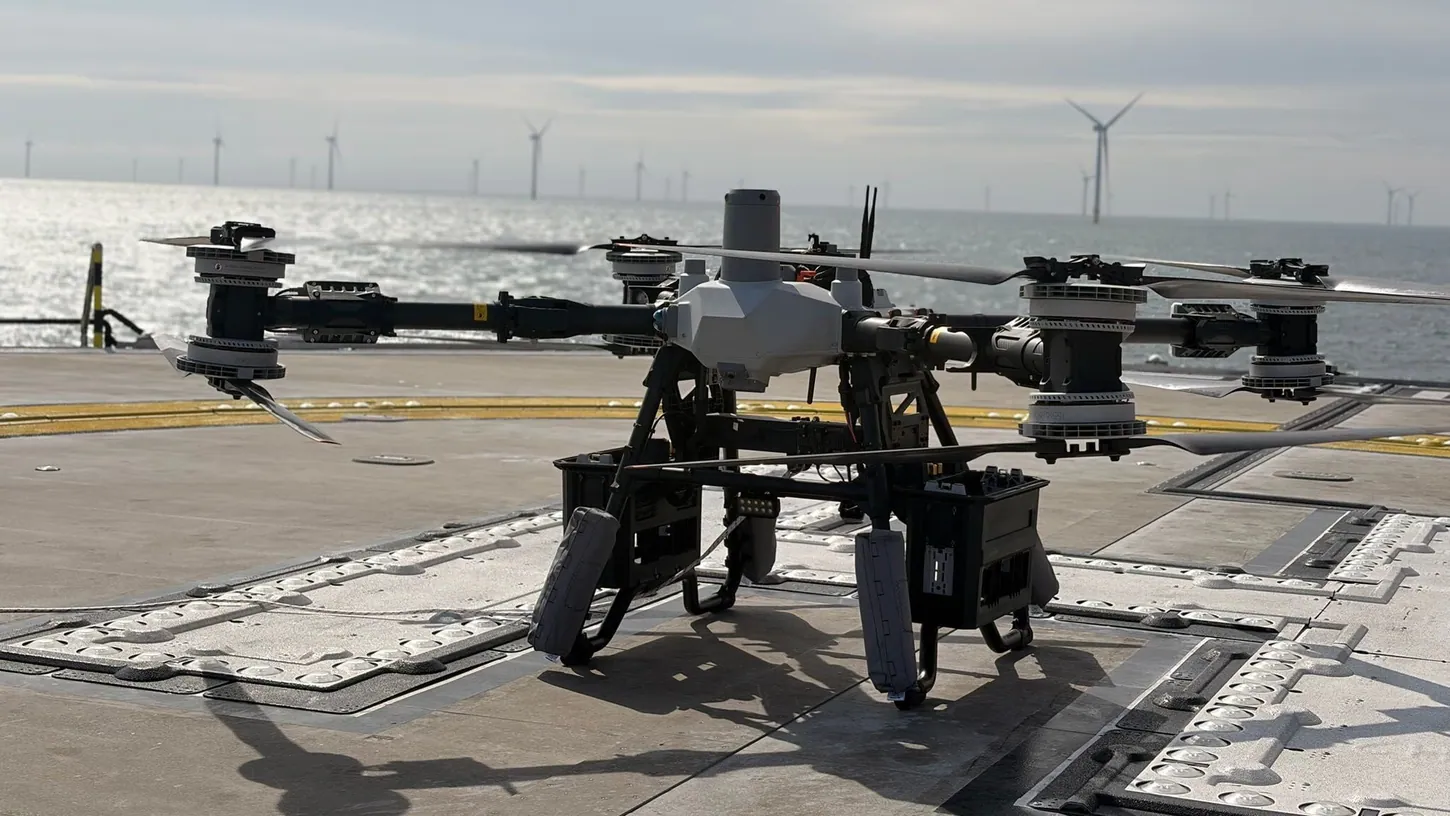
Ørsted spent four weeks flying maintenance kits of 121 to 143 pounds (55 to 65 kg) from a service vessel to turbines at Hornsea 2, its wind farm in the North Sea, with Skyports Drone Services flying the aircraft. When the technicians finished, the drone went back out, picked up the bag on an automatic hook so nobody had to clip it on by hand, and returned it to the ship.
Ørsted announced the trial on October 7. Neither its release nor the copy Skyports posted names the aircraft, but the photo Ørsted published with it shows what DroneXL identifies as a DJI FlyCart 100, the heavy lifter the United States put in a 100% tariff bracket on Sept. 3.
Drones have delivered to Hornsea 2 before. Last summer a different operator flew safety boxes to more than 400 Ørsted turbines, Hornsea 2’s included.
Ørsted’s 2025 Flights Dropped Boxes Off, While Hornsea 2 Ran Round Trips
The 2025 program, flown by Skylift on FlyingBasket drones, left evacuation kits of up to 154 pounds (70 kg) on turbines at four Ørsted wind farms over 550-plus flights. The Hornsea 2 trial flew task-specific maintenance kits out before technicians arrived and carried them back once the work was done.
Each bag held the tools and parts for one job. Ørsted project lead Richard McCrilley said the team had a daily presence on site and took ad hoc flight requests as they came in. “We were able to cover both planned and reactive works,” he said.
The turbine keeps generating while the drone delivers. Ørsted put numbers on that in 2025: a crane delivery to the nacelle took two lifts and up to a six-hour shutdown, against about five minutes by drone, according to Ørsted’s account of the Skylift program. DroneXL covered those flights when the BBC reported them.
The Trial’s First BVLOS Delivery Ran 2.5 Miles Inside Hornsea 2
The team’s first delivery beyond visual line of sight (BVLOS) inside Hornsea 2 ran about 2.5 miles (4 km), planned and monitored from a specialist service vessel. The UK Civil Aviation Authority helped secure the airspace approvals for the project, which Ørsted calls a milestone.
Ed Clay, the CAA’s head of technical strategy for future safety and innovation, said the regulator is working toward “integrating routine BVLOS operations into the airspace system.” Clay also spoke for the CAA when Glasgow’s Airspection flew a shore-launched drone to a Liverpool Bay wind farm beyond line of sight, announced the day before Ørsted’s release.
Skyports has done longer offshore runs. In 2025 it teamed with Skyways and RWE to fly Skyways V2 aircraft on 50-mile (80.5 km) round trips from port to RWE’s Arkona wind farm in the Baltic, with payloads of up to 22 pounds (10 kg). Hornsea 2’s BVLOS leg was shorter, and its kits weighed 5.5 to 6.5 times as much.
Ørsted’s Photo Matches DJI’s FlyCart 100, the Only FlyCart Sized for the Load
The drone on the vessel’s deck in Ørsted’s release has the FlyCart 100’s coaxial eight-rotor layout, top-mounted parachute and twin side battery cases. DJI rates it at 143 pounds (65 kg) for 7.5 miles (12 km) on two batteries. That is the top of Ørsted’s kit range.
The rest of DJI’s lineup doesn’t fit. The FlyCart 30 carries 66 pounds (30 kg) on two batteries, and the much larger FlyCart 200 launched in April for the Chinese market only. DJI’s own photo of the FlyCart 100, below, shows the same fuselage, parachute housing and battery cases.
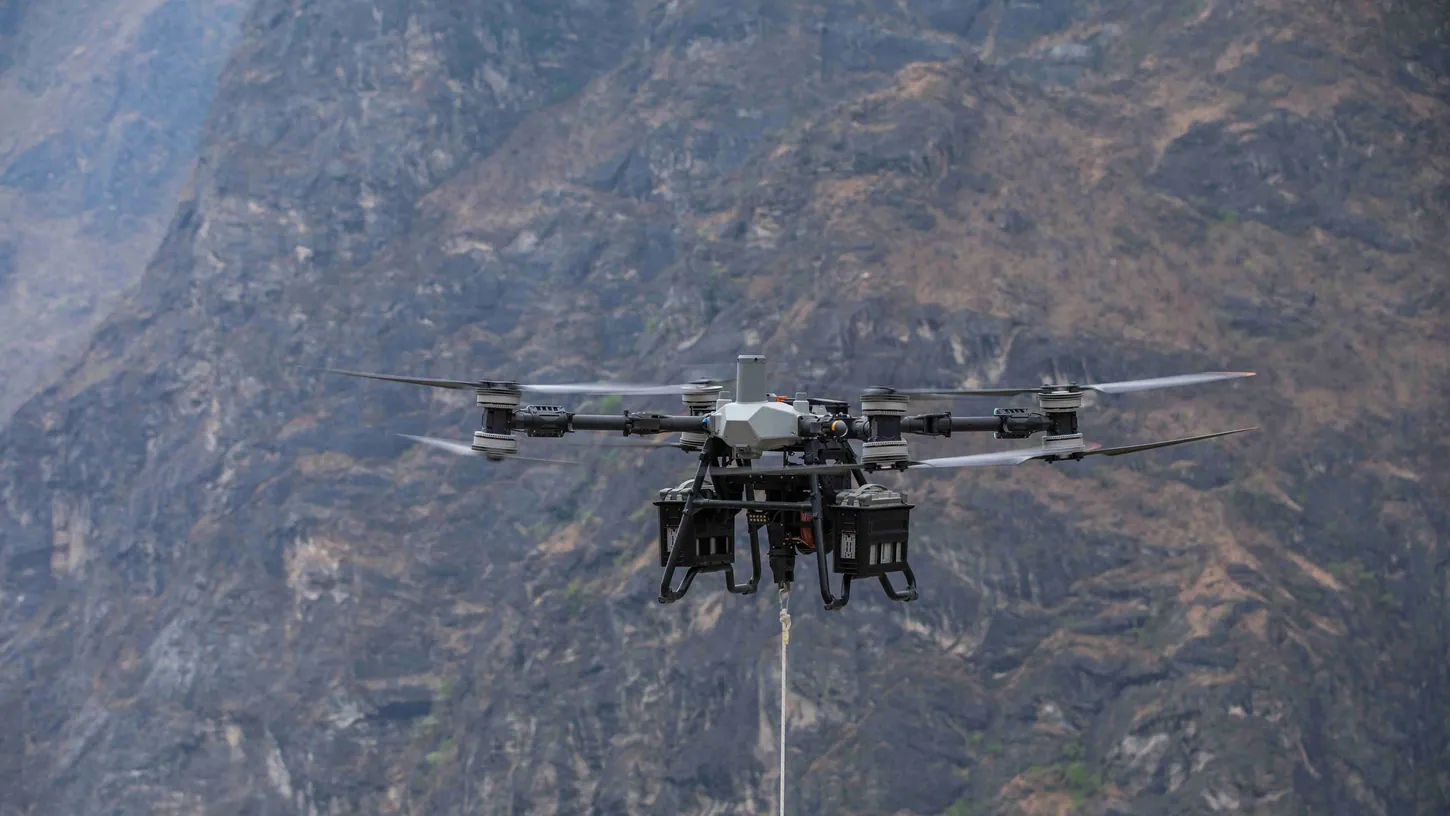
DJI sells the FlyCart 100 with a winch that has an electric hook and 98 feet (30 meters) of cable, with automatic release and retrieval. Ørsted credits the trial team with developing the automatic-hook pickup and doesn’t say how much of it is DJI’s stock hardware and how much is Skyports’ own procedure.
DroneXL’s Take
Washington is making the job in Ørsted’s photo harder to do in American waters, and I think that’s a mistake. Ørsted also runs South Fork Wind off Long Island. A US operator who wanted to sell the Hornsea 2 service there would already need an FAA exemption to fly a drone over 55 pounds, and since Sept. 3 it would also pay a 100% tariff on the aircraft, while the FCC weighs ending U.S. sales of heavy-lift drones it already approved. None of that makes an American heavy lifter carry more or fly farther. It makes the crews keeping US turbines running pay more for the same delivery, or go back to the crane and the six-hour shutdown. If American drone makers want the offshore wind work, I’d like to see them win it on payload, range and price.
Sources: Ørsted, Skyports Drone Services, DJI.
DroneXL uses automated tools to support research and source retrieval. All reporting and editorial perspectives are by Haye Kesteloo. Read our editorial standards.


