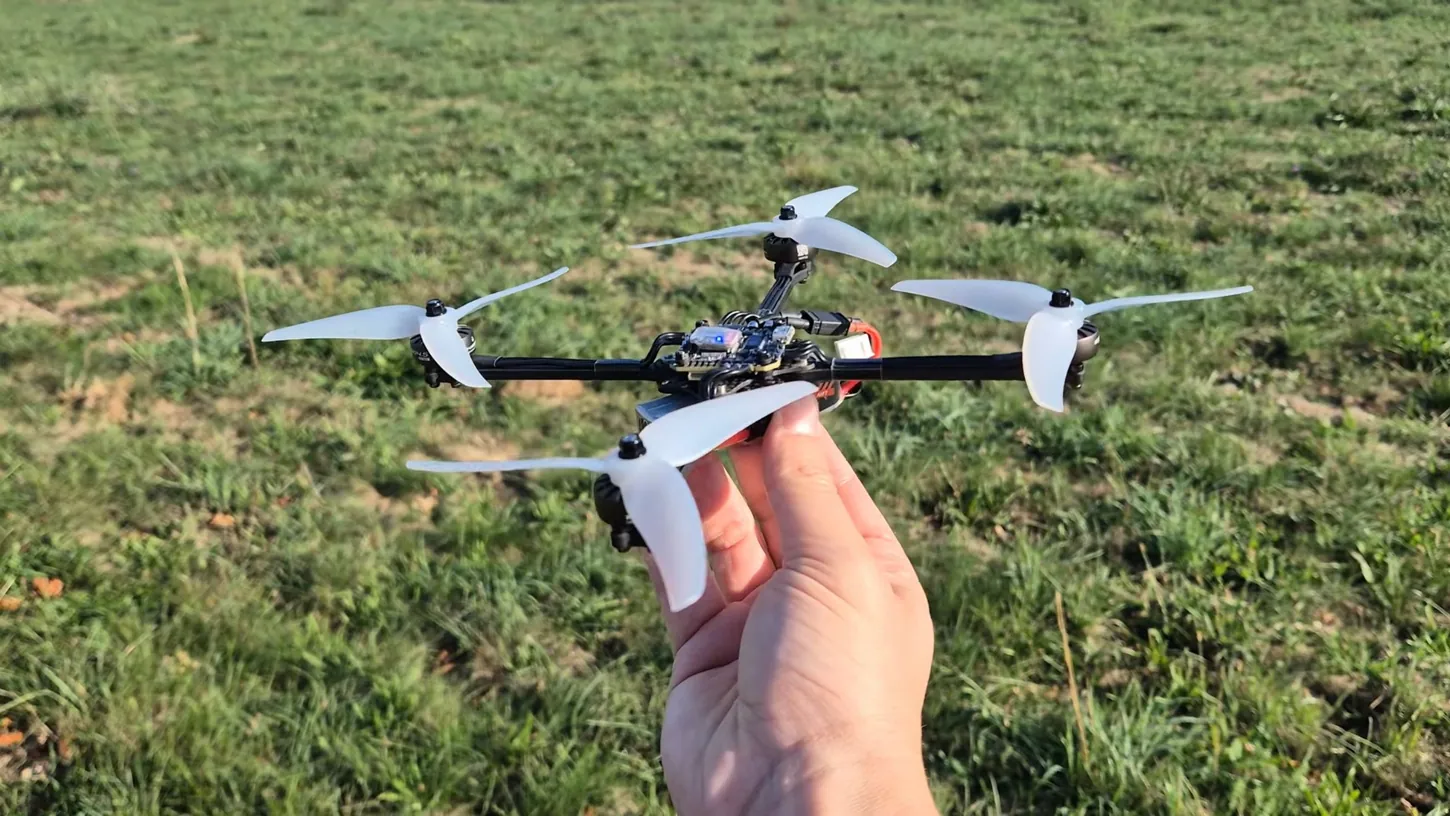
A single lithium-ion cell kept a custom 3-inch FPV drone in the air for 34 minutes and carried it more than 3 miles across a lake, in a build video published August 20 by YouTube creator Mediocre Nerd. The quad, which he calls the Swift, runs one 18650 or 21700 cell, a DJI O4 Air Unit, and a carbon frame he cut on a desktop CNC machine in his own workshop.
The numbers are the creator’s own, read off the flight timer and voltage overlay in his goggles, and the video shows both throughout. A 3,000 mAh 18650 gave him 20 minutes of cruising. A 5,000 mAh 21700 pushed that to 27 minutes, and a heavier high-capacity 21700 kept flying past 30 minutes, dropping below 2.4 volts before telemetry cut out at 34.
The video also launches LithiumIonFPV, a testing database he co-founded, and a frame kit he is now selling. The kit sold out within a day of publication.
The Swift Frame Fixes What Off-The-Shelf 18650 Quads Get Wrong
Mediocre Nerd designed the Swift because no existing 1S lithium-ion frame met his three goals: a better camera, at least 5 km (3.1 miles) of range, and a frame that survives more than a couple of crashes. His previous Crux 3 build was light but fragile, with few mounting options.
The new frame puts the front arms straight out to the sides in a dead-cat layout, which keeps the props out of the camera’s view. He cut it himself on a Makera Z1, a desktop CNC machine that lists at $1,199 and sold for $1,099 during its June pre-order window, according to Makera’s announcement. Makera supplied the machine, and the creator says the video would not exist without it. Carbon fiber is hard on tooling, and his report on that is specific: “I’ve already cut around a dozen sheets with one of the included carbide bits.”
He tested three thicknesses. A 3 mm cut came out at 15 grams, bombproof but too heavy, so he flew a 9-gram version, and it cracked. His diagnosis was the material: the carbon sheet came from Amazon, and frames cut by a professional supplier from the same file held up. The kit he sells now uses a 2.5 mm frame from that supplier.

The electronics are a Flywoo Goku F405 HD 1S 12A all-in-one flight controller, sold by Flywoo at $69.99 with a 12-amp ESC and a built-in ELRS receiver, driving GEPRC 1202.5 motors at 15,000 KV on Gemfan Hurricane 3018 props. A TPU canopy with a GPS mount holds the camera from the O4 Air Unit series DJI launched in January 2025. He later swapped to larger RCinPower 1303 motors at 11,500 KV, which added 4 grams but drew less current while delivering more low-end torque.

One Lithium-Ion Cell Beats Three LiPos On Capacity Per Gram
The case for lithium-ion in a micro quad is energy density. Mediocre Nerd weighed a 3,000 mAh 18650 at just under 45 grams and three 1S LiPo packs at 48 grams with 2,000 mAh combined. That is 50 percent more capacity at roughly the same weight.
The bigger 21700 format pushes the same math further. The 5,000 mAh cell he used weighs 66 grams, and his flight results track the capacity gain almost exactly: 20 minutes on the 18650, 27 on the 21700, and 30 to 34 on a Linkdata 65P with lower discharge capability but more capacity. He flew that last cell down to 2.39 volts and it was still airborne.
Handling suffered as the cells got heavier. He describes the 21700 build as no speed demon at roughly 50 mph (80 km/h), with the 18650 clearly better in the turns. On one hard turn the heavier setup went in, landing in grass overhanging the water’s edge. The ESCs built into the flight controller also ran hot under sustained throttle and cooled back down at cruise.

The DIY battery holder was the surprise result. Using strips of 0.2 mm copper and 3D-printed trays, he built contacts for both cell sizes, then ran 10-second full-throttle tests against a BT2.0 plug, an XT30 plug, and a commercial 18650 holder. The copper holder showed the lowest resistance and best voltage retention, though he notes all four results were close and the XT30 caught up later in the run. The raw data is on LithiumIonFPV, the site he built with a fellow pilot to replace forum opinion with repeatable test results.
The Lake Crossing Hit 5 km Before A Headwind Nearly Ended It
The range test was a flight over open water with about 7 km (4.3 miles) of unobstructed line of sight, flown on DJI Goggles N3 and a stock RadioMaster Pocket transmitter. The O4 video link began throwing signal warnings as the quad approached the 5 km mark.

He turned around there. DJI rates the O4 Air Unit at 10 km under FCC power limits, a figure from DJI’s own spec page that assumes an open environment with no interference, and he was seeing bitrate readings near the 3 Mbps floor where the feed drops. On the way out he was doing 56 mph (90 km/h) at half throttle, which told him he had a tailwind of about 22 mph (35 km/h). The return leg is where the video earns its runtime.
Into that wind the quad managed 9 mph (15 km/h) at first, then crawled past 19 mph (30 km/h) at double the amp draw of the outbound leg, more than 20 amps on a single cell. Voltage was falling toward 3 volts with the shore still distant. He descended to find slower air near the surface, accepting a weaker radio link and less margin for GPS rescue to save the aircraft if the link failed. The wind eased, the shore came into view, and the Swift made it back.
An earlier version of the build did not survive its own testing. A metal tab on the back of the camera touched an exposed negative lead and shorted the air unit, and the video shows the burnt component. Liquid electrical tape over every exposed contact is now part of the build guide.
US Builders Face A DJI Air Unit Problem The Video Skips Past
Anyone in the US who wants to copy this build runs into the video’s own parts list. The creator writes that most retailers are sold out of the original O4 Air Unit and recommends the newer O4 Wide kit from Flywoo instead. That product has no path to American shelves.

DroneXL reported in June that the O4 Wide Air Unit skips the US market entirely, because the FCC’s December 22, 2025 Covered List designation blocks new equipment authorizations for DJI radio devices. The original O4 Air Unit was authorized before that date and remains legal to buy and fly. Supply is the problem: once existing stock runs out, no new DJI transmission unit can be certified to replace it. FPV pilot Joshua Bardwell argued in December that the FCC component ban may not be as bad as it sounds for parts that never needed FCC authorization, and the motors and cells in this build fall on that side of the line. The video transmitter does not.
DroneXL’s Take
I like this video because it is the FPV hobby working the way it should: one pilot with a problem, a CNC machine, and the discipline to publish raw voltage curves instead of just flight footage. Luke Maximo Bell’s Guinness endurance record in July came from the same instinct.
I covered Bell’s record flight in detail, and the pattern holds here. The interesting engineering in small drones right now is coming from people who log data and share it, and the boring result in this video is the useful one: a copper strip holder beat a soldered XT30 on voltage sag, with all four connectors inside a narrow band. That finding saves a lot of people from soldering leads to a cell they will want to swap next week.
Two warnings, one of them mine. His, delivered from the middle of a lake at 9 mph into a headwind: open water gives you range and takes away your recovery options, and the breeze that pushed you out will fight you all the way home. Mine: wherever that lake is, a 3-inch quad 3 miles from the pilot is a beyond-visual-line-of-sight flight. In the US, 14 CFR 107.31 requires the remote pilot or a visual observer to keep the aircraft in sight unaided, and the recreational exception in 49 U.S.C. 44809 carries the same requirement. Copy the build. Don’t be that guy about the flight.
Then there is the part I keep coming back to. The best 1S HD transmission unit on the market weighs 8.2 grams, and an American hobbyist reading this build guide cannot reliably buy one, or the wide-angle version at all, because the FCC decided in December that a camera module for a 3-inch quad is a national security matter. Yes, the original O4 unit is still legal here while stock lasts. That is my point. The ban is not stopping DJI from selling air units. It is stopping this builder’s American audience from finishing his drone, and the next O4 stockout is when that lands on people who have not been paying attention.
Sources: Mediocre Nerd on YouTube, LithiumIonFPV, DJI, Makera
DroneXL uses automated tools to support research and source retrieval. All reporting and editorial perspectives are by Haye Kesteloo.