
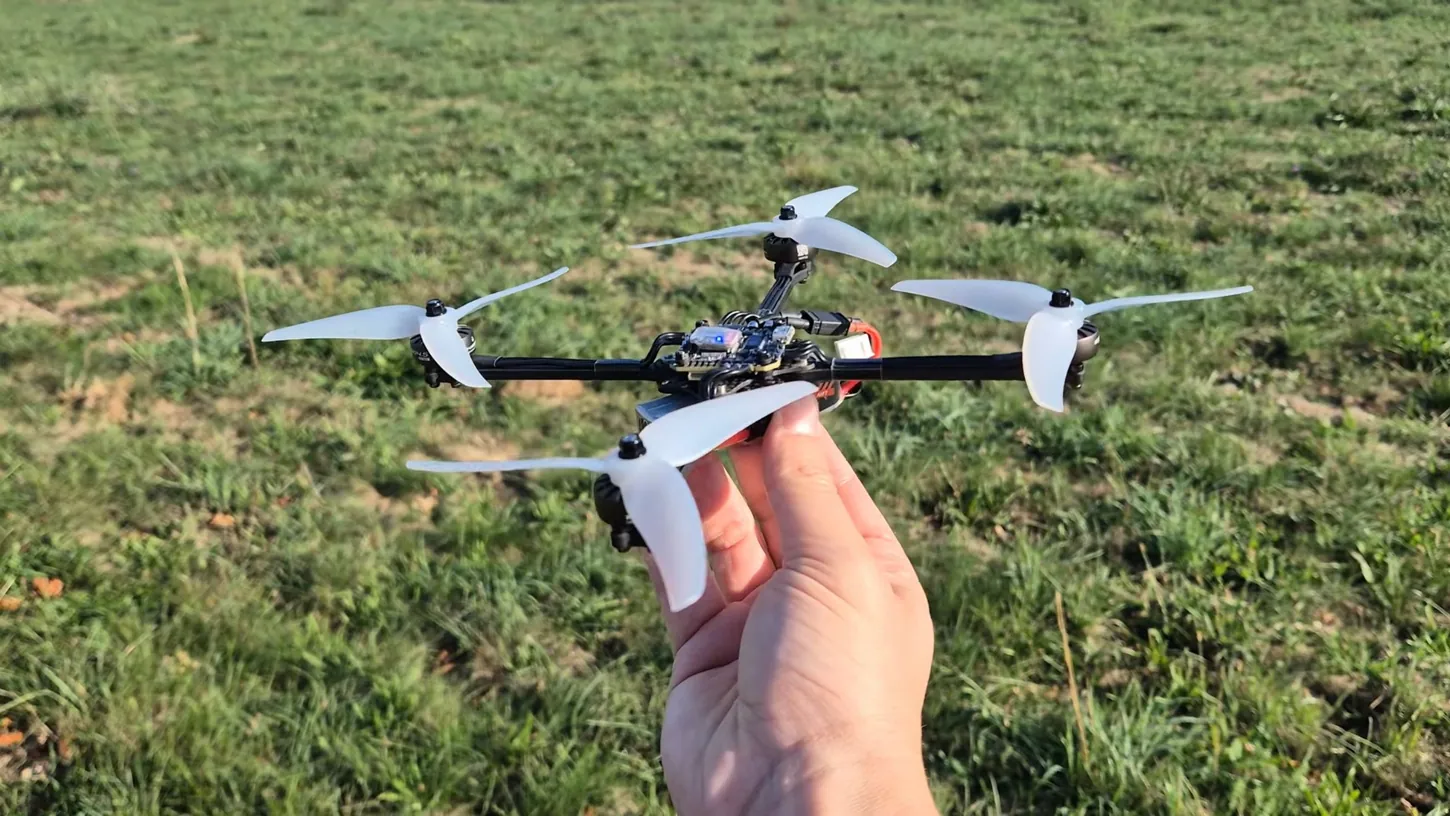
Quadmovr posted a new video on Sunday of a 5-inch quadcopter that weighs 160 grams (5.6 ounces) with its battery on, flown line of sight in acro mode. The parts list carries no camera. He watches the aircraft itself, and the entire clip is two minutes and 23 seconds of flips and low passes over a field.
It comes two weeks after the impeller video DroneXL covered on September 20, which stood at 1,679,127 views on Monday. The new one had 19,615 views and 532 likes a day after posting. Quadmovr lists the dry weight at 117 grams (4.1 ounces), on motors whose maker says they belong on a quad weighing 250 to 350 grams.
The Parts List Puts 599 Grams Of Thrust On Each Corner
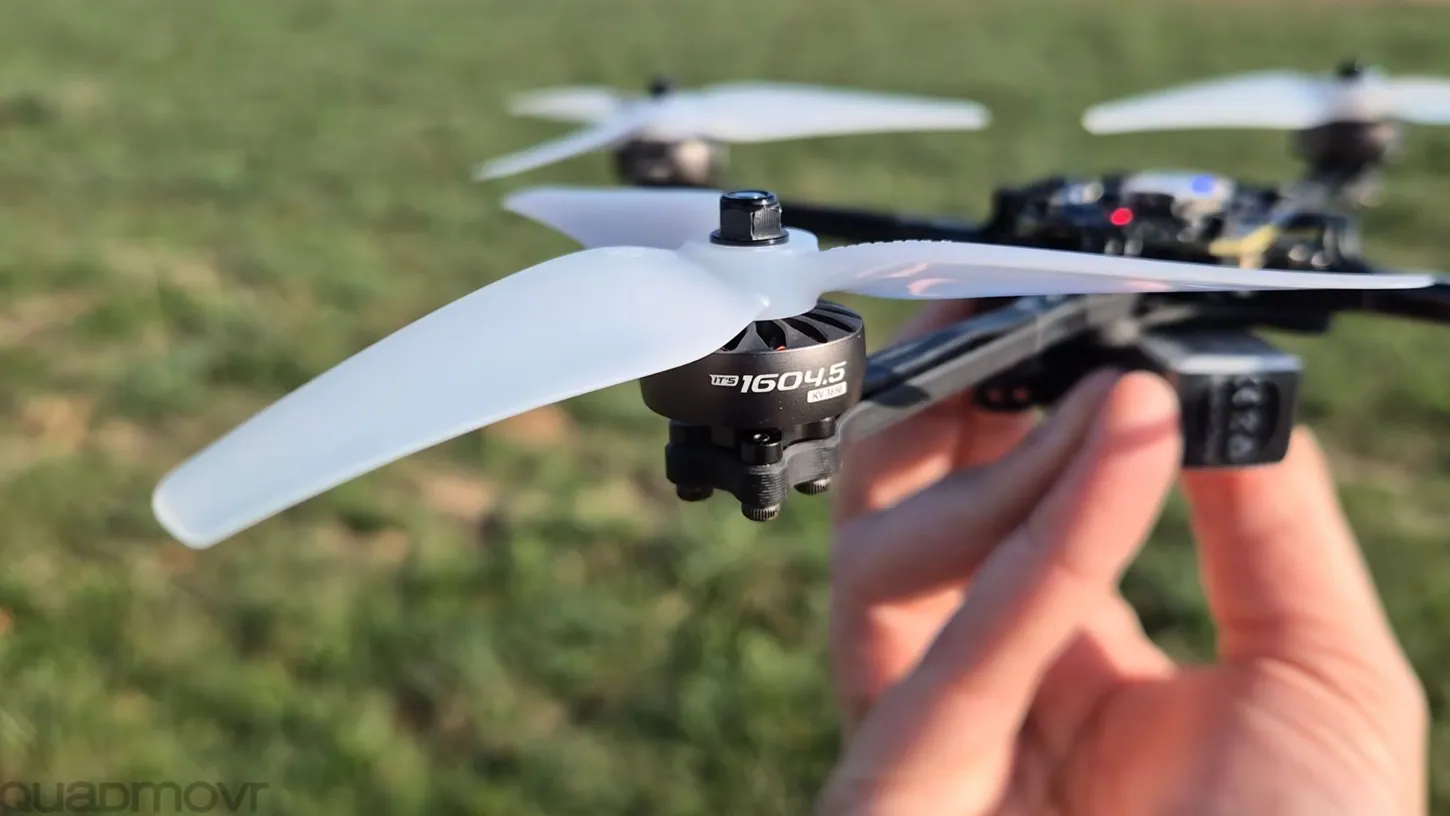
The build runs four ITS-1604.5 KV3650 motors, co-developed by T-Hobby and IT’S FPV, on quadmovr’s own movr200cp1 frame. T-Hobby’s spec sheet rates each at 599 grams of maximum thrust on 4S and names an ideal quad weight of 250 to 350 grams. Quadmovr flies them on 3S.
The motors weigh 13.8 grams each with their leads, so 55 grams of the 117 gram dry weight is motor. A 3 mm titanium shaft runs straight through each one and the propeller is held by an M3 nut. The props are HQProp J33 Juicy Props, a 4.9 by 3.3 inch polycarbonate tri-blade that weighs under 4 grams. The flight controller is a T-Hobby F7 AIO with a 35 amp four-in-one ESC on the same board.
Quadmovr’s description adds the context he puts under every build: these drones are self-built and cannot be bought, and learning to fly them this way takes years. He flies manually in acro mode, “which means no gps, no self stabilization, etc.” The parts list names no camera and no video transmitter, so nothing on board would let anyone fly it from a headset.
At 160 Grams The Drone Sits Under The US And EU Weight Lines
A 160 gram takeoff weight leaves 90 grams of margin under the 250 gram line that decides whether a recreational drone has to be registered with the FAA and broadcast Remote ID in the United States. Europe draws its lightest drone class at the same 250 gram figure.
That line has been the fight of the past year for consumer drones, and DJI’s trouble staying under it with the Mini 5 Pro filled a month of DroneXL coverage. Scratch builders treat the same number differently. Born4Flight in the Czech Republic put a sub-250 gram drone through 351 mph in May. Quadmovr himself has a history of chasing the other end of the spectrum: his SUB400speed approached 200 mph in 2022. This build spends its margin on nothing. The 117 gram dry aircraft lifts a battery of roughly 43 grams, by subtraction, and that is the whole machine.

DroneXL’s Take
The impeller video pulled 1.6 million people in because it looked like a new idea. This one will not do those numbers, and I think it is the better video. Flying a 5-inch quad by eye in acro, with no horizon to lean on and no camera to show which way is forward, is the hardest discipline in this hobby. The motor spec sheet tells the story: T-Hobby designed these for a 250 to 350 gram 3.5-inch freestyle quad, and quadmovr hung them on an aircraft well under half that weight, then ran a cell below rating to keep it flyable. Consumer drones are not built with that power-to-weight ratio. My read is that the 160 gram number is the point of the video, not the flying: a full 5-inch acro quad under the US and EU registration lines, built from parts anyone can order, by a person who tells you in the description that the parts are the easy half.
Sources: quadmovr on YouTube, T-Hobby ITS-1604.5 product page
DroneXL uses automated tools to support research and source retrieval. All reporting and editorial perspectives are by Haye Kesteloo. Read our editorial standards.


