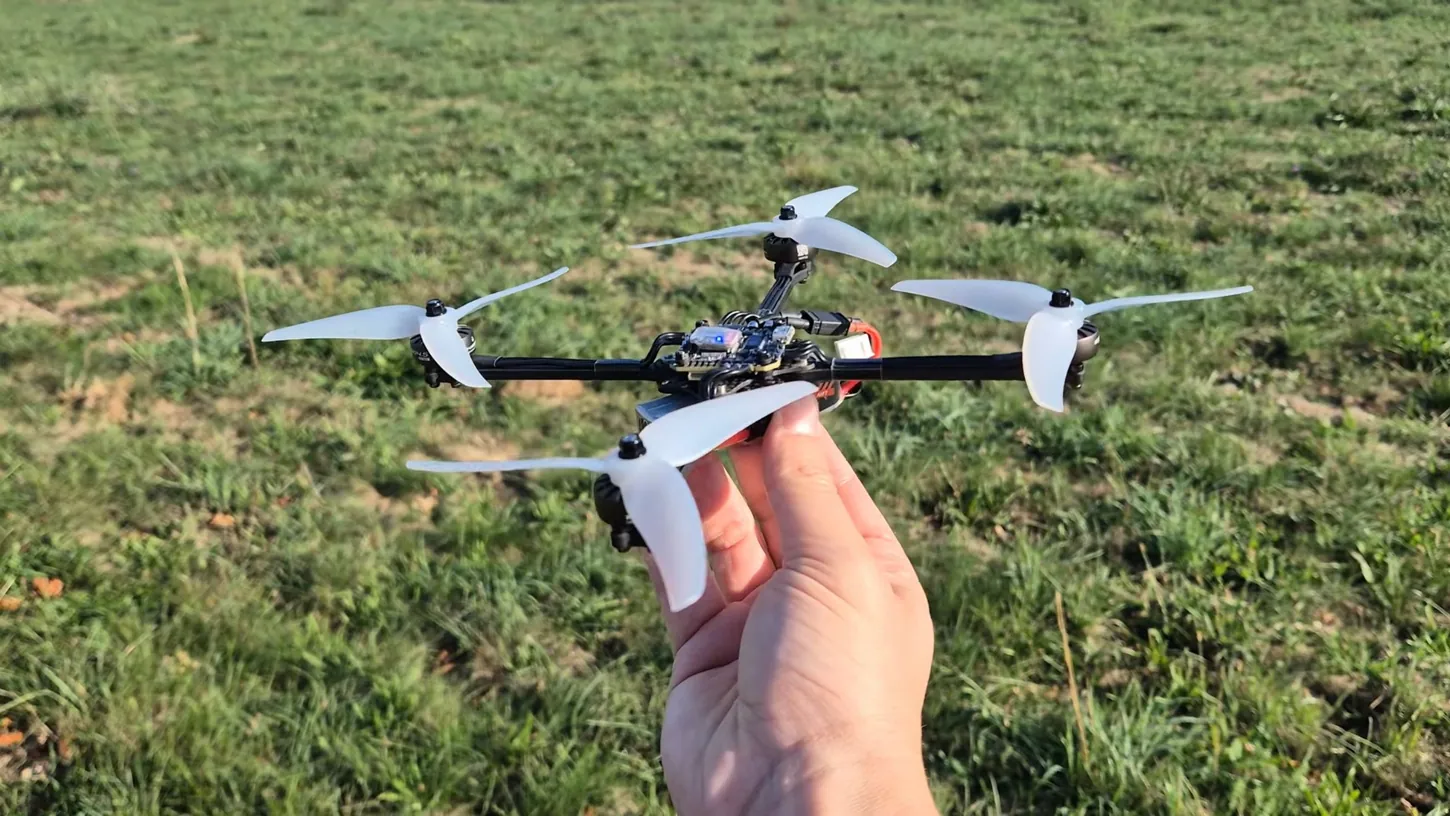
FPV builder quadmovr posted a video on Sunday of a quadcopter flying on four 3D printed radial impellers in place of propellers. Each motor spins a centrifugal wheel inside a white PETG housing, and the airframe underneath is a plain carbon X frame with a flight controller and an XT60 lead. The impellers went on the drone exactly as they came off the printer: not balanced, not cleaned up, as quadmovr states in the video description.
The parts are not a one-off. Quadmovr published the files on MakerWorld in May under the name Experimental Radial Impeller for Drones (T-Mount), free under a Creative Commons noncommercial license, with a print profile that runs about seven hours across two plates. The listing counted 82 downloads and 25 logged prints on Sunday. The design has already been raced: a pilot in the comments says quadmovr’s remix convinced him to print the original impellers and fly them on a 5-inch quad at the first MultiGP race of the season.
The Impeller Draws Air In From The Top And Throws It Outward
A radial impeller works like a leaf blower wheel. Air enters through the open center on top, the curved vanes fling it outward as the wheel spins, and the housing catches that flow. Quadmovr’s case has swept vanes that turn the air downward, and that column lifts the drone.
The numbers on the MakerWorld listing show how much housing that takes. The spinning impeller is 60 mm (2.4 inches) across. The complete unit is 90 mm (3.5 inches) in diameter and 28 mm (1.1 inches) tall, and the case bolts in between the motor and the frame arm so the wheel sits inside it. The gap between impeller and case is 0.3 mm, which quadmovr flags as tight enough that some prints will need sanding to spin freely.
Quadmovr tested the set on NewBeeDrone FLOW 2004 1750KV motors on a 6S battery. The impeller mounts with the standard T-mount, two M2 screws and a 1.5 mm center hole, so it goes onto the same motors that normally carry a 3-inch prop. The design assumes a motor height of 12.8 mm; a taller or shorter stator moves the wheel out of position in the case and the model has to be edited to match.

The Design Started As Baba’s 2024 MakerWorld Model
Quadmovr’s files are a remix. The original, Drone radial Impeller Propeller, was posted on MakerWorld in August 2024 by a designer named Baba, fitted to Fettec 2004 1800KV motors, with a flight clip on Instagram. Quadmovr reworked it for T-mount motors and changed the mounting, stability and cable routing.
Baba’s listing is the one with the tuning guidance. For the 60 mm wheel it recommends roughly 3000KV motors on 3S, 2400 to 3000KV on 4S and 1700 to 2200KV on 6S, which is where quadmovr’s 1750KV FLOW motors land. Baba also offers a smaller 45 mm impeller for higher-KV motors, and says the top of the 60 mm wheel should sit level with the top of the duct or recessed about 1 mm.
Both designers give the same print advice. Print each impeller on its own plate so the layers come out clean, use PETG rather than PLA for toughness, and go to the finest layer height the printer will do. Quadmovr’s profile uses 0.16 mm layers, five perimeter walls and zero infill. MakerWorld is Bambu Lab’s model library, and the listing carries profiles for the H2S, X1 Carbon and H2D printers. The remix stays under Baba’s Creative Commons Attribution-Noncommercial-Share Alike terms, so anyone can print, modify and republish it, but nobody can sell it.
One Racer Already Flew The Impellers At A MultiGP Event
The best evidence on the listing is a comment from a pilot posting as WillpowerFPV. He flew Baba’s original impellers on a 5-inch quad at the first MultiGP race of the season, and says quadmovr’s remix and flight GIF sent him back to a file he had doubted would work.
They flew. He calls the result hilarious, says he will print quadmovr’s T-mount version for a 242 gram ultralight freestyle rig next, and links a YouTube clip of the attempt. That is one pilot’s account and one race, not a benchmark, but it is an independent build of the same rotor design that got airborne on a different frame and different motors. (Quadmovr’s channel describes its author as designing, building and flying high-performance drones since 2008, so the remix did not come from a beginner either.)

3D Printing Keeps Producing Propulsion Experiments Outside The Lab
The impeller quad joins a line of printed propulsion experiments DroneXL has covered. In 2021, a builder flew an FPV racing drone on 64 propeller blades, stacking printed multi-blade props. In April, British engineer Tom Stanton flew a 15.6 gram printed plane on a hand-cranked supercapacitor.
The commercial side has chased the same question of how air leaves a rotor. Delson Aeronautics demonstrated ultra-quiet propellers in 2021, and Zipline’s silent propellers are shaped to cut delivery-drone noise. Printed airframes have moved from novelty to product too: the Lace frame folds a large 3D printed quad into a backpack, and Unusual Machines has used HP’s industrial printers for FPV parts since 2024.
DroneXL’s Take
Quadmovr’s video is titled as a completely new propulsion system, and I’d knock the “completely” off that. Centrifugal blowers are more than a century old, and Baba flew the design this remix is built on in 2024. What is new is the distribution: a flyable rotor design that a stranger downloaded, printed on a desktop machine, bolted to a race quad and flew at a sanctioned event because a second builder’s remix convinced him it would work, with the whole chain documented in a comment thread. No manufacturer ships a propulsion experiment with the sanding instructions and the “it wasn’t balanced” disclaimer attached. The FPV community does, and it is the reason the interesting propeller ideas keep showing up on MakerWorld before they show up in a DJI spec sheet.
An open propeller moves a large volume of air at low speed, which is the efficient way to make lift, and this design turns the flow twice inside a plastic case before it ever points down. My read is that an impeller quad will always hover shorter than the same frame on 3-inch props, and quadmovr labels it experimental for a reason. That does not make it pointless. The 90 mm housing is also a full shroud around every moving part, the flow exits through vanes rather than an open disc, and the whole thing prints in PETG on a desktop machine. If anyone has a noise or a safety application for a rotor whose blades sit inside a case, this is the file to start from, and Baba’s license allows it for anything noncommercial.
The number to watch is the print count on quadmovr’s listing. Twenty-five logged prints in four months is a curiosity. If the racer’s 242 gram build lands and a few more pilots post flights, the remix count is where this either becomes a niche or stays a video.
Sources: quadmovr on YouTube, quadmovr on MakerWorld, Baba on MakerWorld
DroneXL uses automated tools to support research and source retrieval. All reporting and editorial perspectives are by Haye Kesteloo. Read our editorial standards.