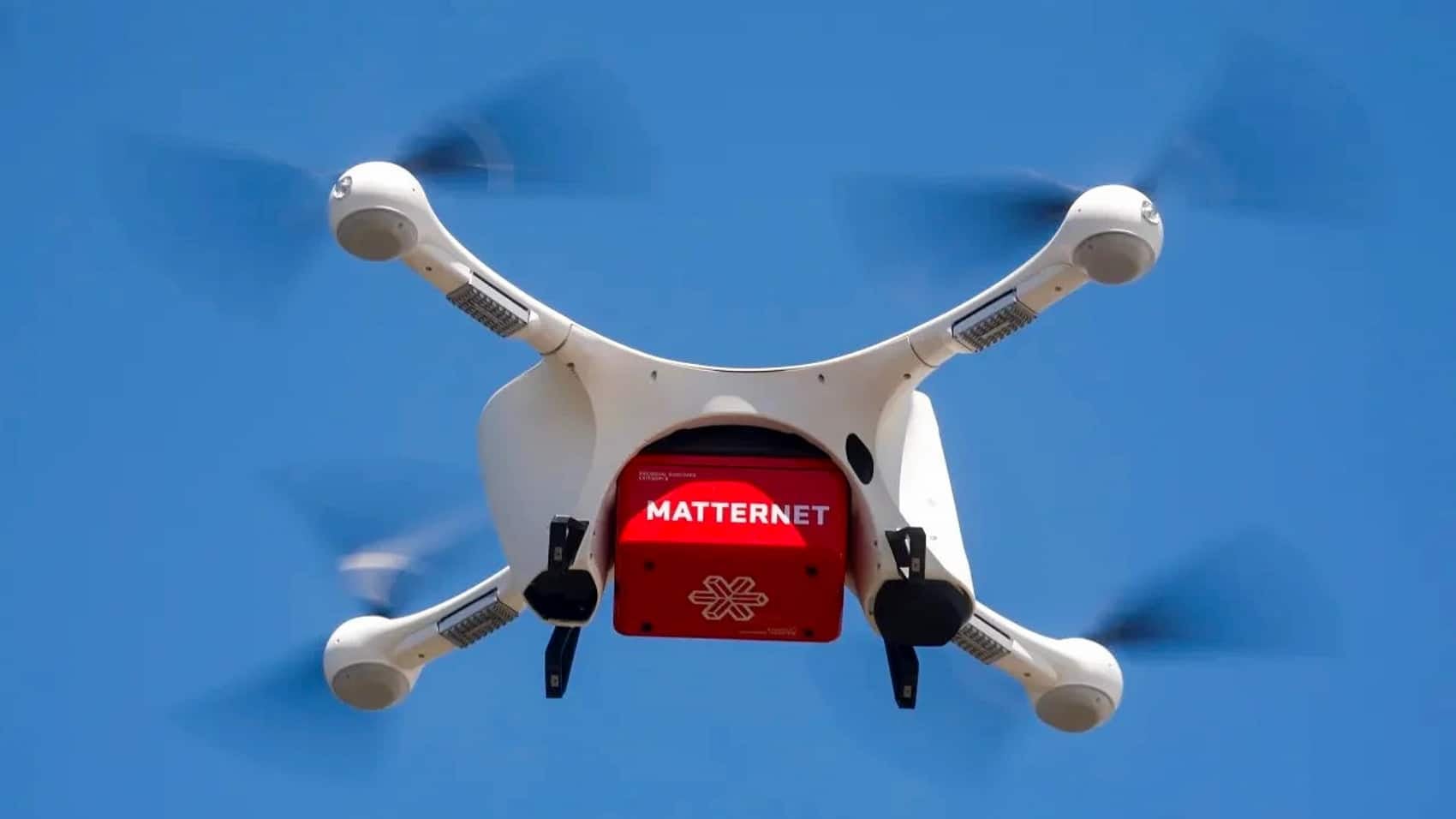
Matternet unveiled M3 on Monday, a delivery drone that carries up to 11 pounds (5 kg) within a 10-mile (16 km) radius and flies from a rooftop dock with nobody on site. The Mountain View company named Dave’s Hot Chicken as its first U.S. launch partner and Apian, which runs a National Health Service drone network in central London, as its U.K. partner.
The system has three pieces: the aircraft, a dock that stores and charges it, and a drop-box called the Portal where a restaurant or hospital worker leaves packages and walks away. Matternet plans to build the aircraft in the United States.
Commercial service is targeted for the second half of 2027. The M3 has no FAA type certificate, and Matternet’s own release lists certifying it among the things that could move that date.
M3 Carries 2.5 Times the M2 Payload on a Shorter Leash
The M3 lifts 11 pounds (5 kg) against the Matternet M2’s 4.4 pounds (2 kg), but its 10-mile (16 km) service radius sits under the M2’s roughly 12.4-mile (20 km) range. The cargo bay takes ordinary food and retail bags and boxes, with separate configurations for healthcare and industrial loads.
The dock installs on a roof or at ground level. The Portal is the new idea: Matternet describes it as low-cost and off-grid, holding several packages at once for the aircraft to collect later, so a sender never times a handoff to a flight. Everything after the drop is automated, per Monday’s release.

Both launch partners already fly M2s. Dave’s Hot Chicken launched an M2 pilot from its Northridge, Los Angeles store in October 2025, with orders placed through the chain’s app. Apian added Matternet to its London hospital network in June 2025. Matternet says more M3 partners follow in the coming months, all aimed at high-volume instant delivery.
Founder and CEO Andreas Raptopoulos said “Drone delivery should be a utility: largely invisible, dependable and low-cost.”

The M2 Took 22 Months From Proposed Criteria to Certificate
The M2 is the only delivery drone holding a standard FAA type certificate, issued in September 2022, plus a production certificate. The FAA published proposed airworthiness criteria for it in November 2020, 22 months before the certificate. A Federal Register search on Monday turns up criteria for the M2 and nothing for an M3.
That is the gap between the M3’s specs and its 2027 date. The release’s forward-looking statement names “the regulatory approvals required for M3” and the company’s ability to complete “development, testing and certification of M3” as risks. Testing and customer pilots are also still ahead. A drone with a bigger battery and a bigger cargo bay is a different aircraft in the FAA’s eyes, whatever the badge says.

The timing fits a pattern DroneXL has tracked all year. Matternet went public in June through a $33 million reverse merger and began trading on the OTCQB as MTTN on September 21, one week before M3. It has named partners at a steady clip since April: SoftBank Robotics America, Amprius, Beeline UAS and, two weeks ago, AVI-SPL. None of those announcements carried flight volumes or revenue, and Monday’s carries no order count, no aircraft count and no price. The SoftBank deal is back in this release as the deployment engine for M3.

DroneXL’s Take
The Portal is the smartest thing in this release, and it has nothing to do with flying. Matternet’s own pitch is that nobody has to be near the aircraft, which reads to me as an admission that the M2 stations, from the hospital routes to the Mountain View home deliveries, never got rid of that person. Remove the labor and the unit economics move more than any payload bump does. So I buy the product. I don’t buy the calendar. Matternet has already lived one certification, and it took 22 months for a 2 kg aircraft while the FAA wrote the rulebook alongside it. Nothing for the M3 has hit the Federal Register, and the company is targeting revenue service in roughly 12 months. Watch for M3 airworthiness criteria there, and watch the Q3 10-Q for whether the launch partners are paying anything. Until one of those shows up, the second half of 2027 is a date for shareholders, not for restaurants.
Source: Matternet via GlobeNewswire
DroneXL uses automated tools to support research and source retrieval. All reporting and editorial perspectives are by Haye Kesteloo. Read our editorial standards.