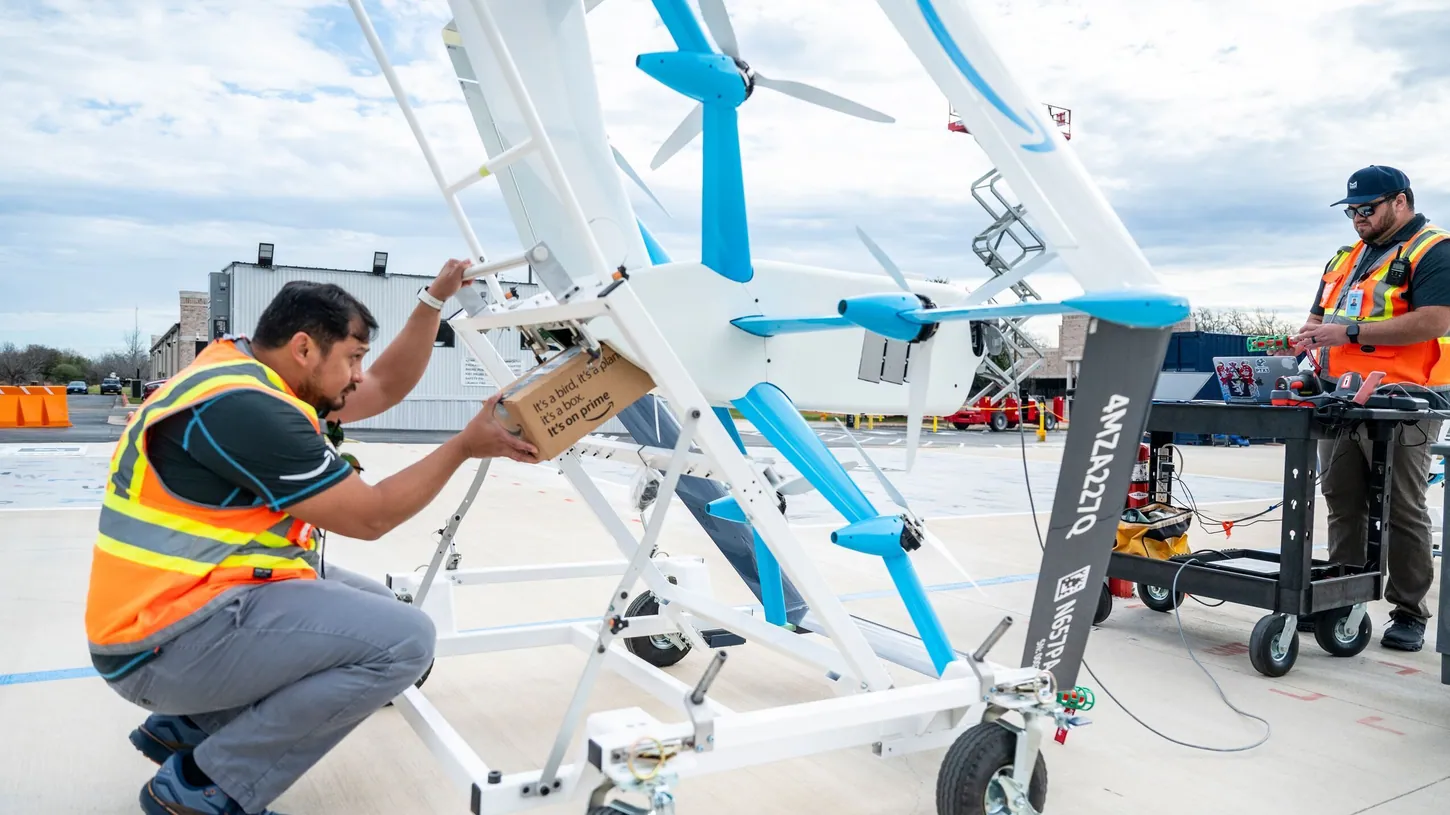
Amazon told the Pflugerville City Council on September 22 that its MK30 delivery drones cannot take pictures. Amazon’s own Prime Air operations page, live on Amazon.com as of September 28, says people, pets and cars near a delivery point may be recorded and that Amazon uses those images to improve its services.
Sam Bailey, Amazon’s senior manager of economic policy, made the pitch in a preliminary presentation that Community Impact reported on September 24. Council member Kimberly Holiday told him the city would need proof. Four weeks earlier, on August 25, the same council had voted unanimously not to renew its license-plate-reader contract with Flock Safety after learning outside agencies had searched Pflugerville’s camera data nearly 1.6 million times in six months.
Pflugerville sits inside the FAA’s February environmental decision covering 22 Texas delivery centers, and the document lists two addresses in the city. Council member David Rogers has since named the site: the parking lot north of Amazon’s STX6 warehouse at 18625 Schultz Lane, south of Toll Road 45. Richardson’s council asked Bailey the same camera question in March. Pflugerville’s had just ended a contract with a camera vendor.
Amazon’s Operations Page Says Its Drones May Record People
Amazon’s Prime Air operations page says MK30 cameras may record “people, pets, cars, and objects near the delivery or landing location” and that Amazon uses them to improve “drone delivery and other Amazon services.” It offers an opt-out at your own address, none for a neighbor’s.
That is the page Amazon publishes for pilots, air traffic personnel and public safety agencies. It does not match what Bailey told Pflugerville. Community Impact quoted him as saying the drones “can’t scan faces, look at license plates, or take pictures or images” and that flight monitors cannot see live footage. The two statements can both be true only if “take pictures” means something narrower than “record,” and Bailey did not draw that line for the council.
He drew a different one in Richardson. At the March 9 Richardson council meeting, Community Impact reported Bailey saying there are no downward-facing cameras collecting data on individuals, cars or license plates, and that sensor data stays on the drone. The New York Times then quoted Amazon spokeswoman Lindsay Hamilton in September saying the images sit on encrypted drives that only authorized staff can access. Encrypted drives hold images that were kept, not images that were never taken.
Holiday’s response was the one a council gets to give once. “We’re going to need you to prove that for us,” she said, tying it directly to the Flock decision. Amazon has already been asked the same question in Westborough, where the answer was that the drones are coming regardless of the town’s view.
The FAA Cleared Two Pflugerville Sites in February
The FAA signed the Finding of No Significant Impact and Record of Decision for Amazon’s Texas expansion on February 5, 2026. The final environmental assessment lists 22 delivery centers statewide, each cleared for 1,000 flights a day between 7 a.m. and 10 p.m. Two are in Pflugerville.
The sites are STX6 at 18625 Schultz Lane and AUS2 at 2000 East Pecan Street. A third Austin-area site, STX9, sits at 9900 Decker Lane in Austin, and the same document covers the Waco hub, where the FAA opened a second probe in November after an MK30 clipped a cable. The assessment has the MK30 cruising between roughly 180 and 377 feet (55 to 115 meters) and descending to 13 feet (4 meters) to drop a package. Community Impact’s report says Amazon filed a request for administrative interpretation with the city on June 15 for “the addition of the Prime Air drone delivery center,” singular. Rogers, writing on his council Facebook page three days after the September 22 work session, said Amazon wants the center in the parking lot north of STX6 on Schultz Lane, and that he wanted “facts on the table” rather than rumors. The FAA’s Texas record does not rank the two Pflugerville sites by launch order, so his post is what puts Schultz Lane ahead of East Pecan Street for now. The aircraft in the photo on his post is a fixed-wing Wing drone, not Amazon’s MK30.
The federal decision settles the airspace question, which is why Richardson dropped its rezoning threat in April on legal advice. That leaves the city the land-use file Amazon opened in June and the noise record. The FAA’s Texas assessment puts an MK30 overflight at 50 feet at roughly 74.2 decibels, which the document compares to a leaf blower at the same distance. Amazon’s Pflugerville slide called the noise “soft to moderate.” Bailey gave the council altitudes of 225 to 280 feet outbound and 300 to 380 feet back. Amazon’s own operations page lists 205 to 250 feet out and 325 to 370 feet back, and the FAA assessment tops out at 377. Three documents, three sets of numbers.
Amazon told Pflugerville it would do more community outreach before council takes the matter up again. No date was set.
Pflugerville Ended Its Flock Contract Over Who Could See the Data
On August 25, 2026, the Pflugerville council voted unanimously not to renew an $87,500-a-year lease for Flock Safety license-plate readers. A resident’s open-records request had shown outside law enforcement agencies searched the city’s plate data nearly 1.6 million times between February and August through a security flaw in Flock’s system.
Police Chief Willie Richards told the council he lacked clarity on how community data was protected, and council member Rudy Metayer said the city needed to get Flock “the hell out of here.” That vote came 28 days before Amazon’s presentation (August 25 to September 22). Holiday’s demand for proof reads differently with that arithmetic in front of it: the council had just learned, from its own records, that a vendor’s description of its cameras and the vendor’s actual data flows were two different things.
DroneXL’s Take
Amazon has three descriptions of the same camera system in circulation, and Pflugerville got the narrowest one. The council pitch says no pictures. The Richardson pitch said no downward cameras on people. The published operations page says people near the drop point may be recorded and the images are used to improve Amazon services, and the spokeswoman’s encrypted-drive line confirms they are kept. My read is that each version is written for its audience rather than for accuracy, and a council that just caught Flock doing the same thing is the wrong room to try it in.
The fix is not complicated. Amazon can put the operations-page language on the council slide, say how long delivery-point images are retained and who can pull them, and let Pflugerville judge the actual policy instead of a paraphrase. Zipline answered DroneXL’s safety questions on the record this month; its own draft assessment for Austin, El Paso and three other Texas metros is open for public comment through October 11. Amazon’s Texas decision is already signed. Pflugerville still holds the land-use file Amazon opened in June and the question Holiday asked on September 22, and that is enough to get the retention policy on the record before a single flight.
Residents inside the 7.5-mile circle around Schultz Lane can find what still works, and what doesn’t, in DroneXL’s guide to what residents can do. Amazon takes drone-delivery complaints and opt-out requests at 1-888-280-4331, or through the customer-service chat on Amazon’s site under “Something Else,” then “Amazon Drone Delivery.” DroneXL tracks every Prime Air hub, filing and incident on the Amazon Prime Air operator page.
Sources: Pflugerville Councilman David Rogers (Facebook, September 25, 2026), Community Impact (Pflugerville, September 24, 2026), Community Impact (Richardson, March 10, 2026), Community Impact (Pflugerville Flock vote), Amazon Prime Air Drone Delivery Operations page, FAA Final Environmental Assessment for Drone Package Delivery in Texas, FAA FONSI/ROD, Amazon Multi-Metro Texas, FAA drone environmental review index
DroneXL may earn a commission from purchases made through the Amazon link in this article, at no extra cost to you.
DroneXL uses automated tools to support research and source retrieval. All reporting and editorial perspectives are by Haye Kesteloo. Read our editorial standards.