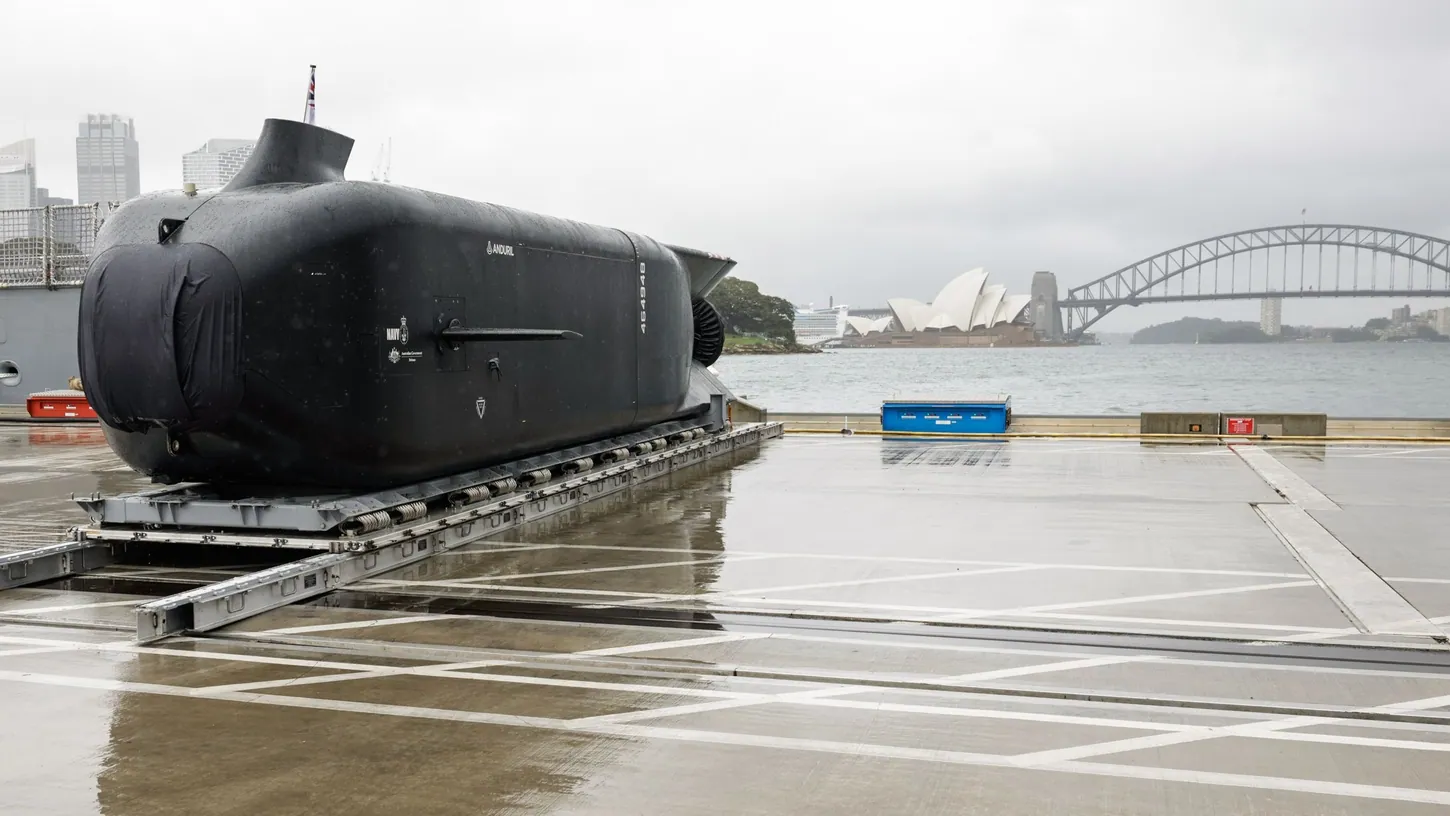
Australia pulled the cover off three previously classified payloads for Anduril’s Ghost Shark on Monday, October 19, at Anduril Australia’s factory in Sydney. The extra-large autonomous underwater vehicle can lay 12 sea mines in one mission, drop logistics caches on the seabed, and release swarms of tube-launched Altius loitering munitions, Defence Industry Minister Pat Conroy said. He told reporters: “The Ghost Shark now has teeth.”
The payloads head to San Diego this week for Exercise Maritime Big Play Pacific, an AUKUS Pillar II event with the United States and the United Kingdom. The U.S. Navy picked Anduril’s Dive-XL, the commercial baseline the Ghost Shark is built on, for its own extra-large AUV program in March. Asked what appetite Washington and London have for the platform, Conroy said the AUKUS work is “more about the payloads.”
Ghost Shark Lays 12 Mines a Sortie and Launches Altius From Its Payload Bays
Conroy told the press conference the Ghost Shark can deploy 12 sea mines at a time, carry equipment caches built by the Defence Science and Technology Group, and release swarms of Altius uncrewed aircraft for reconnaissance and strike. He withheld the swarm count for operational reasons.
Anduril Australia CEO David Goodrich went further than the minister on what the hull can hold. He said the payload bays also support heavyweight and lightweight torpedoes and what he called “cost-effective, undersea effectors,” and that the vehicle will be able to engage threats on its own. Chief Defence Scientist Tanya Monro said her group took the logistics cache from concept to integration, so that supplies can sit beneath the surface and be recovered when a unit needs them. Conroy would not say which forces would use the caches beyond telling reporters to use their imagination.
The Altius is the same tube-launched family the U.S. Army fired from an Apache at Yuma Proving Ground in February, and the one whose two Eglin test crashes Reuters documented last November. Goodrich said Anduril is looking to bring the Altius to Australia at scale, subject to government approval. Monday’s event showed the munitions on floor stands beside the sea mines and a Ghost Shark hull, in photos published by Defence Connect and the ABC. The Defence imagery set the government’s media note points to, S20263404, had not been published when I checked Monday morning.
The Payloads Go to a U.S. Navy Exercise Under AUKUS Pillar II
Some of the new payloads will take part in Maritime Big Play Pacific, the government’s media release says, an AUKUS Pillar II exercise running near San Diego from October 5 to 25 hosted by Naval Information Warfare Center Pacific, per Naval News.
The exercise follows May’s first AUKUS Pillar II signature project, common payloads and sensors for the three navies’ uncrewed undersea vehicles, and that framing explains Conroy’s answer on exports. The AUKUS partners each have their own hulls, so the marquee project funds payloads that fit all of them. Conroy said Australia has not given up on selling the Ghost Shark itself to the U.S. and the UK, both of which have seen it on display at Maritime Big Play, and that the hull is one of the priority campaigns for the Australian Defence Strategic Sales Office. Goodrich said Anduril is fielding an enormous amount of demand from allies.
The payload work covers two more platforms. Conroy announced the first payload for the Ocius Bluebottle uncrewed surface vessel, a thin-line towed array sonar for detecting submarines, and the media release names the Speartooth uncrewed underwater vehicle as a third integration target. On the U.S. side, Anduril’s Dive-XL line at Quonset Point, Rhode Island, and the Maryland shipyard DroneXL covered when the Navy put $6.6 billion into it this month are where the same hull family gets built for American crews.
Anduril Delivered the First Ghost Shark Three Months After Signing
Australia signed the A$1.7 billion (about $1.2 billion) Ghost Shark production contract on September 10, 2025. The Navy took delivery of its first vehicle for testing and acceptance early this year, Conroy said. The only fleet size he would give was “dozens and dozens.”
The program sits inside up to A$5.8 billion (about $4 billion) the government has budgeted over the decade for autonomous undersea warfare. Goodrich put the supplier base at 42 Australian companies and Anduril Australia’s headcount at 350. Conroy called the program the fastest peacetime acquisition of a major platform in Australian Defence Force history, three years from concept to delivery. When DroneXL reported on Albacore’s Ghostfin drone subs in August, the Ghost Shark’s concept-to-contract sprint was already the benchmark the smaller American program was being measured against.
DroneXL’s Take
Announcing classified payloads is a deterrence move, and Conroy said so in plain words: an adversary now has to assume any shipping container near an Australian wharf could hold a Ghost Shark, and that the Ghost Shark carries mines. I rate the mine payload as real today. Mines are heavy and well understood, and laying them from an uncrewed hull is the dull, dangerous job Goodrich described.
I want to see the Altius swarm fly. The Altius has launched from tubes on helicopters and ships for years, so the unproven step is getting one out of a submerged hull and into the air, and nothing released Monday showed that. Anduril gets to prove it in front of its most important customer, because the AUKUS common-payload project makes whatever works off San Diego this month a candidate for the Dive-XL the U.S. Navy is now buying. If Defence releases footage of an Altius leaving a Ghost Shark, the deterrent gets a lot more convincing. Until then, Australia has an uncrewed minelayer, and its neighbors already have to plan around that.
Sources: Australian Minister for Defence media release and press conference transcript, Defence Connect, ABC News, Naval News.
DroneXL uses automated tools to support research and source retrieval. All reporting and editorial perspectives are by Haye Kesteloo. Read our editorial standards.