
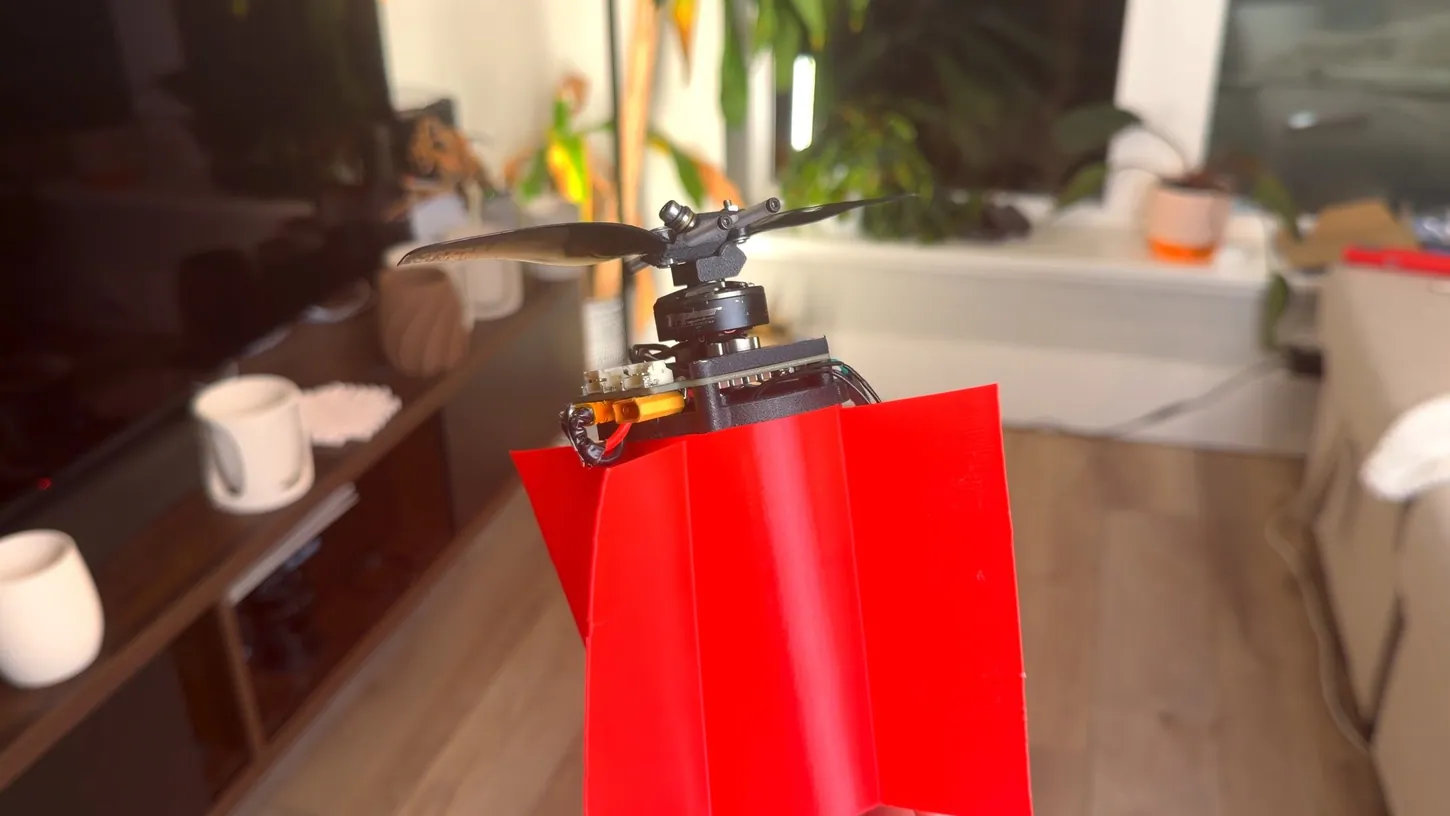
Maker and YouTuber Joshua Bird has flown a drone that hovers and steers on a single motor, with no servos, no tail rotor and no second propeller. His video, posted Saturday, shows the 3D printed aircraft lifting off and holding level while it answers his stick inputs. The firmware and CAD files are free on GitHub.
Bird says it can’t fly outside his bedroom yet. Its sense of direction comes from an infrared beacon aimed at one corner of the room.
A 45-Degree Hinge Turns Motor Speed Into Pitch And Roll
The propeller hub replaces a helicopter’s swashplate with hinges angled at 45 degrees. When the motor accelerates, the blades lag behind the hub, so one blade pitches up and the other pitches down. Time those surges to the right point in each rotation and the drone tilts in any direction.
Hinged rotors have flown before. The University of Hong Kong’s PULSAR flew on one motor in a 2023 Science Robotics paper, and British YouTuber Tom Stanton, whose 3D printed windup plane DroneXL covered in April, built a swashplateless helicopter that Bird notes still needs two motors. Bird went small instead. His 6-inch propeller spins at almost 20,000 RPM while the motor speeds up and slows down 300 times per second. He says that is more than six times less propeller area than PULSAR, and the smallest and fastest-spinning hinged propeller flown on a drone that he knows of.
Drone ESCs Lost Sync, So Bird Switched To A Servo Drive
A standard drone ESC lost sync above 50 accelerations per second, because it estimates rotor position from back EMF and the torque swings made that signal too noisy. Bird swapped in an mjbots moteus r4 servo controller, which reads rotor position from a magnetic encoder.
At 20,000 RPM the propeller completes a turn every 3 milliseconds, and routing commands through a separate microcontroller left them about 20 degrees of rotation late, by Bird’s count. He rewrote the moteus firmware so the motor controller talks to the flight controller directly and computes the motor commands itself. The hub shrank to a single pivot at less than half its old size, printed in carbon-fiber-filled PPA on an H2C printer that Bambu Lab sent him.
A Homemade Strobe Camera Found The 160 Hz Vibration
The first flights crashed, and a 160 Hz vibration swamped the accelerometers. Bird built a strobe rig that fires a camera flash at a known blade angle, freezing tips moving at over 310 mph (500 km/h). The photos showed the blades flapping and bending.
Stiffer blades cured the vibration. Over weeks of testing, crashes cost him propellers, motor controllers, receivers and several cracked TPU bodies, until he moved tuning to a test stand weighted down with a takeaway bag.

An Infrared Beacon Ties The Drone To One Room
The drone’s 3D printed body never stops spinning, and its motor sits too close for a compass to work. An infrared sensor on the drone spots Bird’s beacon each time the body turns past it, and his ArduPilot fork uses each sighting to correct the heading estimate.
Without that correction, the drone loses track of which way is forward and becomes uncontrollable. The beacon itself is an infrared blaster borrowed from his earlier motion-capture project. Bird says his next video adds a linear camera sensor that scans the room as the body spins, so the drone can hold its heading and navigate on its own.
DroneXL’s Take
Bird opens the video by saying one motor could make drones smaller and cheaper. Smaller is on screen. I’m not sold on cheaper yet, because the mechanical parts he deleted came back as custom firmware and a $94 moteus servo drive where a hobby ESC used to sit. That is a fair trade to make in public, and Bird posted the fix for every dead end on GitHub, the way quadmovr shared the files for its 3D printed impeller quad. The next video decides whether this stays a bedroom demo. If the linear camera holds the heading without a beacon, the drone can leave the room.
Sources: Joshua Bird on YouTube, jyjblrd/single-propeller-drone on GitHub, Tom’s Hardware.
DroneXL uses automated tools to support research and source retrieval. All reporting and editorial perspectives are by Haye Kesteloo. Read our editorial standards.


