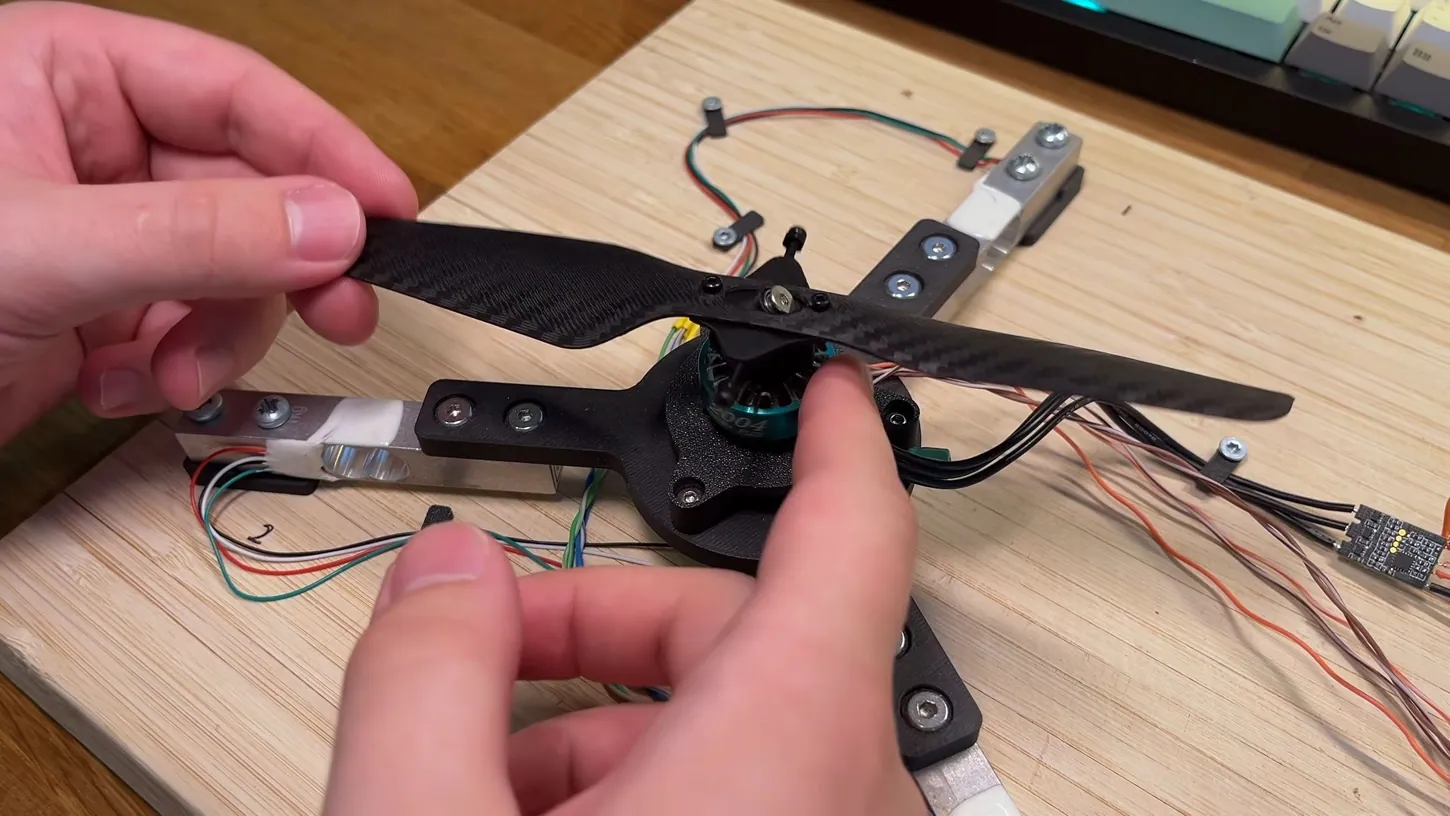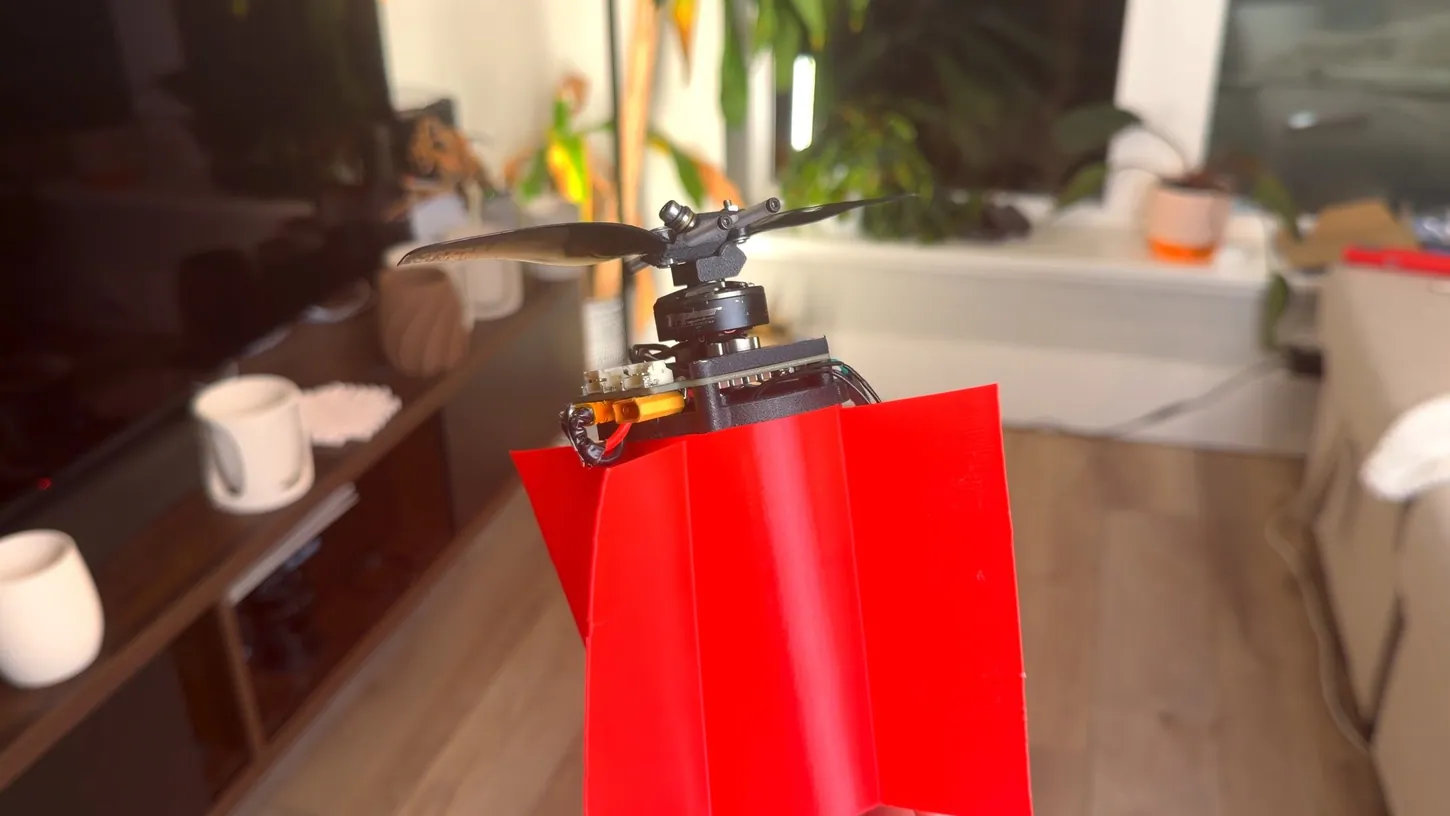
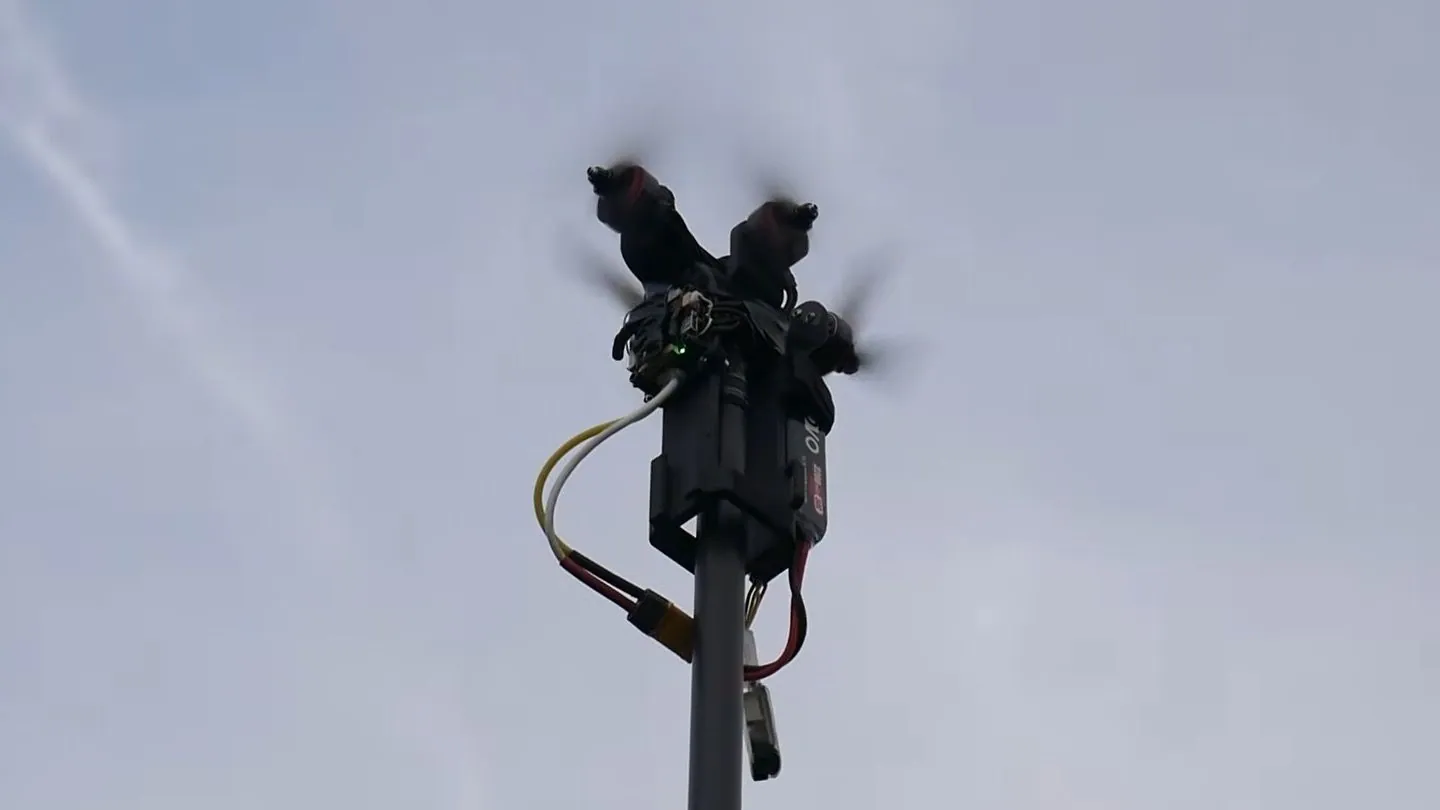
Peter Ryseck, an aerospace engineer with a master’s degree from the University of Maryland, built a carbon fiber pole that stands on a tip the size of a coin and keeps itself upright with four drone propellers. In a video posted September 2, the pole stood for more than three hours in a windy park on a single 2200 mAh three-cell battery, and the pack still read 11.1 volts at the three-hour mark.
The propellers are not holding the pole up. Ryseck says almost all of its weight goes straight down the shaft into the ground, and the motors run just above idle, making small sideways corrections whenever the pole starts to tip. Push it with a hand and it leans back to vertical.
Ryseck is the builder of the Mini QBiT, the winged quadcopter DroneXL cited in June as the hobbyist ancestor of Ukraine’s long-range winged FPV drones, and his site lists a flight dynamics role at Joby Aviation. His first version of the pole, built with larger motors and propellers, never balanced.
Larger Propellers Failed Because They Could Not Change Thrust Fast Enough
Ryseck started with big, slow propellers for quiet, efficient running, and the pole was unstable no matter how he tuned it. The motors had enough thrust. They could not change it quickly enough. He tried 3-inch props before settling on 5-inch ones, the FPV racing size.
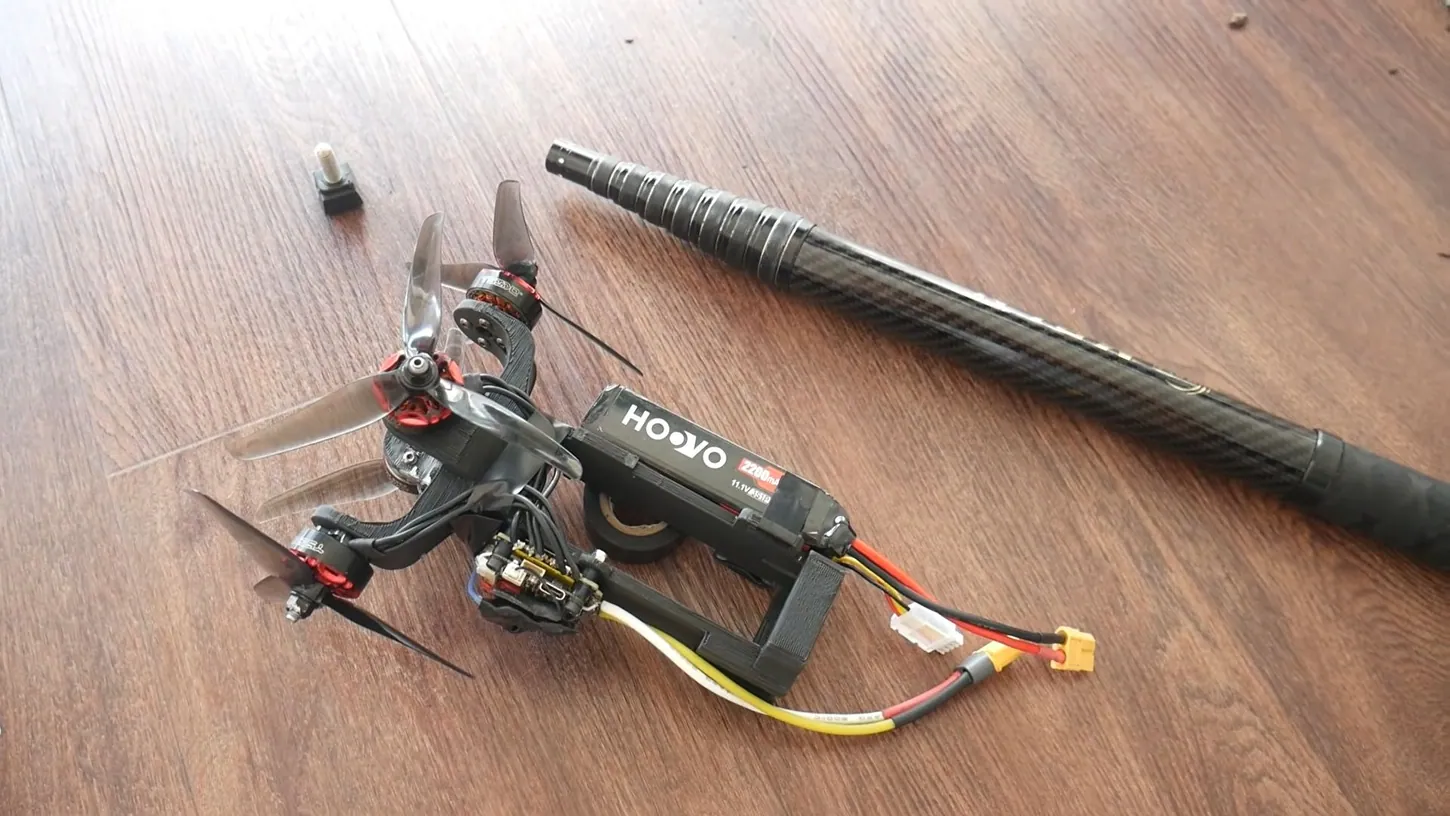
When a pole begins to fall, the controller has milliseconds to react, and a large propeller’s rotational inertia means it cannot speed up or slow down in that time. In control terms, Ryseck says in the video, the big props left him without enough bandwidth. The hardware that survived is plain. Four motors on a 3D printed mount, a Pixhawk flight controller, a Hoovo 2200 mAh 3S pack, and a carbon fiber pole taken from a swimming pool cleaning net, attached with one screw.
A Notch Filter Hunts Down the Pole’s 18 Hz Flex Every Time It Arms
The controller is a PD loop, tuned first in a simulation built from the pole’s measured mass and inertia. The same gains held across many pole lengths, but a short pole went unstable, and the simulation assumed a rigid shaft while the real one flexes.
The controller could not tell bending from falling. Flight logs showed the pole’s tilt rate concentrated around 18 Hz, while the balancing motion, he estimates, lives below 5 Hz. Left alone, the controller kept pumping energy into that flex. Ryseck added a low-pass filter, which he had to limit because it adds phase lag near the balancing frequencies, and a dynamic notch filter that measures the pole’s natural frequencies every time the system arms and notches each one out. In the video you can hear the motor tone change as the notches engage one by one.
Setting motor idle to zero worked but added small instabilities, so the motors keep spinning at minimum throttle. And because an IMU’s estimate of vertical is never perfect, the controller slowly shifts its attitude estimate until the motors stop pushing harder in one direction. In steady wind that same logic makes the pole learn to lean into the breeze instead of fighting it.
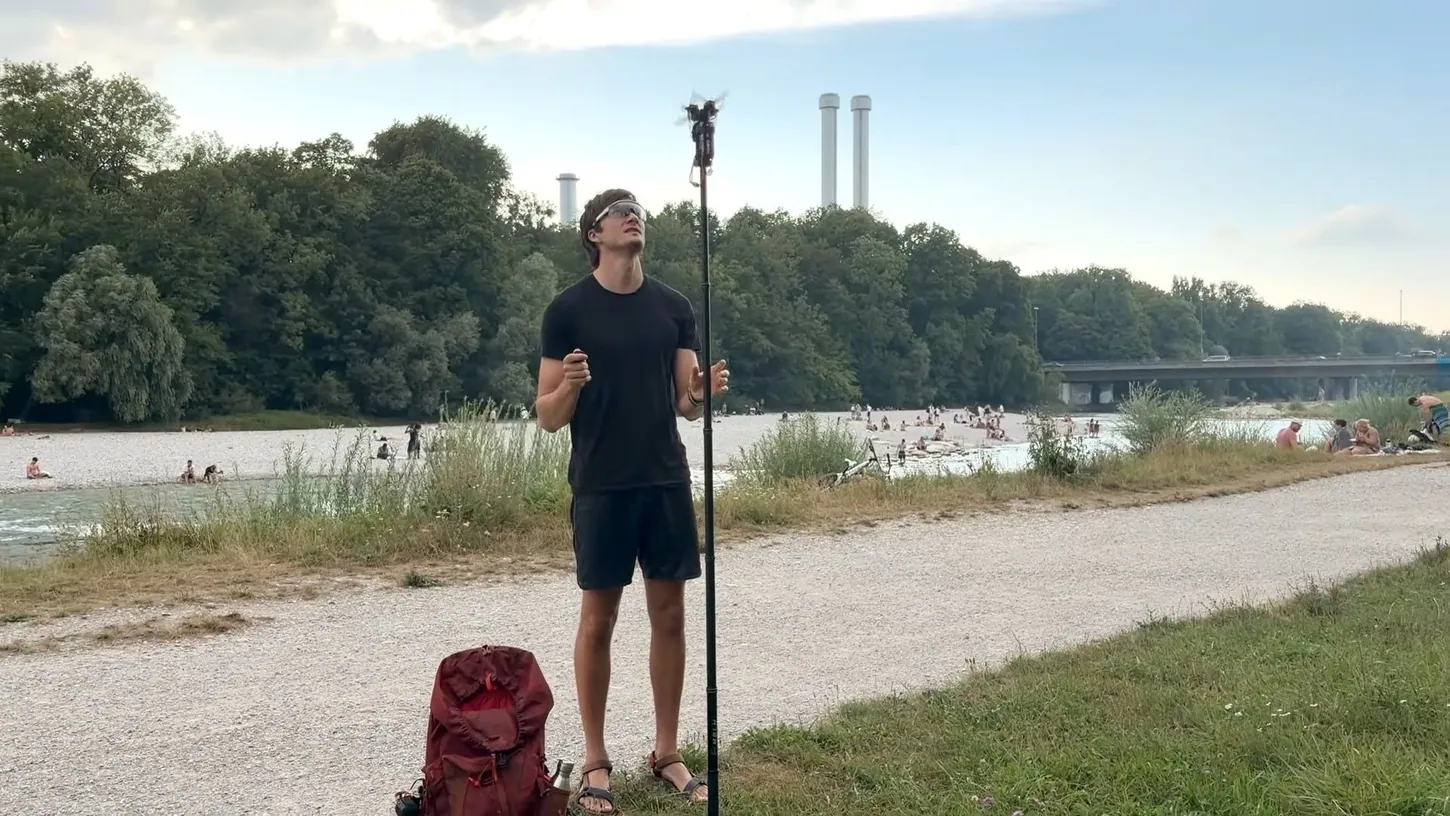
Ryseck wanted a controller that would survive a different pole length or a random weight on top, a phone for a selfie, say, without retuning, and the video shows it recovering from pushes. The endurance run in the park passed the three-hour mark with the pole where he left it and the pack at 3.75 volts per cell, down from a 12.6 volt full charge. One secondhand write-up reported the run as 3.75 hours. That figure in the video is the cell voltage, not the time.
The video does not give the pole’s length or total weight, the power the motors draw at idle, or how much wind the park test saw. Ryseck does not say what the pole is for, and asks viewers what they think of it.
DroneXL’s Take
Nothing I have watched this year explains better why a 5-inch quad feels locked in and a cinelifter on 10-inch props never quite does. The limit is how fast a propeller can change its thrust, and Ryseck shows that physics with no flying involved. FPV pilots run RPM and dynamic notch filters for exactly the resonance he hunts down here, and the notch filter section is worth the nine minutes on its own. Joshua Bird’s one-motor drone, which we covered in October, fought a 160 Hz vibration, and most makers solve that kind of problem by trial and error. Ryseck measured his and filtered it, which is why his pole stands for hours. My read is that this project has a useful life beyond a party trick, because a camera or antenna mast that holds itself up in wind is a product. I want his idle power draw next, because that number decides whether this runs for three hours or for days.
Source: Peter Ryseck on YouTube, peterryseck.com
DroneXL uses automated tools to support research and source retrieval. All reporting and editorial perspectives are by Haye Kesteloo. Read our editorial standards.